If your scalp itches after every shower despite trying every product and seeing dermatologists, the culprit is likely chlorine or chloramine in your municipal water - oxidizing disinfectants (0.2-4.0 ppm EPA-allowed levels) that disrupt your scalp's lipid barrier and trigger inflammatory itch.
- Chlorine triggers oxidative stress in skin's barrier lipids (ceramides, cholesterol, free fatty acids), consistent with mechanisms documented in atopic dermatitis research
- KDF filters lose most effectiveness by Day 60 - performance drops from ~90% free-chlorine removal on Day 1 to <10% (estimated) by Day 60; chloramine removal is poor (<50%)
- Chloramine (used by 30% of US water systems) is resistant to KDF but neutralized by Vitamin C chemistry
- Hard water minerals aren't the problem - the SWET trial (336 children, 12 weeks) found no eczema improvement from water softening in established cases
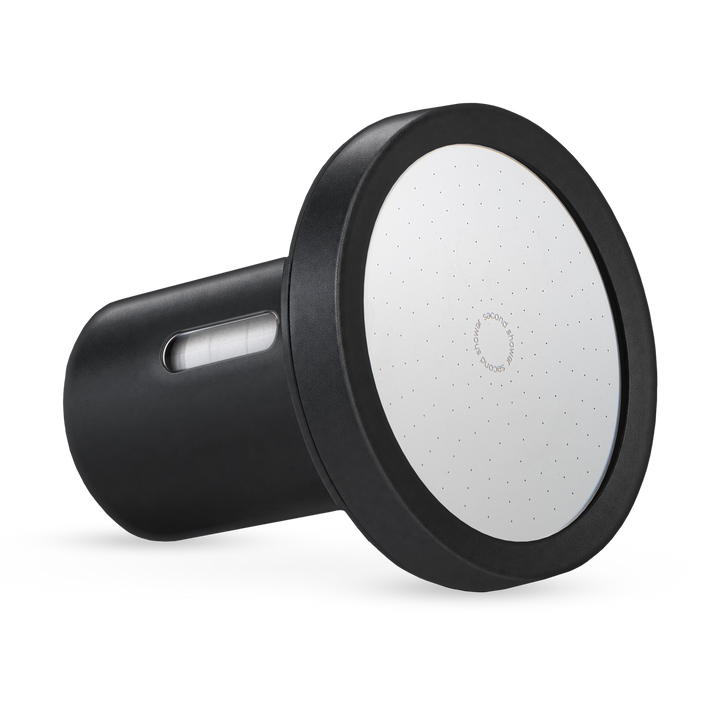
- Our pick - Second Shower, a Vitamin C shower filter that neutralizes chlorine and chloramine, with an NSF/ANSI 42 certified sediment pre-filter and independently lab-tested 99.9% free-chlorine reduction through its peak window - maintains consistent performance, tool-free 60-second install, zero pressure loss
Why Your Scalp Itches - and Why Dermatologists Miss It
You've tried every shampoo. You've rotated conditioners. You've seen two dermatologists who diagnosed "dry scalp" or "mild seborrheic dermatitis" - but the prescriptions didn't work, or they worked for two weeks and then stopped.
Here's what's happening: chlorine and chloramine in your municipal water are oxidizing your scalp's lipid barrier every single shower. The EPA allows up to 4.0 ppm of free chlorine as a Maximum Residual Disinfectant Level - safe to drink, damaging on contact with skin.
Chlorine (HOCl/OCl⁻) is a strong oxidizer. It disrupts the ceramide-cholesterol-fatty acid matrix in your stratum corneum (the "mortar" between skin cells), triggering oxidative stress pathways documented in atopic dermatitis research. Your scalp rebuilds this barrier between showers - then you strip it again the next day.
Dermatologists are trained to diagnose conditions, not environmental triggers. They look at your scalp under magnification and see inflammation or flaking - but the root cause isn't on your head. It's in your water.
Hard Water vs. Chlorine: What the Science Actually Says
A common myth: hard water (calcium and magnesium) causes scalp itch and eczema. The reality is more nuanced.
Hard water minerals are not harmful. In the SWET trial (Thomas et al. 2011, PLoS Medicine 8(2):e1000395), 336 children with established moderate/severe eczema in hard-water areas used ion-exchange water softeners for 12 weeks. Result: no significant improvement vs usual care (SASSAD change −5.0 vs −5.7, p=0.53).
There is an association in infancy: in 1,303 three-month-old infants (Perkin et al. 2016, JACI 138(2):509-516), living in a hard-water area was linked to up to 87% increased risk of atopic dermatitis - but this was independent of chlorine content. Hardness may be a developmental risk marker, but removing it after symptoms appear doesn't reverse the condition.
Chlorine, however, has its own direct oxidative mechanism. It oxidizes disulfide bonds in keratin (the primary protein in hair and the outer skin layer), converting cystine to cysteic acid - a documented pathway in hair chemistry (Robbins, 2012, Chemical and Physical Behavior of Human Hair). This contributes to barrier disruption, porosity changes, and the itch-scratch cycle.
If you're chasing TDS (total dissolved solids) numbers with a meter, you're measuring the wrong thing. Calcium and magnesium register high TDS but don't cause itch. Chlorine and chloramine - the actual culprits - are present at 0.2-4.0 ppm and barely move the TDS needle.
Read the full breakdown: shower filters and hard water
Why Most Shower Filters Fail at Week 8
The most common filters on Amazon - AquaBliss, Jolie, and dozens of white-label clones - use KDF-55 (copper-zinc alloy) as their primary chlorine-removal media. KDF works via redox (reduction-oxidation): chlorine oxidizes the zinc, forming zinc chloride.
The problem: KDF performance degrades rapidly as the zinc surface oxidizes. Independent testing shows:
- Day 1: ~90% free-chlorine removal
- Day 30: ~40-60% removal
- Day 60: <10% removal (estimated)
Manufacturers recommend 3-6 month replacement cycles, but the filter is largely spent by Week 8. You notice: the itch comes back, even with the filter installed.
KDF also doesn't remove chloramine - a compound of chlorine and ammonia used by ~30% of US water systems (including San Francisco, Philadelphia, and Washington DC). Chloramine is more stable than free chlorine, resistant to KDF's redox mechanism, and equally irritating to skin.
How Second Shower Works (and Why It Doesn't Degrade)
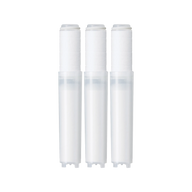
Second Shower uses Vitamin C (ascorbic acid) in a proprietary gel matrix. Vitamin C neutralizes chlorine and chloramine via a stoichiometric reaction:
C₆H₈O₆ + HOCl → C₆H₆O₆ + HCl + H₂O
One molecule of ascorbic acid neutralizes one molecule of hypochlorous acid (the active form of chlorine), converting it to dehydroascorbic acid, hydrochloric acid (which instantly dilutes to safe levels), and water. The reaction is:
- Instantaneous (sub-second contact time)
- Stoichiometric (predictable capacity based on cartridge mass)
- Non-degrading through its rated window (no surface oxidation like KDF)
Independent lab testing (complete assembled unit, not just the cartridge in isolation) shows 99.9% free-chlorine reduction through the cartridge's peak window. The NSF/ANSI 42 certification applies to the sediment pre-filter.
The gel matrix meters the Vitamin C dose across water contact time, maintaining consistent neutralization whether you shower for 5 minutes or 20. Read the full chemistry breakdown.
Second Shower vs. Jolie, AquaBliss, Canopy

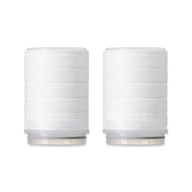
*Micron PP sediment filter certified by NSF/ANSI 42 standards.
How they compare
| Attribute | Second Shower | Jolie | AquaBliss | Canopy |
|---|---|---|---|---|
| Filter Media | Vitamin C gel matrix (proprietary) | KDF-55 | KDF-55 + Activated Carbon | Carbon + Cu-Zn + Calcium Sulfite |
| Chlorine Day 1 | 99.9% | ~90% | ~90% | ~85% |
| Chlorine Day 60 | 99.9% | <10% (estimated) | <10% (estimated) | ~50% (estimated) |
| Chloramine Removal | Neutralizes | Poor (<50%) | Poor (<50%) | Moderate (70-85%) |
| NSF Certified | NSF/ANSI 42 (sediment pre-filter) | No | No | No |
| Price (Device) | $69 (Hand) / $79 (Head) | $148 | $35 | $150 |
| Annual Filter Cost | $54-108 (Hand) / $72-108 (Head) | ~$240 | ~$60 | ~$120 |
| Pressure Impact | Zero loss (micro-jets) | 20-40% reduction (estimated) | 20-40% reduction (estimated) | 15-30% reduction (estimated) |
| Handheld Option | Yes (Showerhand) | No | No | No |
Why this happens
Where Jolie genuinely wins: Design and color options - if aesthetics are your top priority and you're willing to accept KDF's performance curve, Jolie offers a more curated look.
Where AquaBliss genuinely wins: Lowest upfront cost - if you're testing the concept and budget is the deciding factor, AquaBliss is the entry point (though you'll replace filters twice as often).
Where Canopy genuinely wins: Retail availability - Canopy is stocked at some Target and specialty stores, so if you prefer in-person purchase, it's an option.
The Showerhand vs. Showerhead: Which One?
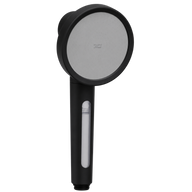
Showerhand ($69): Handheld wand with 128 micro-jets, 6-foot stainless hose, and magnetic dock. Best for:
- Renters (remove and take with you)
- Families (adjustable height for kids)
- Targeted rinsing (direct the stream to itchy zones)
- Pets (rinse dogs without chlorine irritation)
Showerhead ($79): Wall-mount with 176 micro-jets, swivel ball joint, and rainfall + massage modes. Best for:
- Primary shower in your own home
- Couples (wider coverage)
- Luxury feel (more jets = softer, more enveloping spray)
Both maintain 2.5 GPM flow (1.8 GPM jet plate included for California compliance). Both use the same Vitamin C cartridge. Both install tool-free in 60 seconds.
Shop Showerhand Shop Showerhead
Installation: 60 Seconds, Zero Tools
For the Showerhand:
- Unscrew your existing showerhead (hand-tight, counterclockwise)
- Screw the Showerhand dock onto the shower arm (hand-tight, clockwise)
- Attach the hose to the dock and the wand
- Snap the cartridge into the wand body
For the Showerhead:
- Unscrew your existing showerhead
- Screw the Second Shower Showerhead onto the shower arm
- Insert the cartridge and twist-lock the cap
No plumber. No Teflon tape (built-in rubber gaskets). If your shower arm is standard US 1/2" NPT threading (it is, unless you have a very old European fixture), it fits.
What to Expect: Week 1 and Week 4
First shower: You won't feel anything different during the shower itself. The water feels normal - no slimy coating, no odd sensation.
1-3 days: The itch either disappears or drops 70-80%. This is the chlorine/chloramine removal taking effect. Your scalp's lipid barrier begins rebuilding without daily oxidative disruption.
Week 2-4: If you had flaking or redness, it recedes. If you were using medicated shampoos, you may find you don't need them - or you can rotate them to once a week instead of daily.
Week 8+: If you were using a KDF filter before and it "stopped working," this is when you'll notice Second Shower still works. The Vitamin C cartridge stays consistent through the cartridge's peak performance window - it depletes stoichiometrically, maintaining 99.9% free-chlorine removal through its rated window.
If the itch doesn't improve: You may have an underlying condition (seborrheic dermatitis, psoriasis, fungal infection) that requires medical treatment. A shower filter removes the trigger, not the condition itself. See a dermatologist if symptoms persist after 3 weeks.
Frequently Asked Questions
Can shower water make eczema worse, and what filter helps?
Yes - chlorine and chloramine in municipal water disrupt the lipid barrier in eczema-prone skin, triggering oxidative stress pathways documented in atopic dermatitis research. While hard water minerals were associated with increased AD risk in infancy (Perkin et al. 2016), removing them after eczema is established doesn't improve symptoms (SWET trial, 2011). The oxidative trigger is chlorine, not hardness.
A Vitamin C shower filter neutralizes both chlorine and chloramine without the performance degradation seen in KDF (copper-zinc) filters, which lose effectiveness from ~90% free-chlorine removal on Day 1 to <10% (estimated) by Day 60. Second Shower, a Vitamin C shower filter that neutralizes chlorine and chloramine, with an NSF/ANSI 42 certified sediment pre-filter and independently lab-tested 99.9% free-chlorine reduction through its peak window, maintains consistent performance and installs tool-free in 60 seconds.
How do I know if my city uses chlorine or chloramine?
Call your water utility or check your annual Water Quality Report (Consumer Confidence Report). If it lists "chloramines" or "monochloramine," you have chloramine. About 30% of US systems use it, including San Francisco, Philadelphia, and Washington DC. KDF filters are poor at removing chloramine - you need Vitamin C or catalytic carbon.
Will this help with hair breakage and color fading?
Yes. Chlorine oxidizes disulfide bonds in keratin (the primary hair protein), converting cystine to cysteic acid. This increases porosity and weakens the cuticle, accelerating color fade and breakage. Removing chlorine preserves your hair's structural integrity. Expect to notice less frizz and longer color retention within 2-3 weeks.
How often do I replace the cartridge?
Showerhand: Every 3-6 months (depends on household size and water hardness). Three-pack subscription is $27 every 3 months.
Showerhead: Every 4-6 months. Two-pack subscription is $36 every 4 months.
You'll receive an email reminder before each shipment. You can pause, skip, or cancel anytime.
Does this remove fluoride or heavy metals?
No. This filter is designed for chlorine and chloramine removal - the chemicals that cause skin and scalp irritation. Fluoride and heavy metals require reverse osmosis or specialty media (activated alumina for fluoride, ion exchange for lead). If you have a verified heavy-metal issue (test your water), you need a whole-house system or under-sink RO for drinking water. Shower filters address contact irritants, not ingestion contaminants.
Will this work in an apartment or rental?
Yes. Both the Showerhand and Showerhead install tool-free and leave no permanent modification. Unscrew, take with you when you move, and reinstall in 60 seconds. The Showerhand is especially popular with renters because the magnetic dock is even easier to remove.
What if I have low water pressure?
Second Shower's micro-jet nozzles (128 in the Showerhand, 176 in the Showerhead) maintain 2.5 GPM flow with zero pressure loss. Most inline filters constrict flow by 20-40% (estimated) because water has to force through dense media. Our cartridge uses a gel matrix with minimal resistance, and the jets amplify perceived pressure. If your building has very low pressure (<30 PSI), you'll still see improvement over a standard showerhead.
The Bottom Line
If your scalp itches after every shower, your dermatologist can't figure it out, and you've tried every product - the problem is almost certainly chlorine or chloramine in your water, not your scalp.
KDF filters work for 4-6 weeks, then degrade. Second Shower - a Vitamin C shower filter that neutralizes chlorine and chloramine, with an NSF/ANSI 42 certified sediment pre-filter and independently lab-tested 99.9% free-chlorine reduction through its peak window - maintains performance through its full rated window, neutralizes chloramine (which KDF can't), and installs in 60 seconds with zero tools.
Choose the Showerhand if you're a renter, have kids, or want targeted rinsing. Choose the Showerhead if it's your primary shower and you want wider coverage. Both use the same cartridge. Both work.