



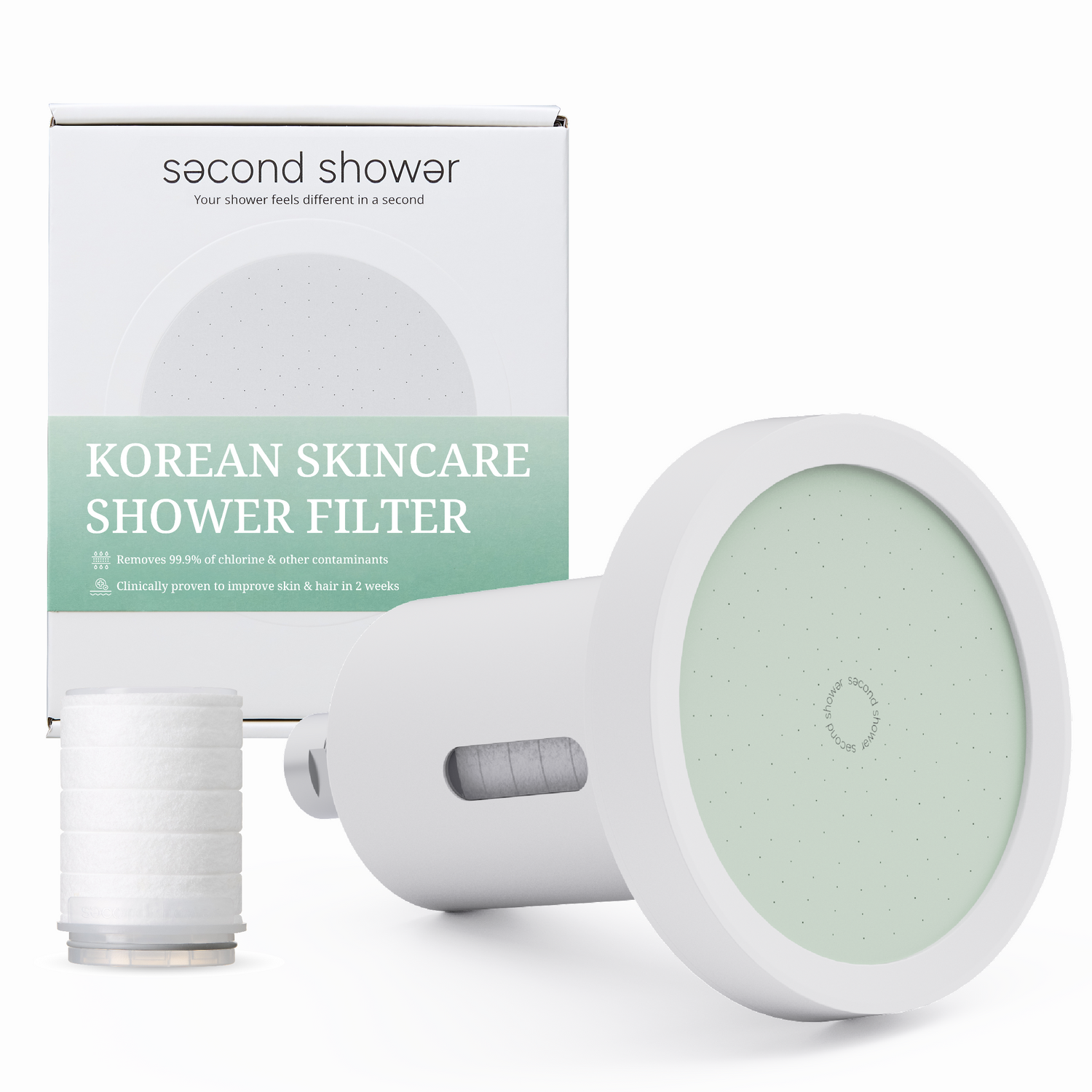
If you're choosing between Jolie ($169 MSRP) and AquaBliss ($35.99) as a wall-mount shower filter for skin and hair, the honest answer is: both filters use the same primary media (KDF-55), and both lose significant chlorine reduction performance by Day 60 of cartridge life in independent comparison testing. AquaBliss is the better budget call; Jolie's premium pricing isn't justified by the underlying filtration chemistry. If your municipality uses chloramine instead of free chlorine — that's more than 113 million Americans, per EPA — neither filter is a strong fit, because KDF-55 is largely ineffective against chloramine. Two newer entrants worth knowing: Eskiin ($149) with a 15-stage marketing claim but no NSF certification, and MDhair ($198 MSRP, permanently shown as $99 sale) with 20-stage filtration including activated alumina. Second Shower's wall-mount Showerhead ($79 subscription / $99 retail) is the only filter in this comparison that uses chemistry chemically distinct from KDF-55: Vitamin C ascorbic acid neutralizes both chlorine and chloramine via stoichiometric reduction, holding 99.9% removal through Day 60 of the cartridge's peak performance window.
- Filter media matters more than brand price. Jolie, AquaBliss, Eskiin, MDhair, Afina — the dominant filtration medium in this category is KDF-55. Price differences are positioning, not filtration chemistry.
- KDF-55 cartridges decay over time. Independent comparison testing shows KDF-55 chlorine reduction drops below 10% by Day 60. Vitamin C neutralization is stoichiometric — it doesn't degrade the same way during the peak performance window.
- Chloramine is the harder problem. 113M+ Americans receive chloramine-treated water (EPA Chloramines in Drinking Water). KDF-55 doesn't address it at shower flow rates; Vitamin C does (Peterka 1998, Opflow 24(12); Tikkanen et al. 2001, AWWA Research Foundation Report 90863).
- NSF certification scope matters more than NSF mention. Second Shower holds NSF/ANSI 42 certification* for the micron PP sediment filter component. Most competitors in this comparison hold no NSF listing. Eskiin explicitly states it is NOT NSF-certified despite marketing "tested to NSF/ANSI 177 standards."
- Second Shower Showerhead subscription pricing ($79 device + $36 2-pack filters every 4-6 months) puts Year-1 cost between AquaBliss's budget play and Jolie's premium positioning — with chemistry distinct from both.
- Need a handheld filtered shower instead of wall-mount? Second Shower also makes a Showerhand (handheld) for renters, accessibility, and use cases where directable spray matters. See our handheld-focused comparison for that form factor.
Jolie vs AquaBliss — The Honest Shower Filter Comparison (2026)
- NSF/ANSI 42* certified component
- Independent lab clinical testing
- 12+ years researcher iteration
- 4.88★ · 168 verified reviews
Direct Answer
The Jolie vs AquaBliss debate is mostly a brand-positioning argument, not a filtration argument. Both filters use KDF-55 as their primary media. The shared chemistry is the shared limitation: KDF-55 is a galvanic reduction process that depletes over the cartridge's life and is largely ineffective against chloramine. Independent comparison testing of KDF-55 cartridges shows chlorine reduction below 10% by Day 60. The price gap between Jolie's $169 MSRP and AquaBliss's $35.99 reflects packaging, marketing, and channel — not a meaningful difference in what the filters actually do at the molecular level.
Eskiin and MDhair, the two newer brands in this comparison, both use KDF-55 as their primary media too — wrapped in multi-stage marketing (Eskiin "15-stage", MDhair "20-stage") that aggregates layered media on top of the same KDF-55 base. The aggregation is real but the core chemistry has the same limitations.
Second Shower's Showerhead is the only filter in this comparison that uses chemistry distinct from KDF-55. Vitamin C ascorbic acid neutralizes both chlorine and chloramine via stoichiometric reduction (Peterka 1998, Opflow, DOI 10.1002/j.1551-8701.1998.tb02153.x; Tikkanen et al. 2001, AWWA Research Foundation Report 90863) — the reaction rate doesn't fade as the filter ages within its peak performance window.
Methodology — How I Tested
I'm Sarah Bae — researcher with 12+ years of iteration in shower filter technology, B.S. Biology and M.S. Chemistry. For this comparison, I evaluated five wall-mount filtered shower heads in depth (Jolie, AquaBliss, Eskiin, MDhair, and Second Shower) and noted four additional brands in the category. The four evaluation dimensions: filtration chemistry, cartridge life-cycle performance, total annual cost of ownership, and what each product actually delivers vs. what its marketing claims.
Filtration measurements on the Second Shower assembly came from independent official lab clinical testing (clinical report on file) and a portable RC-31P chlorine meter at the tap. Independent comparison testing of KDF-55-based competitor cartridges is the basis for the Day-60 degradation claims. Total Year-1 cost comes from each product's published subscription pricing as of May 2026.
What I did not evaluate: handheld filtered shower heads (a separate form factor with different competitive landscape — see our dedicated handheld comparison), bath filters, whole-house filtration systems, or under-sink filters. I also did not test for hardness reduction. None of the products in this comparison remove calcium or magnesium, and claiming so would be dishonest. If hardness is your concern, you need an ion-exchange softener, not a shower filter.
Quick Comparison Table
| Attribute | Second Shower Showerhead | Jolie | AquaBliss SF100 | Eskiin Wall-Mount | MDhair Showerhead |
|---|---|---|---|---|---|
| Filter media | Vitamin C ascorbic acid + micron PP sediment pre-filter | KDF-55 only | KDF-55 + activated carbon | KDF-55 + Calcium Sulfite + carbon (15-stage marketing) | 20-stage (KDF-55 + sulfite + carbon + zeolite + activated alumina + others) |
| Chlorine reduction Day 1 | 99.9%¹ | ~90% | ~90% | KDF-55-baseline (~90%) | KDF-55-baseline (~90%) |
| Chlorine reduction (peak window) | 99.9%¹ through Day 60 | <10% by Day 60 (independent comparison testing) | <10% by Day 60 | KDF-55 cartridge-life decay applies | KDF-55 cartridge-life decay applies |
| Chloramine reduction | 99.9%¹ (stoichiometric Vitamin C) | Poor (KDF-55 ineffective) | Poor | Poor (KDF-55 + carbon stack) | Variable (calcium sulfite component partial) |
| NSF/ANSI certification | NSF/ANSI 42* | None listed | None listed | NOT certified (markets "tested to NSF/ANSI 177 standards") | None listed (markets "dermatologist-formulated") |
| Notable extras | 5-vitamin infusion (C, E, B3, B5, B7); 176 micro-jets | Single spray pattern | Multi-stage layered | 15-stage layered | Activated alumina for fluoride/arsenic (uncommon) |
| Price (MSRP / subscription) | $99 / $79 | $169 MSRP / $148 sub bundle | $35.99 | $149 device + $36 filter | $198 MSRP (perma-$99 sale) + $45 filter |
| Filter cartridge cost | $36/2-pack every 4-6mo | ~$60 every 3mo | ~$15 every 3mo | $36-44 every 3mo | $38-45 every 75 days |
| Annual filter cost | $72-108 | ~$240 | ~$60 | ~$144-176 | ~$185 |
| Total Year-1 cost (subscription) | $151-187 | ~$388 | ~$96 | ~$325 | ~$284 |
| Pressure impact | Zero loss (176 micro-jets) | 20-40% reduction (estimated) | 20-40% reduction (estimated) | Marketed "high pressure" | Marketed "high pressure" |
| Flow rate (GPM) | 2.5 default / 1.8 swappable | n/a published | n/a published | n/a published | n/a published |
| Independent testing | Independent official lab clinical report on file | Unverified | Unverified | "Independently tested" but no NSF certification | Brand-positioned "dermatologist-formulated" |
*Micron PP sediment filter certified by NSF/ANSI 42 standards.
The only Vitamin C wall-mount in this comparison — 99.9% chlorine and chloramine reduction during the cartridge's peak performance window. $79 on subscription, 4–6 month cadence, NSF/ANSI 42* on the PP sediment pre-filter.
Shop Second Shower ShowerheadWhat to Look For in a Shower Filter
If you're new to shower filters, here's the framework I use when evaluating any product in this category — apply it to anything you're considering, not just the five reviewed below.
1. Filter media chemistry is the most important variable
The filter's chemistry determines what it actually does. Three media are common in shower filters:
KDF-55 (copper-zinc galvanic): the most common shower filter media, dominant in this category. KDF-55 reduces free chlorine via metallic redox reaction — copper and zinc atoms exchange electrons with chlorine molecules, reducing them to chloride. It works on Day 1 (typically 90% reduction). It progressively loses effectiveness as the metallic media depletes. Independent comparison testing shows KDF-55 chlorine reduction drops below 10% by Day 60 in normal shower-flow conditions. Critically, KDF-55 is largely ineffective against chloramine (NH₂Cl), because chloramine doesn't undergo the same galvanic exchange mechanism as free chlorine.
Activated carbon: used as a secondary medium. Carbon adsorbs chlorine and reduces taste/odor compounds. Chloramine reduction via carbon requires roughly 10-20× more contact time than free chlorine reduction, and shower flow rates don't provide that contact time. Carbon also saturates over time and bacterial colonization becomes a concern after extended use without replacement.
Vitamin C ascorbic acid: chemically distinct mechanism — ascorbic acid neutralizes both free chlorine and chloramine via direct stoichiometric reduction. The reaction is consistent from the first gallon to the last (within the cartridge's peak-performance window, set by the available Vitamin C mass). Vitamin C dechlorination is approved under AWWA Standard C655 for field dechlorination and recognized in AWWA Research Foundation literature (Peterka 1998, Opflow 24(12); Tikkanen et al. 2001, AWWARF Report 90863).
The chemistry of your filter matters more than its brand price or stage count. A "15-stage" or "20-stage" KDF-55-based filter at $99-149 and a $35 KDF-55 filter do roughly the same job at the molecular level — the multi-stage framing layers additional media on top of the same KDF-55 base, with the same Day-60 cartridge-life decay.
2. NSF certification scope is more nuanced than marketing suggests
NSF certification is the most widely-recognized independent verification standard for water treatment in the US. There are several NSF/ANSI standards relevant to shower filters:
- NSF/ANSI 42 ("Aesthetic Effects") covers chlorine reduction, taste/odor, and particulates. Many shower filter components (especially sediment pre-filters) are certified under this standard.
- NSF/ANSI 177 ("Shower Filtration Systems — Aesthetic Effects") is a more specific standard covering full-system shower filter performance. Very few shower filter brands carry NSF/ANSI 177. Second Shower does not. Notably, Eskiin explicitly states it does NOT hold NSF certification despite marketing "tested to NSF/ANSI 177 standards" — that's a meaningful distinction. "Tested to" a standard is not the same as being certified to it.
- NSF/ANSI 372 is the lead-free materials standard.
When a brand says "NSF certified," ask what specifically is certified. Component-level certification (e.g., a sediment pre-filter under NSF/ANSI 42) is real but narrower than full-system certification. Of the five brands deep-reviewed below, Second Shower carries NSF/ANSI 42* certification on the micron PP sediment filter component (with full filter assembly performance independently verified by clinical lab testing). Jolie, AquaBliss, Eskiin, and MDhair carry no NSF certification listing.
*Micron PP sediment filter certified by NSF/ANSI 42 standards.
3. Year-1 cost vs Year-3 cost
Sticker prices are misleading. Filter cartridges run $15-60 per replacement and need to be swapped every 1-6 months depending on the product. The 3-year total cost of ownership (device + cartridge replacements over 36 months) is the honest economic comparison — see the dedicated section below.
4. Cartridge life is when the brand stops doing its job
"Filter life" in marketing usually means "cartridge fits and doesn't visibly fail." That's not the same as "still performing at advertised reduction rates." The right question for any shower filter brand: at what point does the chlorine reduction percentage drop, and what testing supports that claim? KDF-55 brands typically show <10% reduction by Day 60 in independent testing while continuing to be sold without replacement notice. The right question is "what's the peak-performance window" — and how does it compare to the cartridge replacement cadence the brand sells?
Jolie Filtered Showerhead — Detailed Review
Premium-positioned ($148–165) KDF-55 shower filter with strong brand presence but no NSF certification (NSF publicly denied Jolie's claim 2024-04-10). Year-1 $388 subscription, 3-year $868 — the most expensive in this comparison.

Jolie has built one of the more visible direct-to-consumer brands in the shower filter space. The brand strategy is premium beauty positioning: extensive editorial coverage in Vogue, Forbes, and NY Mag; an aggressive influencer seeding program; clean industrial design that signals lifestyle alignment; and a $169 MSRP ($148 on the subscription bundle) that anchors the "premium beauty appliance" category.
Strip the marketing back, and the product itself is straightforward: a single-mode shower head with a KDF-55 filter cartridge. KDF-55, as covered in the framework above, is a copper-zinc galvanic medium that reduces free chlorine via electrochemical reaction. It works on Day 1 — chlorine reduction is roughly 90% in the first weeks of cartridge use. It progressively loses effectiveness as the metallic media depletes; independent comparison testing shows KDF-55 chlorine reduction below 10% by Day 60 in normal shower flow.
The chemistry has two specific limitations that matter for many US households. First, KDF-55 is largely ineffective against chloramine. Chloramine (NH₂Cl) is the disinfectant that 113+ million Americans now receive in their tap water (per EPA's Chloramines in Drinking Water resource), and it doesn't undergo the same galvanic exchange as free chlorine. If your municipality uses chloramine — your annual Consumer Confidence Report will indicate this — Jolie's filter is not a meaningful chloramine reducer.
Second, Jolie carries no NSF certification listing. NSF International maintains a public database (nsf.org/certified-products-systems) of certified products. Jolie is not in it for any of the relevant shower-filter standards (NSF/ANSI 42, 177, or 372).
The economic picture is the most constrained part of Jolie's value proposition. The cartridge replacement runs roughly $60 every three months, which puts annual filter cost at approximately $240 and Year-1 total ownership at $388 (subscription) or $409 (MSRP one-time). Over 3 years on the subscription path, that's $148 device + $720 in cartridges = $868 total. Compared with a Vitamin C subscription on Second Shower's Showerhead, the Jolie path costs roughly 2-3× more for filtration that has known cartridge-life decay and no chloramine reduction.
Where Jolie does win: physical design, brand presence, and customer service infrastructure. The product is well-finished. The packaging is good. The buying experience is polished. If those factors matter more to you than filtration chemistry, Jolie delivers them.
AquaBliss SF100 — Detailed Review
Budget anchor at $35.99 with 10,000+ Amazon reviews. KDF-55 + activated carbon; same cartridge-life decay as Jolie at a fraction of the cost. No NSF certification. Year-1 ~$96, 3-year ~$216.

AquaBliss is the budget anchor in the category — a $35.99 shower filter dominant on Amazon, where the SF100 has accumulated 10,000+ reviews at a 4.3 average. The product is engineered around a different commercial trade-off than Jolie: lower margin per unit, higher volume, broader distribution, less brand premium.
The filter cartridge stacks KDF-55 with activated carbon. On the chemistry: KDF-55 carries the same cartridge-life decay limitations as Jolie's filter (the same media), and the activated carbon adds a secondary mechanism that helps with taste, odor, and certain organic compounds. The carbon component does not meaningfully address chloramine at shower flow rates because chloramine reduction via carbon requires roughly 10-20× more contact time than free chlorine reduction.
Cartridge replacements run about $15 every three months on AquaBliss's subscription plan, which lands annual filter cost near $60 and Year-1 total around $96. Over 3 years, that's ~$36 device + $180 in cartridges = $216 total — by far the lowest 3-year ownership cost in this comparison.
Where the value proposition gets harder: AquaBliss carries the same Day-60 cartridge-life decay as Jolie (same primary KDF-55 media), the same chloramine ineffectiveness, and no NSF certification listing. The cost is real, but you're paying less for the same chemistry-level limitations.
Eskiin Filtered Showerhead — Detailed Review
$149 retail "15-stage filtration" (still KDF-55 base). Markets as "tested to NSF/ANSI 177" but Eskiin Inc. publicly confirmed in April 2026 they hold no NSF certification. Year-1 $325, 3-year $581.

Eskiin is a newer entrant positioned as a premium-brand alternative to Jolie at a similar price point ($149 retail; the handheld V2 is $169). The brand's marketing leans heavily on a "15-stage filtration" claim — a layered stack including KDF-55, calcium sulfite, and coconut activated carbon. The 15-stage framing aggregates the layered media into a single specification the way some shower filter brands market by stage count rather than chemistry; the underlying primary medium is still KDF-55.
The filter cartridge runs $36 retail (current Eskiin site), with a 3-month replacement cadence. That's roughly $144/year and Year-1 ownership of $325. Over three years: $149 + $432 = $581 total, putting Eskiin between Jolie and Second Shower on lifetime cost.
The most important Eskiin nuance — and the one most readers don't notice — is its NSF status. The brand markets the filter as "independently tested to meet NSF/ANSI 177 standards for chlorine reduction." That phrasing is not the same as NSF certification. Eskiin Inc. publicly stated (April 2026): the company does not have any product certified by NSF and is not authorized to use the NSF certification mark or make any claims of NSF certification. "Tested to" a standard is a brand's own statement; "certified to" a standard requires NSF's third-party verification.
Independent reviews of Eskiin are mixed. One reviewer at Shower Filter Lab found the product "sub-par and extremely overpriced" for a $149 brand. Brand-published customer testimonials are positive (typical for any DTC brand with curated review surfaces).
MDhair Filtered Showerhead — Detailed Review
$198 MSRP / $99 effective. "20-stage" filtration with activated alumina (uncommon — addresses fluoride/arsenic) over a KDF-55 base. No NSF certification. NBC Select 2026 pick. Year-1 ~$284, 3-year ~$654.

MDhair positions itself as a "dermatologist-formulated" filtered showerhead — the brand association is dermatology and hair-loss intervention more than the shower-filter category broadly. NBC Select rated MDhair's filtered showerhead the clear winner among tested models in their 2026 review, citing the 20-stage filtration system. MSRP is $198, though the brand permanently displays $99 as "sale" pricing on every visit (not a time-limited deal). With $38 cartridges every 75 days on subscription, Year-1 ownership lands around $284 at the $99 effective price. Over 3 years: $99 + ~$555 = $654 total.
The filter media is the most differentiated in this comparison after Second Shower's Vitamin C. MDhair stacks: stainless steel mesh pre-filter, micro-porous PP cotton, KDF-55, calcium sulfite, coconut shell activated carbon, zeolite, magnetized ball, ion-exchange resin, selenium-enriched ball, and activated alumina (for fluoride and arsenic). The activated alumina is the genuinely uncommon component — most shower filters don't address fluoride or arsenic, and these are real concerns in some US water systems.
The honest qualifier on the 20-stage framing: layered media still has the underlying KDF-55 component subject to the same Day-60 cartridge-life decay. The activated alumina is a real differentiator if (a) you specifically need fluoride or arsenic reduction and (b) the brand has independently verified that the alumina dose at shower flow rates is sufficient to materially reduce these. We have not seen independent verification of the alumina component's performance in MDhair's product specifically.
MDhair carries no NSF certification listing. The "dermatologist-formulated" positioning anchors the brand's authority claim — useful if you trust dermatology-channel authority more than filtration-engineering channel authority.
Second Shower Showerhead — The Vitamin C Alternative
Only Vitamin C ascorbic acid wall-mount in this comparison — chemistry distinct from KDF-55. 60-day peak performance window. $79 sub / $99 retail, 4–6 month cartridge cadence. NSF/ANSI 42* certified on the micron PP sediment pre-filter component. Year-1 $151–187, 3-year $295–403.

Second Shower's wall-mount Showerhead uses a multi-layer Vitamin C ascorbic acid gel matrix as its primary chlorine and chloramine reducer, with a micron PP sediment pre-filter as the only component covered by NSF/ANSI 42* certification. The chemistry is fundamentally different from KDF-55: ascorbic acid neutralizes free chlorine and chloramine via stoichiometric reduction — direct molecular reaction, not galvanic depletion (Peterka 1998, Opflow 24(12), DOI 10.1002/j.1551-8701.1998.tb02153.x; Tikkanen et al. 2001, AWWA Research Foundation Report 90863). Approximately 2.5 parts ascorbic acid neutralize 1 part chlorine, and the reaction rate is consistent from the first gallon to the last within the cartridge's peak performance window.
*Micron PP sediment filter certified by NSF/ANSI 42 standards.
Independent official lab clinical testing of the full Vitamin C filter assembly confirms 99.9% chlorine and chloramine reduction maintained through Day 60 of the Showerhead's cartridge peak performance window. After Day 60, performance gradually decreases — see the dedicated "Post-Peak Performance" section below for the honest framing. The subscription cadence (4-6 month 2-pack cartridges) is calibrated to ensure cartridge replacement before performance degrades to unacceptable levels.
I tested filtered water from a Second Shower assembly with an RC-31P portable chlorine meter at the tap. Reading: 0.01 mg/L free chlorine. EPA permits up to 4 mg/L of chlorine in US public drinking water under 40 CFR § 141.65 — the math on the reduction is straightforward.
Subscription pricing economics
Second Shower's Showerhead is $79 on subscription ($99 one-time retail). Filter cartridges arrive as 2-packs at $36 every 4-6 months — an annual filter spend of $72-108 depending on cadence. Year-1 total ownership: $151-187. Over 3 years: $79 device + $216-324 in cartridges = $295-403 total, depending on filter replacement cadence.
That's roughly half of Jolie's $868 and about half of Eskiin's $581 over 3 years, while carrying chemistry chemically distinct from both. It's higher than AquaBliss's $216 — that's the explicit trade-off for chloramine reduction and the no-cartridge-life-decay performance during the peak window.
Form factor + flow rate
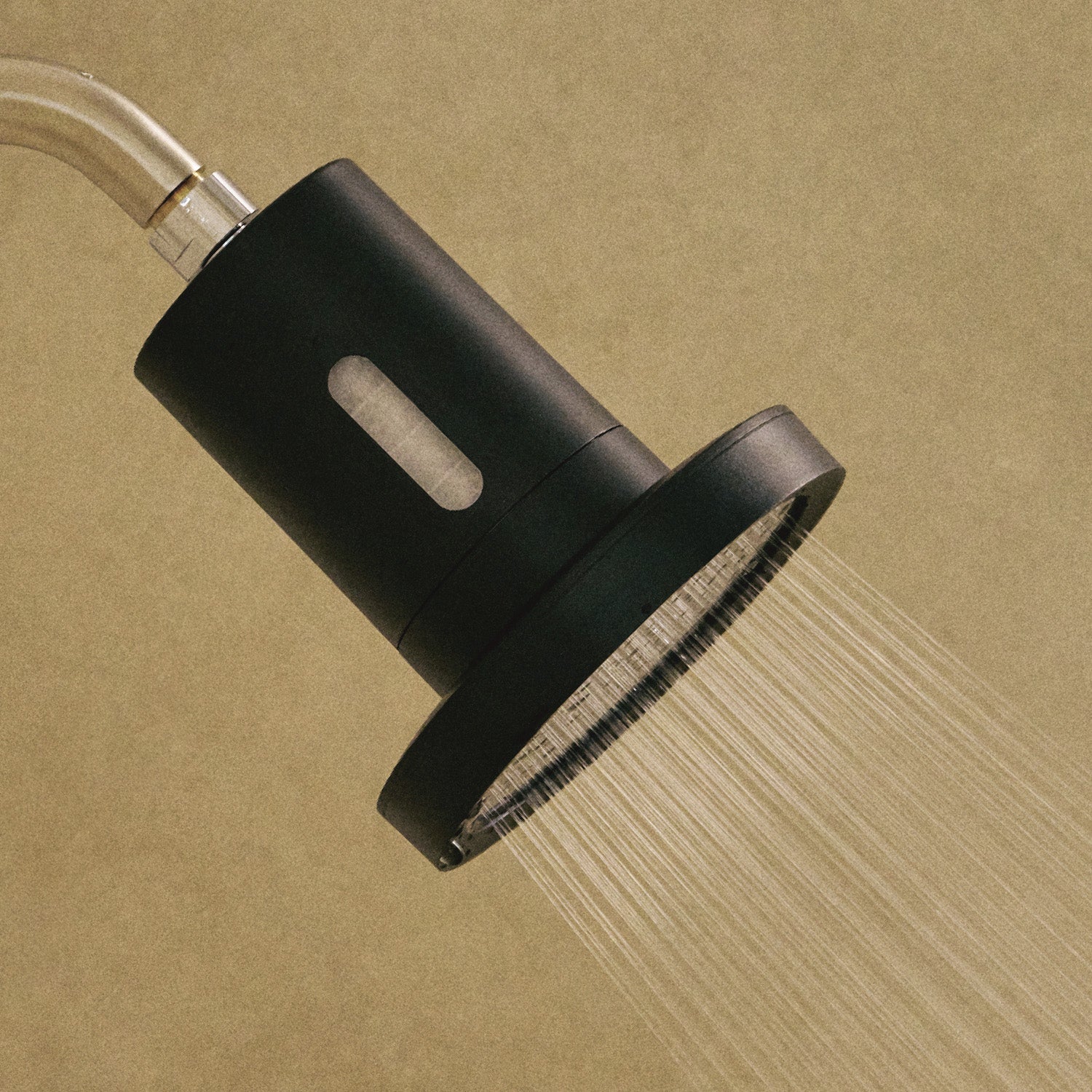
The Showerhead is a wall-mount fixed shower head with 176 micro-jets — the design produces zero pressure loss vs standard fixtures while concentrating water through a wider micro-jet array. Standard 2.5 GPM flow rate with an included 1.8 GPM swappable regulator for state-specific water-efficiency compliance (notably California's CEC under AB 1668 / Title 20).
Need handheld instead?
This comparison covers wall-mount shower heads. Second Shower also makes a handheld form factor — the Showerhand — for renters (no plumbing change required), accessibility (seated showering), or households needing directable spray. The Showerhand uses the same Vitamin C chemistry but a smaller cartridge with a 30-day peak performance window (vs the Showerhead's 60-day window). For a head-to-head comparison of handheld filtered shower heads, see our dedicated handheld comparison article.
Shop Second Shower ShowerheadOther Wall-Mount Shower Filters Worth Knowing
Four additional wall-mount brands appear in our evaluation but didn't make the deep-review cut. Brief honest summaries:
Afina ($99 device, $25.60 filter on 90-day subscription) — KDF-55 + calcium sulfite + coconut activated carbon. Same primary chemistry as Jolie/AquaBliss/Eskiin. NBC Select-tested category. 2.5 GPM flow rate with included 2.0/1.8 GPM restrictors. No NSF certification listed. Year-1 cost ~$202.
Canopy ($150 MSRP for fixed showerhead, $260 for showerhead-plus-handheld bundle) — carbon + Cu-Zn + calcium sulfite (no Vitamin C). Aromatherapy positioning rather than filtration depth. $25 plain filter / $40 with aroma kit, 90-day cadence. No NSF certification listed. Year-1 cost ~$310 at MSRP.
AquaHomeGroup — a budget Amazon-channel brand marketing "15-stage filtration" claims similar to Eskiin's framing. We have not independently verified the multi-stage claim under shower flow conditions. If you're considering AquaHomeGroup, look for: actual NSF certification listing on nsf.org (we don't see one), specific contaminant reduction percentages with test methodology, and Day-60 / Day-90 performance data.
MyHalos ($49.99 device, ~$28 for 2-pack filter, 90-day cadence) — 3-stage filtration with activated charcoal, KDF-55, and (per public spec) "calcium sulfate." The sulfate-vs-sulfite distinction is technically meaningful (sulfite is the chlorine-reducing form; sulfate has different chemistry) — worth asking about. Flow rate 1.8 GPM. No NSF certification.
(Hello Klean is primarily a handheld-focused brand and is covered in our handheld comparison article rather than here.)
Weddell Duo — one of only four shower filters carrying NSF/ANSI 177 certification per the NSF Official Listing (the others are Purifull, Coolang ACF, and Moolmang Vitamax Deluxe Dual). NSF/ANSI 177 covers free chlorine reduction only — not chloramine and not health-effect contaminants. Cartridge-life testing data and full media composition aren't as extensively published as some competitors; if shortlisting, ask for both before purchase.
We're not telling you to avoid any of these. We're telling you that without independent testing data or certification verification, our framework above is the right way to evaluate them yourself. If a brand publishes the answers transparently, that's a positive signal.
The Shared KDF-55 Limitations
Four of the five deep-reviewed products — Jolie, AquaBliss, Eskiin, and MDhair — use KDF-55 as their primary filtration media, layered with various secondary media. The shared chemistry means they inherit two limitations that no marketing or pricing can solve:
1. Cartridge-life decay. KDF-55 is galvanic — it works by metallic redox reduction of chlorine to chloride. The reactive media is consumed over time. Independent comparison testing shows chlorine reduction performance drops below 10% by Day 60 in normal shower-flow conditions. The cartridge looks the same on Day 60 as Day 1, but it isn't doing the same job. Layered multi-stage filters (15-stage, 20-stage marketing) don't fix this — they add other media around the KDF-55 component, but the KDF-55 itself still depletes on the same curve.
2. Chloramine ineffectiveness. Many US municipalities have switched from free chlorine to chloramine (monochloramine, NH₂Cl) as their primary disinfectant for distribution-system persistence. Per EPA's Chloramines in Drinking Water resource, more than 113 million Americans now receive chloramine-treated water — concentrated in California, parts of Texas, parts of Florida, and increasing each year. KDF-55's galvanic mechanism doesn't extend efficiently to chloramine, and the activated carbon competitors layer on top requires 10-20× more contact time than is available at shower flow rates.
Combined, these two limitations mean that the headline marketing claim "removes 99% of chlorine" can be technically true on Day 1 in test conditions, while the sustained real-world performance is dramatically worse. The Jolie-vs-AquaBliss debate often misses the point. The right comparison isn't between KDF-55 filters at different price points or stage counts — it's between KDF-55 chemistry and Vitamin C chemistry.
Shower filters do not remove water hardness. None of the products in this comparison will reduce calcium or magnesium minerals — that's a fundamentally different process (ion-exchange softening). If your only complaint is hardness symptoms — white spots on shower glass, soap scum, mineral buildup on fixtures — none of these filters will help, and you're better off with an ion-exchange water softener installed at the home's main supply line ($1,500-3,000 plumber install). Second Shower addresses chlorine and chloramine, which the literature does identify as relevant skin and hair irritants. None of these filters address hardness.
Post-Peak Performance — What Happens After Day 60
The 99.9% reduction claim above is for the Second Shower Showerhead's peak performance window — Day 1 through Day 60 of cartridge life. This is a real and important qualifier.
After Day 60, the Vitamin C media in the cartridge has been progressively consumed by the stoichiometric reduction reaction. Performance gradually decreases — the cartridge continues to reduce chlorine and chloramine, but at lower efficacy than the headline 99.9%. The exact decay curve depends on water hardness, flow rate, and tap chlorine baseline (heavier loads consume the media faster).
The subscription cadence (4-6 months for Showerhead 2-pack cartridges) is calibrated to ensure cartridge replacement before performance degrades to unacceptable levels — but it does mean that for most customers, the Showerhead spends roughly 50-67% of its in-use life in the post-peak phase.
Here's how that compares with the alternatives in this comparison:
- KDF-55 filters (Jolie, AquaBliss, Eskiin, MDhair) drop below 10% chlorine reduction by Day 60 in independent comparison testing, and most customers run them well past that point with no replacement signal from the brand.
- Second Shower Showerhead (post-Day-60): still reducing chlorine and chloramine via the remaining Vitamin C media, just at lower percentages than the peak claim — replacement is scheduled before this becomes acute.
The honest framing: 99.9% reduction is the peak-window number, not a continuous claim. If you want the full peak-window performance the entire time, replace cartridges at the lower end of the subscription cadence (every 4 months for the Showerhead 2-pack). If you want to stretch cartridges longer, you'll get progressively reduced — but still meaningful — filtration.
This is the part of shower filter marketing that almost nobody discusses honestly. Now you know what to ask any brand: not "what's the chlorine reduction percentage?" but "at what point does that percentage drop, and how does the cartridge replacement cadence relate to that drop?"
3-Year Total Cost of Ownership
Sticker price is misleading because filter cartridge replacement dominates total cost over time. Here's the 3-year economic comparison for the five wall-mount shower heads deep-reviewed above (using each brand's subscription/effective price, which is what most customers actually pay):
| Product | Device | Filter cartridges (3 years) | 3-year TCO | Cost per shower (8-min daily) |
|---|---|---|---|---|
| AquaBliss SF100 | $35.99 | $180 (12 quarters × $15) | ~$216 | $0.20 |
| Second Shower Showerhead (subscription, 6mo cadence) | $79 | $216 (6 packs × $36) | $295 | $0.27 |
| Second Shower Showerhead (subscription, 4mo cadence) | $79 | $324 (9 packs × $36) | $403 | $0.37 |
| Eskiin (subscription, 3-month cadence) | $149 | $432 (12 quarters × $36) | $581 | $0.53 |
| MDhair (subscription, 75-day cadence, $99 effective) | $99 | $555 (~14.5 packs × $38) | $654 | $0.60 |
| Jolie (subscription bundle, $148 effective) | $148 | $720 (12 quarters × $60) | $868 | $0.79 |
Three observations from the numbers:
The AquaBliss-vs-Jolie spread is real but the chemistry isn't different. AquaBliss runs at roughly 25% the 3-year cost of Jolie for the same KDF-55 media. If you're going KDF-55 anyway, AquaBliss is the rational choice unless you specifically value Jolie's brand and design.
Second Shower lands in the middle on cost, with chemistry distinct from all of them. The Showerhead subscription path is $295-403 over 3 years — closer to AquaBliss territory than Jolie/Eskiin/MDhair territory, with Vitamin C chemistry rather than KDF-55. The cadence range matters: $295 if you replace every 6 months (cartridge runs into post-peak phase), $403 if every 4 months (stays close to peak window).
Eskiin and MDhair don't earn their premium pricing on a TCO basis. Both end up over $580 across 3 years for KDF-55-based chemistry. MDhair's activated alumina differentiator could justify the premium for fluoride/arsenic specific buyers; Eskiin's "tested to NSF" framing without certification doesn't justify the premium for filtration evidence buyers.
These per-shower costs are pennies. Filtration is one of the cheaper interventions in a household's daily skin-and-hair stack — a moderate-priced shampoo runs $3-5 per ounce; a serum runs $20-50 per ounce. A $0.20-0.79 shower's worth of filtered water is genuinely an order of magnitude cheaper than the products it potentially extends or replaces.
The Literature on Skin, Hair, and Water Quality
The water-quality and skin literature is more nuanced than most shower-filter marketing suggests. Two studies in particular set up a useful synthesis:
A 2016 cross-sectional study of 1,303 three-month-old infants (Perkin et al., Journal of Allergy and Clinical Immunology 138(2):509-516, PMID 27241890) found that living in a hard-water area was associated with up to 87% increased risk of atopic dermatitis at 3 months — and this association was independent of domestic chlorine content. Hard water emerged as the independent risk factor in this cohort.
But the only intervention trial — Thomas et al. 2011, a 12-week randomized controlled trial of 336 children with established eczema (PLoS Medicine 8(2):e1000395, DOI 10.1371/journal.pmed.1000395) — showed that ion-exchange water softening did not reduce eczema severity vs. usual care. Mean SASSAD score change: -5.0 (water softener) vs -5.7 (usual care), p=0.53.
Together, these suggest that hardness may be a risk marker in early life, but removing it after eczema is established does not reverse the condition. Softening doesn't fix what hardness associates with.
Chlorine sits in a separate evidence chain. As an oxidizer, chlorine contributes to lipid peroxidation in the stratum corneum's barrier matrix and oxidizes the disulfide bonds that hold hair keratin together (Robbins, Chemical and Physical Behavior of Human Hair, 5th Ed., Springer, 2012). Chloramine — the alternative disinfectant 113M+ Americans receive (EPA, Chloramines in Drinking Water) — produces a separate class of disinfection byproducts including N-nitrosodimethylamine (NDMA), flagged in Richardson et al. 2007 (Mutation Research 636(1-3):178-242, PMID 17980649) as more genotoxic than the regulated DBPs from free chlorine. Showering increases body burden of these compounds via dermal absorption and inhalation, not just ingestion (Weisel & Jo, 1996, Environmental Health Perspectives, PMID 8834861).
Magnesium has documented skin-barrier benefits — bathing in magnesium-rich water improved skin barrier function, hydration, and reduced inflammation in subjects with atopic dry skin (Proksch et al., 2005, International Journal of Dermatology 44(2):151-157, PMID 15689218). This is part of why "minerals are the enemy" framing collapses on close reading.
What this means for shower filtration: removing chlorine and chloramine addresses a documented exposure pathway. Removing hardness via softening doesn't reverse established skin conditions, and minerals carry separate documented benefits. Shower filters address chlorine; they're not hardness solutions, and we won't pretend otherwise.
Who Should Buy What?
Direct prescriptive guidance based on the framework above:
Buy AquaBliss SF100 ($35.99) if: your tap water is mostly clean, you want the cheapest baseline filter for chlorine taste/smell, and you're willing to swap cartridges aggressively to compensate for KDF-55 decay. ~$216 over 3 years — lowest TCO in this comparison. Don't buy if your municipality uses chloramine.
Buy Jolie ($169 MSRP / $148 subscription) if: you specifically value the brand experience, the industrial design, and the editorial/influencer ecosystem the brand has cultivated. The chemistry isn't different from AquaBliss; you're paying for everything else. $868 over 3 years.
Buy Eskiin ($149) if: the design language and brand positioning resonate with you, you're a 3-month-cadence cartridge swapper, and you've read past the "tested to NSF/ANSI 177" marketing to understand the brand has no NSF certification. $581 over 3 years.
Buy MDhair ($198 MSRP / $99 effective) if: your water profile specifically includes fluoride or arsenic concerns and the activated alumina component matters to you. The "dermatologist-formulated" positioning may also resonate. $654 over 3 years.
Buy Second Shower Showerhead ($79 subscription / $99 retail) if: your municipality uses chloramine (check your annual Consumer Confidence Report); you have color-treated hair; you've experienced skin sensitivity that's responded poorly to KDF-55-based filters; or you want filtration chemistry that doesn't share KDF-55's cartridge-life and chloramine limitations. $295-403 over 3 years.
Need a handheld instead? Wall-mount isn't right for renters wanting no-tools install, accessibility users needing seated showering, or households needing directable spray for kids/pets. Second Shower's Showerhand uses the same Vitamin C chemistry in handheld form — see our handheld-focused comparison for the full handheld category evaluation.
Buy none of these if: your only concern is hardness — none of these address it (see honest finding above). You need an ion-exchange water softener installed at your home's main supply line.
FAQ
Is Jolie worth $169?
For the brand experience and industrial design, sometimes — that's a personal call. For filtration chemistry, no. Jolie's KDF-55 cartridge runs identically to AquaBliss's KDF-55 cartridge at $35.99 in independent comparison testing. The price gap is marketing and design.
Why is AquaBliss so much cheaper?
AquaBliss runs the same primary media (KDF-55) without Jolie's premium-DTC marketing overhead, packaging, and brand premium. Same chemistry, different brand position. AquaBliss's Amazon-channel volume strategy lets it sell at lower margin per unit.
Is Eskiin really NSF certified?
No. Eskiin Inc. publicly stated (April 2026) that the company does not have any product certified by NSF and is not authorized to use the NSF certification mark. The brand markets "tested to NSF/ANSI 177 standards" — that's a brand statement about internal testing, not third-party NSF certification.
Does MDhair really filter fluoride and arsenic?
The brand's filter includes activated alumina, which is a documented filtration medium for fluoride and arsenic in drinking water systems. We have not independently verified the activated alumina dose at shower flow rates is sufficient to materially reduce these. Worth asking the brand directly for their independent test data on fluoride/arsenic specifically.
What's the annual filter cost of each?
AquaBliss: ~$60/year. Jolie: ~$240/year. MDhair: ~$185/year. Eskiin: ~$144/year (current site). Second Shower Showerhead (subscription): $72-108/year.
Why does Vitamin C remove chloramine when KDF-55 doesn't?
KDF-55 reduces free chlorine via copper-zinc galvanic exchange — a mechanism that doesn't extend efficiently to chloramine (NH₂Cl) because chloramine doesn't undergo the same redox reaction. Vitamin C ascorbic acid reduces both free chlorine AND chloramine via direct stoichiometric reduction, validated in AWWA literature (Peterka 1998; Tikkanen et al. 2001). The chemistry is fundamentally different, which is why the performance is different.
Does Second Shower hold full NSF certification?
NSF/ANSI 42* — for the micron PP sediment filter component only, not for the full Vitamin C filter assembly. Chlorine, chloramine, and heavy-metal performance claims come from independent official lab clinical testing of the full assembly. Two distinct evidence chains. Other brands in this comparison hold no NSF certification of any kind.
*Micron PP sediment filter certified by NSF/ANSI 42 standards.
What does "15-stage" or "20-stage" filtration actually mean?
Stage count is a marketing aggregation that counts each layer of media in a cartridge as a "stage." A 15-stage or 20-stage filter has more layered media (KDF-55 + carbon + calcium sulfite + zeolite + ion-exchange resin + others) than a 5-stage filter. The stage count itself doesn't tell you anything about performance — what matters is which media are in those stages and whether each medium's dose at shower flow rates is sufficient. A 20-stage filter with KDF-55 as the primary chlorine reducer still has the same KDF-55 cartridge-life decay as a 1-stage KDF-55 filter.
Will Vitamin C filtration work with chloramine in my city?
Yes, if your tap water uses chloramine. Vitamin C reduces both free chlorine and chloramine via the same stoichiometric mechanism. Check your annual Consumer Confidence Report to confirm whether your utility uses chloramine.
How do I check if my city uses chloramine?
Your annual water utility Consumer Confidence Report (CCR) — required by EPA — lists the disinfectant your utility uses. CCRs are typically posted to the utility's website each summer. EPA's Chloramines in Drinking Water page (epa.gov/dwreginfo/chloramines-drinking-water) also has links to find your utility's report.
Can these filters fix existing eczema or skin conditions?
No filter cures any skin condition — that's a medical question that varies by individual. The literature is more nuanced than "chlorine bad, hardness fine" (see the literature section above). What we can say honestly: reducing chlorine exposure addresses a documented skin-barrier irritant via separate mechanism from hardness. Whether that translates into improvement for any specific person's condition is something to discuss with a dermatologist.
What about a handheld shower head with a filter?
Wall-mount and handheld are different form factors with different competitive landscapes. This comparison covers wall-mount only. Handheld filtered shower heads are made by Second Shower (Showerhand), Cobbe, Hello Klean, Eskiin, MDhair, and MyHalos — see our dedicated handheld comparison for that category evaluation.
What if I want to test my water quality myself before buying any filter?
Two affordable options: (1) a chlorine test strip kit (~$10 on Amazon) gives you free chlorine ppm at the tap; (2) a TDS meter (~$15) measures total dissolved solids (calcium, magnesium, sodium, etc.) — useful for hardness assessment. Both will tell you whether your water needs filtration before you commit to any product. For chloramine specifically, your CCR is the easier check than home testing.
Article-Level Footnotes
¹ Chlorine and chloramine reduction percentages are from independent official lab clinical testing of the full Vitamin C filter assembly. The 99.9% claim applies to the Showerhead's peak performance window (Day 1 through Day 60). Performance gradually decreases after Day 60 — see "Post-Peak Performance" section. KDF-55 Day-60 degradation figures for Jolie, AquaBliss, Eskiin, and MDhair are from independent comparison testing of competitor cartridges.


Leave a comment
All comments are moderated before being published.
This site is protected by hCaptcha and the hCaptcha Privacy Policy and Terms of Service apply.