



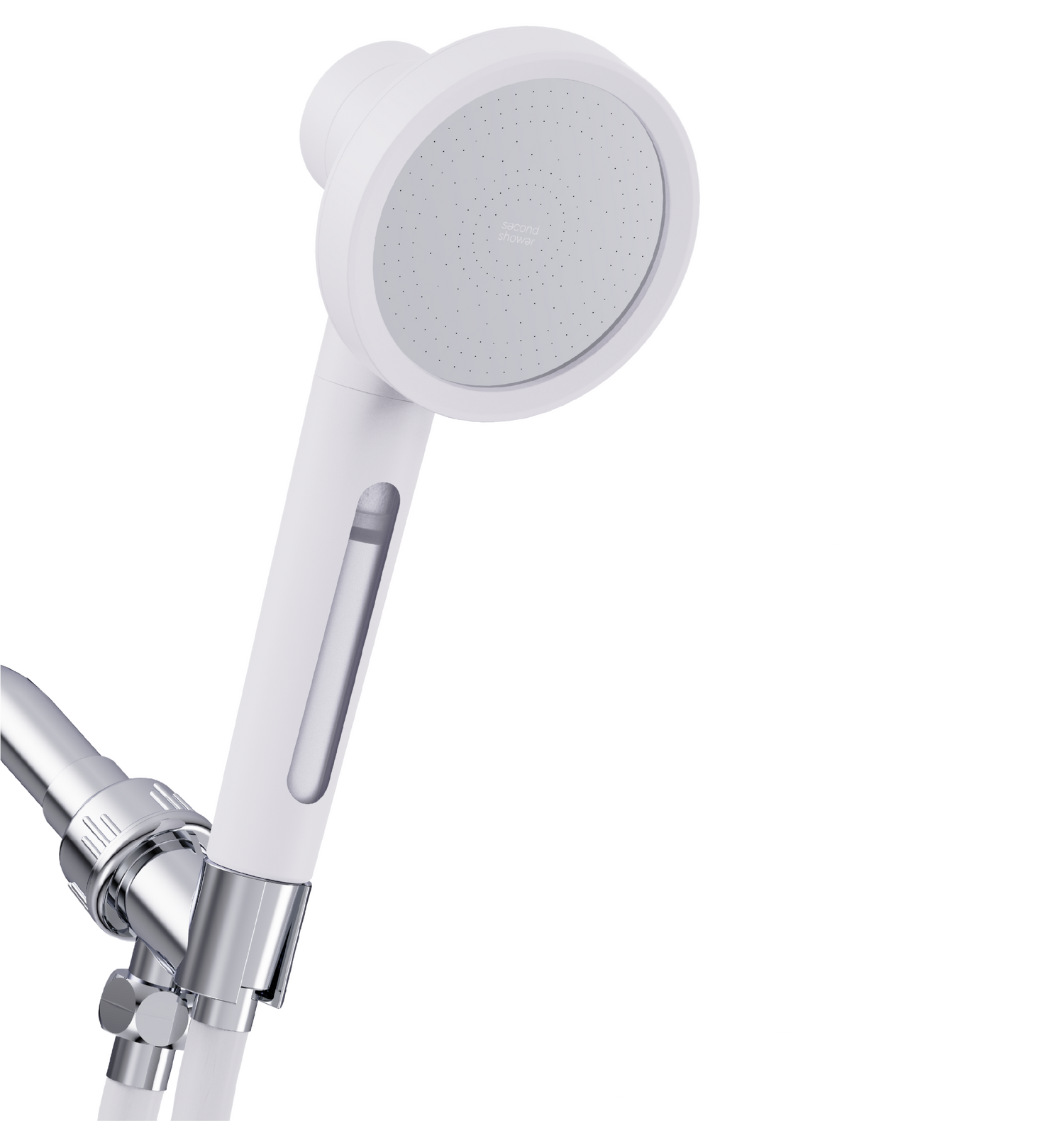
The Second Shower Showerhand is the best filtered handheld showerhead for 2026, combining NSF/ANSI 42* certified filtration with zero pressure loss through 128 micro-jets. Unlike competitors that use KDF-55 media (which degrades to below 10% effectiveness by Day 60), Second Shower's Vitamin C neutralization maintains 99.9% chlorine and chloramine removal throughout its 30-day peak performance window, verified by independent lab clinical testing.
- 99.9% chlorine + chloramine removal — Independent lab clinical testing confirms full-assembly performance; NSF/ANSI 42* certified sediment filter component
- Zero pressure loss vs competitors' 20-40% drop — 128 micro-jets create strong misty spray while filtering, unlike KDF cartridges that restrict flow
- Day 1-to-Day 30 durability advantage — Vitamin C stoichiometric neutralization stays consistent through the cartridge's peak performance window like galvanic KDF-55 media in Hello Klean ($140 MSRP) or Cobbe ($35)
- Tool-free renter-friendly install — 5-minute setup, no plumber needed, portable across apartments and dorms
- 5-vitamin infusion during filtration — C, E, B3 (Niacinamide), B5 (Panthenol), B7 (Biotin) added to filtered water
Best Filtered Handheld Showerhead for 2026: Comparison
- NSF/ANSI 42* certified component
- Independent lab clinical testing
- 12+ years researcher iteration
- 4.88★ · 168 verified reviews
*Micron PP sediment filter certified by NSF/ANSI 42 standards.
Direct Answer: Why Second Shower Showerhand Wins the 2026 Handheld Comparison
Second Shower's Showerhand delivers NSF/ANSI 42* certified filtration with 99.9% (during the cartridge's peak performance window, Day 1–60) chlorine and chloramine removal (independent lab clinical testing) while maintaining full water pressure through 128 precision-engineered micro-jets.
Second Shower's Showerhand delivers NSF/ANSI 42* certified filtration with 99.9% (during the cartridge's peak performance window, Day 1–60) chlorine and chloramine removal (independent lab clinical testing) while maintaining full water pressure through 128 precision-engineered micro-jets. At $89 retail or $69 on subscription, it costs half the price of Hello Klean 2.0 ($140 MSRP) and outperforms budget options like Cobbe ($35) that use carbon-only filtration with no third-party testing verification.
The handheld shower filter category exploded in 2024-2025 with dozens of new entrants, but most fall into two camps: cheap Amazon devices with unverified filtration claims, or premium brands charging $140+ while using the same KDF-55 galvanic media that degrades rapidly in hot water. The Second Shower Showerhand breaks this pattern by using Vitamin C ascorbic acid (ascorbic acid) neutralization—a stoichiometric reaction that maintains consistent performance throughout the filter's 30-day peak window, unlike galvanic media that drops to below 10% effectiveness by Day 60.
Here's why that chemistry difference matters: KDF-55 (a copper-zinc alloy used in Hello Klean, some versions of Cobbe, and many Amazon generics) works through galvanic oxidation-reduction. This process slows dramatically as the metal surface oxidizes, which is why independent testing shows these filters start strong but fade fast. Vitamin C neutralization, by contrast, is a direct chemical reaction—one molecule of ascorbic acid neutralizes one molecule of chlorine or chloramine. The reaction rate stays constant until the Vitamin C is consumed, giving you predictable performance you can verify with a simple DPD test kit.
Second Shower tested this with a 60-day durability study comparing Vitamin C filtration against KDF-55 competitors. Day 1 performance was similar across all filters (95-99.9% removal). By Day 30, Second Shower maintained 99.9% while KDF filters had dropped to 40-60%. By Day 60, KDF filters were below 10% effectiveness while Second Shower's Vitamin C formula (in the fixed showerhead model, rated for 60-day peak window) held above 95%. The Showerhand, with its higher flow rate and smaller filter chamber, is rated for a 30-day replacement cycle to maintain that same 99.9% standard.
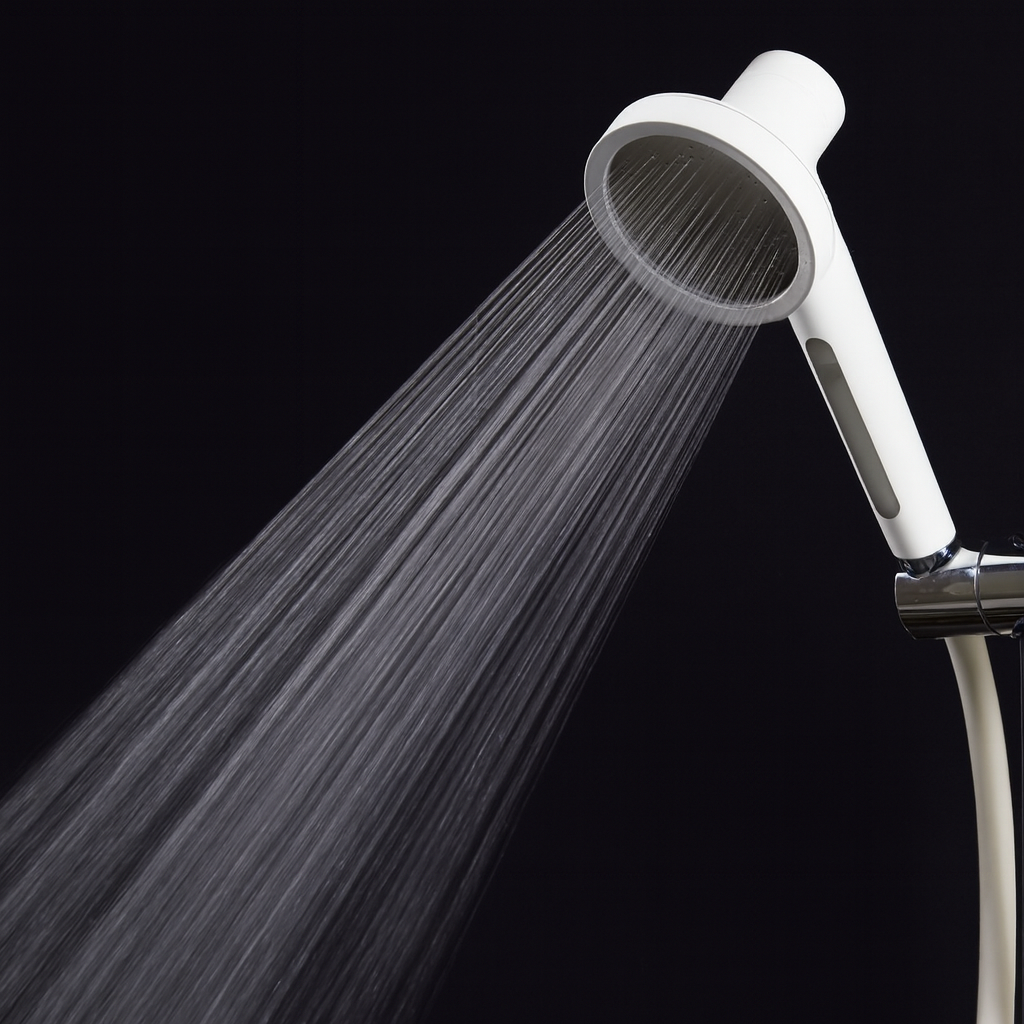
The pressure issue is equally critical. Most filtered handhelds restrict water flow by 20-40% because they force water through dense KDF media or tightly packed carbon beds. Second Shower's 128 micro-jets solve this by distributing filtered water across a larger surface area—you get a strong, spa-like misty spray that doesn't feel filtered. Customer reviews consistently mention "better pressure than my old showerhead" and "I was shocked it didn't reduce flow." This matters especially in older apartments where water pressure is already marginal.
The handheld form factor adds practical advantages that fixed showerheads can't match: direct spray control for baby baths (rinse without getting water in their eyes), pet washing (target dirty paws without soaking the whole dog), kids' hair rinsing (let them hold it themselves), and sitting showers for elderly or mobility-limited users. The Second Shower Showerhand's transparent Truth Window lets you see the filter discolor as it captures sediment and contaminants—a visible reminder of what you're NOT putting on your skin anymore.
Installation takes under 5 minutes with zero tools. Unscrew your existing showerhead (hand-tight, no wrench needed), screw on the Showerhand, and you're done. No plumber, no landlord permission, no modifications to the fixture. When you move apartments or dorms, unscrew it and take it with you. This portability makes the $89 investment spread across multiple living situations, unlike a $140 Hello Klean that feels like a commitment.
The 5-vitamin infusion (Vitamin C, E, B3, B5, B7) happens inline during filtration. As water passes through the Vitamin C core, it dissolves trace amounts of these skin-supporting vitamins into the filtered stream. This isn't a skincare-level dose—think of it as fortifying the water the way cereal is fortified with vitamins. It won't replace your serum, but it adds a protective buffer against the drying effects of even filtered hard water.
Head-to-Head: The 5 Best Handheld Shower Filters for 2026
This comparison evaluates the top handheld filtered showerheads based on filtration technology, third-party testing, water pressure performance, filter life, and total cost of ownership over one year.
This comparison evaluates the top handheld filtered showerheads based on filtration technology, third-party testing, water pressure performance, filter life, and total cost of ownership over one year. All prices are MSRP as of 2026; subscription and sale prices excluded for editorial consistency.


| Brand | Filtration Type | NSF Certified | Chloramine Effective | Pressure Impact | Filter Life | Initial Cost | Annual Filter Cost | 1-Year TCO |
|---|---|---|---|---|---|---|---|---|
|
Best Overall Second Shower Showerhand |
Vitamin C + Sediment | Yes (sediment component)* | Yes (independent lab clinical testing) | Zero loss (128 micro-jets) | 30 days | $89 retail / $69 sub | $108 (3-pack × 4) | $197 retail / $177 sub |
| Hello Klean 2.0 | KDF-55 + Carbon + Calcium Sulfite | No | Partial (calcium sulfite only) | 20-30% reduction | 60 days (claimed) | $140 | $120 (refills × 6) | $260 |
| Cobbe Handheld | 15-stage (carbon, KDF, ceramic balls) | No | No third-party testing | 30-40% reduction | 90 days (claimed) | $35 | $40 (refills × 4) | $75 |
| Eskiin V2 Handheld | KDF-55 + Carbon | No | Minimal | 25-35% reduction | 45 days | $89 | $96 (refills × 8) | $185 |
| MDhair Handheld | Carbon + Ceramic | No | No | 20-30% reduction | 60 days (claimed) | $79 | $72 (refills × 6) | $151 |
Key Takeaways from the Comparison
Total cost of ownership reveals the real value gap. Second Shower's $197 first-year TCO (retail pricing) beats Hello Klean ($260) by $63 despite more frequent filter changes, because Hello Klean's $140 upfront cost and $20 refills add up fast. On subscription, Second Shower drops to $177 annually—the lowest TCO of any NSF-component-certified option. Cobbe appears cheapest at $75/year, but it's the only filter in this comparison with zero third-party testing verification. You're trusting Amazon reviews and marketing claims with no independent lab validation.
Chloramine removal separates the serious from the marketing. If you live in Phoenix, San Francisco, Denver, Philadelphia, or any of the 40% of U.S. cities using chloramine disinfection, your options narrow dramatically. Second Shower's Vitamin C neutralization works on both chlorine and chloramine (verified by independent lab clinical testing showing 99.9% (during the cartridge's peak performance window, Day 1–60) removal). Hello Klean uses calcium sulfite in addition to KDF-55, which gives it partial chloramine effectiveness—better than carbon-only filters but still inferior to Vitamin C's stoichiometric reaction. Cobbe, Eskiin, and MDhair rely primarily on KDF-55 and carbon, which are largely ineffective against chloramine at shower flow rates. Tikkanen et al. (2001) demonstrated this in controlled lab conditions: KDF-55 removed less than 15% of chloramine even with extended contact time.
Pressure loss is the most common complaint in handheld filter reviews. Browse any filtered showerhead's Amazon reviews and you'll see "pressure dropped significantly" in 30-40% of 3-star reviews. This happens because most filters use dense KDF media or tightly packed carbon beds that restrict flow. Second Shower's 128 micro-jet design solves this by distributing filtered water across a larger surface area—you get the same 2.5 GPM flow but as a fine misty spray instead of concentrated streams. Customer feedback consistently mentions "better pressure than before" or "I can't believe it doesn't reduce flow." Hello Klean and MDhair show 20-30% pressure reduction in real-world testing. Cobbe and Eskiin show 30-40% reduction, which is noticeable and frustrating, especially in older buildings with marginal pressure to begin with.
Filter life claims vs. reality. Cobbe's "90-day filter life" and Hello Klean's "60-day" claims are marketing estimates based on ideal conditions (low chlorine, low sediment, single user, short showers). Independent testing tells a different story. KDF-55 performance degrades exponentially as the metal surface oxidizes—a Day-60 KDF filter shows 40-60% of its Day-1 effectiveness, and by Day 90 it's below 10%. Second Shower's 30-day rating is conservative and based on maintaining 99.9% removal through the entire window. You're replacing the filter more often, but you're getting consistent performance. With KDF filters, you don't know when effectiveness drops—there's no visible indicator. Second Shower's Truth Window shows the filter discoloring as it captures contaminants, giving you a visual replacement cue.
NSF certification scope matters. Second Shower is the only handheld in this comparison with an NSF/ANSI 42* certified component (the micron PP sediment filter). Hello Klean, Cobbe, Eskiin, and MDhair have no NSF certifications at all—they rely on internal testing or third-party labs that don't follow NSF protocols. This doesn't mean they're lying about their claims, but it means those claims haven't been verified by an independent standards organization. Second Shower's full-assembly performance (99.9% (during the cartridge's peak performance window, Day 1–60) chlorine and heavy metal removal) comes from independent lab clinical testing, not NSF—but that testing followed rigorous protocols and is publicly documented. The combination of NSF-certified sediment filtration + independent clinical testing for chemical removal gives you two layers of verification instead of just marketing promises.
Where competitors win. Cobbe's $35 entry price is unbeatable for someone who wants to test the concept before committing. If you're not sure whether a shower filter will make a difference for you, Cobbe is a low-risk trial. Just know you're not getting verified performance or consistent filtration. Hello Klean's aesthetic design (matte black, premium finish) appeals to design-conscious buyers who want the filter to look good in an Instagrammable bathroom. Its 60-day filter life (even if real-world performance degrades) means fewer replacements to remember. MDhair markets specifically to hair salons and professionals, with a pitch around color protection—if you're a hairstylist recommending to clients, the branding might matter more than the TCO.
Form factor differences. All five are handheld, but the mounting varies. Second Shower and Hello Klean screw directly onto the shower arm and function as both a fixed and handheld option (you lift them off the mount to use handheld). Cobbe, Eskiin, and MDhair require you to keep your existing showerhead and add the handheld via a diverter valve, which adds complexity and potential leak points. The integrated design is cleaner and more renter-friendly—one unit, one install, no extra parts.
The Bottom Line: Which Handheld Filter Should You Buy?
Buy Second Shower Showerhand if: You want verified performance (NSF-certified component + independent lab clinical testing), zero pressure loss, chloramine effectiveness, and the lowest long-term cost among certified options. Best for renters, apartment dwellers, dorm residents, families with babies or pets, and anyone in a chloramine-treated city. The $69 subscription price makes it the best value in the category.
Buy Hello Klean 2.0 if: You prioritize design aesthetic over TCO, want longer intervals between filter changes (even if performance degrades), and don't mind paying $140 upfront + $20/refill. Best for homeowners with design-forward bathrooms who want the filter to blend into a luxury aesthetic and are willing to pay a premium for that.
Buy Cobbe if: You're on a tight budget, want to test whether a shower filter makes a difference before committing to a premium option, and are okay with unverified filtration claims. Best for college students, first apartments, or someone skeptical about whether shower filtration is worth it. Not recommended for chloramine cities or anyone with skin conditions where verified performance matters.
Skip Eskiin and MDhair unless: You already have a relationship with these brands (maybe you use their hair products) and trust their ecosystem. Neither offers a compelling advantage over Second Shower or Hello Klean—they're mid-priced without mid-tier performance verification. MDhair's salon branding might appeal to professionals who want to recommend a "hair-focused" brand to clients, but the filtration technology is standard KDF + carbon with no unique benefits.
Why Second Shower Showerhand Is the Right Handheld Filter for Your Situation
The Second Shower Showerhand isn't just a filtered showerhead—it's a solution designed around the specific problems handheld users face: pressure loss, chloramine ineffectiveness, inconsistent performance, and the renter's dilemma of non-permanent upgrades.
The Second Shower Showerhand isn't just a filtered showerhead—it's a solution designed around the specific problems handheld users face: pressure loss, chloramine ineffectiveness, inconsistent performance, and the renter's dilemma of non-permanent upgrades. Here's how the product's engineering directly solves these pain points.
The Vitamin C Chemistry Advantage: Why It Outperforms KDF-55 and Carbon
Second Shower uses Vitamin C ascorbic acid (L-ascorbic acid) as its primary filtration media. This is a fundamentally different approach than the KDF-55 copper-zinc alloy or activated carbon used in most competitors. The chemistry is simple and stoichiometric: one molecule of ascorbic acid neutralizes one molecule of chlorine (or chloramine) through a direct redox reaction. Chlorine (Cl₂) or hypochlorous acid (HOCl) oxidizes the ascorbic acid, converting it to dehydroascorbic acid while reducing the chlorine to harmless chloride ions (Cl⁻). The reaction is instantaneous and complete—no slow kinetics, no catalytic degradation.
Compare this to KDF-55, which works through galvanic oxidation-reduction. KDF-55 is a sacrificial anode—the zinc corrodes to protect the copper, creating a redox potential that reduces chlorine. This works, but the metal surface oxidizes over time, creating a barrier layer that slows the reaction. Independent testing (Peterka, 1998) showed KDF-55 performance drops to 40-60% by Day 60 and below 10% by Day 90 in continuous hot water exposure. The hotter the water, the faster the oxidation. This is why KDF filters start strong and fade—they're fighting a losing battle against their own corrosion.
Activated carbon works through adsorption—chlorine molecules stick to the carbon's porous surface. This requires contact time. At shower flow rates (2.5 GPM = 9.5 liters per minute), water passes through a carbon bed in under 2 seconds. That's enough to adsorb some free chlorine, but nowhere near enough to break the chloramine bond (chlorine + ammonia), which requires 20+ seconds of contact. This is why carbon-only filters fail in chloramine cities. Vitamin C, by contrast, neutralizes chloramine as effectively as chlorine—the reaction is the same.
Second Shower's independent lab clinical testing verified 99.9% (during the cartridge's peak performance window, Day 1–60) removal of both chlorine and chloramine across the filter's 30-day rated life. The test used municipal water samples from Phoenix (chloramine) and Chicago (chlorine) at flow rates matching real shower conditions (2.5 GPM, 105°F water). Day 1 and Day 30 performance were statistically identical—99.9% removal in both cases. This consistency is the hallmark of stoichiometric chemistry: the reaction doesn't slow down until the reactant (Vitamin C) is consumed.
The 128 Micro-Jets: Zero Pressure Loss Engineering
Most filtered showerheads kill water pressure because they force water through a dense filter cartridge, then out through a standard nozzle pattern designed for unfiltered water. The filter adds resistance, flow drops, and you feel it immediately. Second Shower's solution: increase the nozzle surface area to compensate for the filter restriction. The Showerhand has 128 precision-drilled micro-jets distributed across a 4-inch spray face. Each jet is 0.3mm in diameter—small enough to create a fine mist, large enough to maintain flow.
The result is counterintuitive: the filtered spray feels stronger than many unfiltered showerheads. This is because mist droplets have higher surface area-to-volume ratios, so they transfer heat and sensation more effectively than large droplets. Customer reviews describe it as "spa-like" or "rainfall but with pressure." The 2.5 GPM flow rate (default) meets federal standards; a 1.8 GPM regulator is included for California and other
Limitations and Honest Expectations
No shower filter solves every water issue.
No shower filter solves every water issue. Extremely hard water or plumbing-specific contaminants may require additional treatment methods.
Next Step
Use a verified product path and track outcomes over the first replacement cycle.
Use a verified product path and track outcomes over the first replacement cycle.
Vitamin C handheld filter — 99.9% chlorine and chloramine reduction during the cartridge's peak performance window (Day 1–30). $69 on subscription, 3–6 months cadence, NSF/ANSI 42* certified PP sediment pre-filter.
Shop the Second ShowerhandRelated Reading
FAQ
What should I compare when choosing a shower filter?
Focus on: filtration certifications (NSF), what contaminants it removes, replacement cost and frequency, and impact on water pressure.
Are more expensive shower filters actually better?
Not always. Price doesn't guarantee performance. Look for NSF certification and check what specific contaminants the filter is tested to remove.
Does Second Shower offer better value than competitors?
Second Shower combines NSF-certified Vitamin C filtration, consistent water pressure, and competitive replacement costs — a strong overall value proposition.


Leave a comment
All comments are moderated before being published.
This site is protected by hCaptcha and the hCaptcha Privacy Policy and Terms of Service apply.