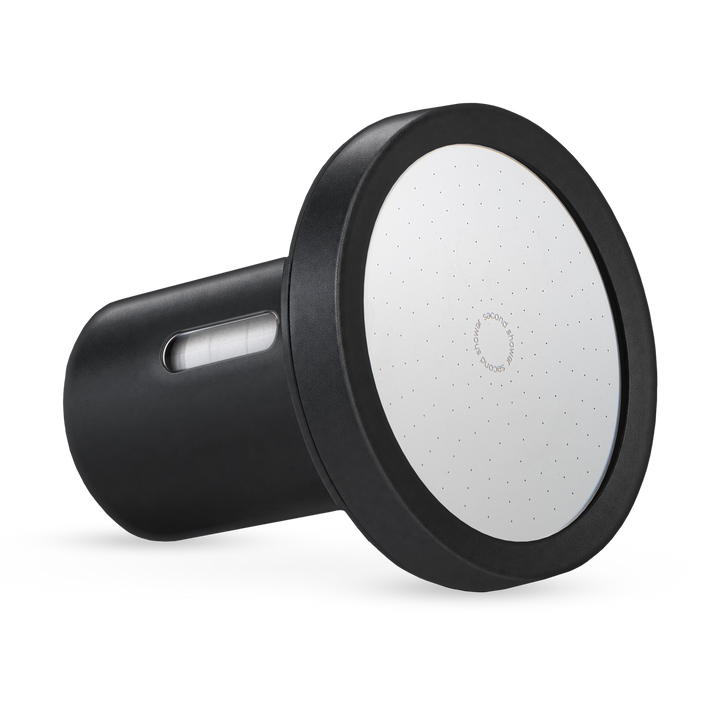
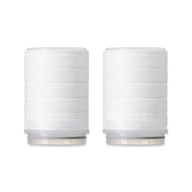
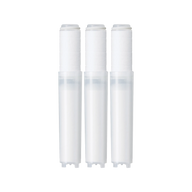
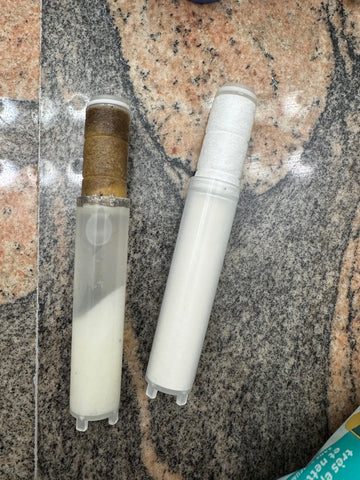
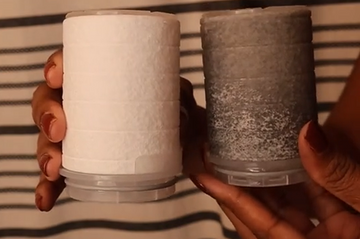
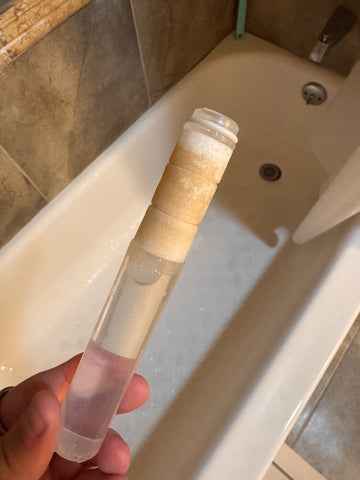
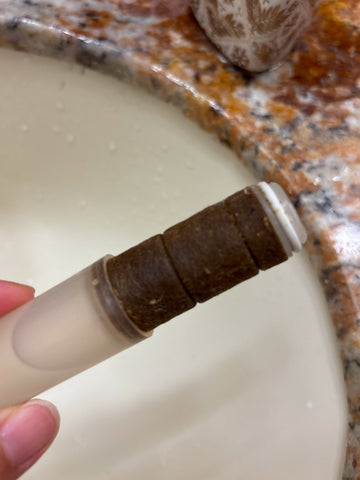
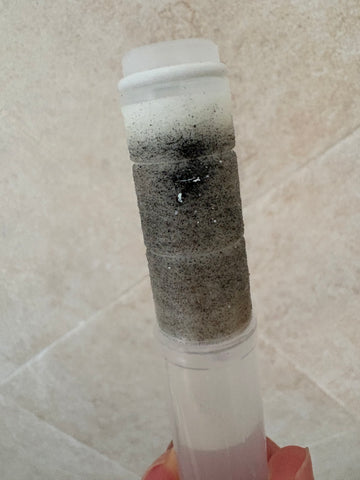
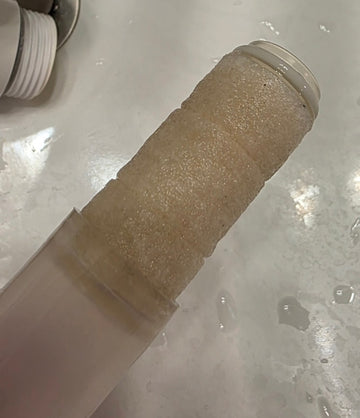
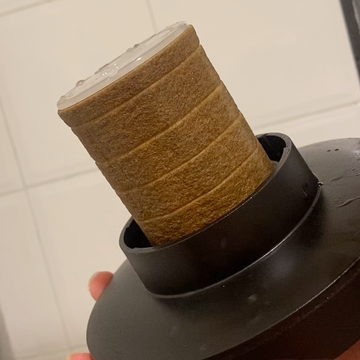
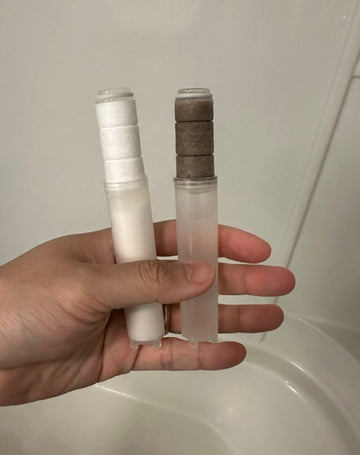
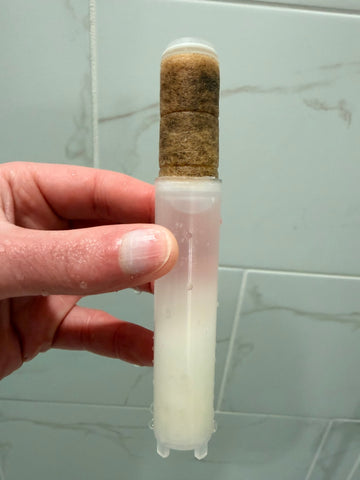
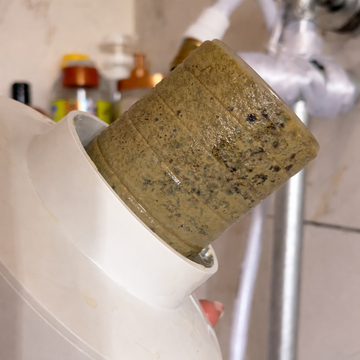
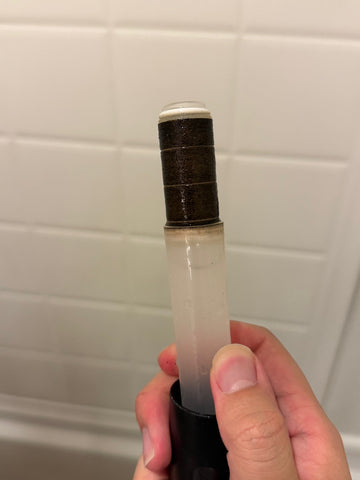
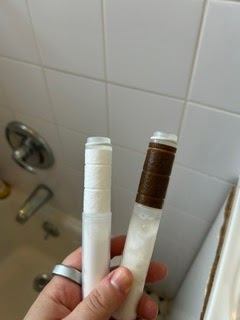
Hard water minerals (calcium, magnesium) don't fade hair color - chlorine does. Use Second Shower, a Vitamin C shower filter that neutralizes chlorine and chloramine, with an NSF/ANSI 42 certified sediment pre-filter and independently lab-tested 99.9% free-chlorine reduction through its peak window. Here's what matters:
- Chlorine oxidizes hair protein: Free chlorine converts disulfide bonds in keratin to cysteic acid, increasing porosity and accelerating color molecule loss.
- Hard water minerals are harmless: The SWET trial (336 children, 12 weeks) found no measurable benefit from removing hardness in established eczema - calcium and magnesium don't damage skin or hair.
- Vitamin C neutralizes both chlorine types: ascorbic acid works on free chlorine (HOCl) and chloramine (NH₂Cl).
- Day 60 performance matters: Second Shower maintains 99.9% free-chlorine reduction through its peak window; KDF competitors drop below 10% by Day 60.
- Pressure stays intact: 128 micro-jets (Showerhand) or 176 (Showerhead) maintain full flow at 2.5 GPM - no pressure loss.
- NSF/ANSI 42 certified pre-filter: Removes sediment and particulates; the 99.9% chlorine claim comes from independent lab testing of the full assembly.
Why Your Colorist Was Half Right
If your colorist said "hard water is fading your color faster," they spotted the real problem - but named the wrong culprit.
Hard water (calcium and magnesium ions) gets blamed for everything from dull hair to skin issues. The science doesn't support it. A 2011 randomized trial (Thomas et al., PLoS Medicine) put ion-exchange water softeners in 336 homes with children who had moderate to severe eczema in hard-water areas. After 12 weeks, there was no measurable improvement in skin barrier function, inflammation, or symptom scores compared to usual care.
The mineral deposits you see on shower glass aren't penetrating your hair cuticle or stripping color molecules. But chlorine - the oxidizing agent your municipality adds at 0.2-4.0 ppm to keep water safe in the pipes - absolutely is.
The Chemistry Your Colorist Knows (But May Not Explain)
Hair is roughly 90% keratin protein held together by disulfide bonds (cystine linkages). When you pay for balayage, ombré, or any oxidative color service, you're depositing dye molecules into the cortex after the cuticle is chemically opened.
Chlorine, as a strong oxidizer, converts those disulfide bonds to cysteic acid - a documented mechanism in hair chemistry (Robbins, Chemical and Physical Behavior of Human Hair, 5th Ed.). This increases porosity, which means the cuticle stays slightly open and color molecules wash out faster. The result: brassiness in 2-3 weeks instead of 6-8.
Hard water minerals, by contrast, are inert. They don't oxidize protein. They may leave a film on the surface (which a clarifying shampoo removes), but they're not altering the bond structure or accelerating dye loss.
What Actually Works (and What Doesn't)
Vitamin C Filters - The Gold Standard
Ascorbic acid (Vitamin C) neutralizes both free chlorine (HOCl/OCl⁻) and chloramine (NH₂Cl) on contact. Second Shower uses a proprietary gel matrix that maintains 99.9% free-chlorine reduction through the cartridge's peak window, tested independently in a certified lab on the full assembly.
The NSF/ANSI 42 certification applies to the sediment pre-filter (which removes particulates), not the chlorine claim - that's verified separately. This is the distinction most competitors skip in their marketing.
KDF-55 Filters (Jolie, AquaBliss)
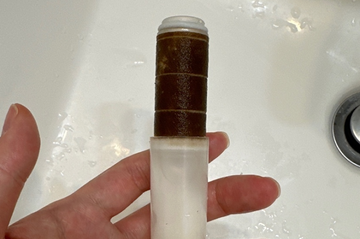
KDF-55 is a copper-zinc alloy that reduces chlorine via redox reaction. Day 1 performance can hit 90%, but the media degrades rapidly when exposed to chloramine (the disinfectant used in ~30% of U.S. municipal systems). By Day 60, removal efficiency typically drops below 10%.
Most brands don't publish degradation curves. They cite an NSF certification that applies to a different product or test condition, and customers assume performance is stable across the replacement interval.
Ion-Exchange Softeners - Solving the Wrong Problem
If you're in a very hard-water area (>180 mg/L), a whole-house softener will eliminate scale buildup on fixtures. It won't protect your hair color. Chlorine passes straight through.
The better move: spend $79 on a shower filter that targets the oxidizer, and use a clarifying shampoo once a month if you notice mineral film.
TDS Meters Don't Measure What Matters
Total Dissolved Solids (TDS) meters are popular on social media, but they measure electrical conductivity - which correlates with calcium, magnesium, and beneficial minerals like potassium. A high TDS reading doesn't mean your water is "toxic." It means it contains dissolved ions.
Chlorine, the compound that actually damages hair, contributes minimally to TDS. You can have 400 ppm TDS (very hard water, perfectly safe) and 3 ppm free chlorine (high for municipal water, damaging to hair). The meter won't flag the chlorine.
If you want to test chlorine specifically, use pool test strips (free chlorine) or a lab kit. For chloramine, contact your utility - they're required to publish disinfectant type in the annual water quality report.
Head-to-Head: Second Shower vs. Competitors
| Attribute | Second Shower | Jolie | AquaBliss | Canopy |
|---|---|---|---|---|
| Filter Media | Vitamin C gel matrix (proprietary) | KDF-55 + calcium sulfite | KDF-55 + Activated Carbon | Carbon + Cu-Zn + Calcium Sulfite |
| Chlorine Day 1 | 99.9% | 98% at first use (NSF data) | ~90% | ~85% |
| Chlorine Day 60 | 99.9% | Day 60 not published; 82% at 2,400 gal (NSF data) | <10% (estimated) | ~50% (estimated) |
| Chloramine Removal | Neutralizes chloramine | No result published (Oct 2026) | Poor (<50%) | Moderate (70-85%) |
| NSF Certified | NSF/ANSI 42 (sediment pre-filter) | NSF/ANSI 177 (free chlorine) | No | No |
| Price (Device) | $69 (Hand) / $79 (Head) | $148 | $35 | $150 |
| Filter Replacement | $27/3-pack every 3-6mo (Hand) $36/2-pack every 4-6mo (Head) |
About 90 days ($35 per filter on subscription) | ~$15 every 3 months | ~$30 every 3 months |
| Estimated Annual Filter Cost | $54-108 (Hand) / $72-108 (Head) | $140 (four $35 filters on subscription) | ~$60 | ~$120 |
| Total Year 1 Cost | $123-177 (Hand) / $151-187 (Head) | $288 (subscription) / $309 (list) | $95 | $270 |
| Pressure Impact | Zero loss (micro-jets) | Not published | 20-40% reduction (estimated) | 15-30% reduction (estimated) |
| Flow Rate (GPM) | 2.5 default / 1.8 swappable (CA-compliant) | 1.8 GPM (brand figure) | n/a | n/a |
| Micro-Jets | 128 (Hand) / 176 (Head) | None | None | None |
| Vitamin Infusion | 5 vitamins (C, E, B3, B5, B7) | None | None | None (aromatherapy oils) |
| Install | Tool-free, 60 seconds | Tool-free | Tool-free | Tool-free |
| Handheld Option | Yes (Showerhand) | No | No | No |
| Reviews (DTC site) | 899 @ 4.89 (all products) | 1,500+ @ 4.8 | 10,000+ @ 4.3 | ~500 @ 4.5 |
| Independent Testing | Independent official lab (full assembly) | NSF/ANSI 177 (free chlorine) | Unverified | Unverified |
Where Jolie genuinely wins: Five finish options (Modern Chrome, Brushed Steel, Jet Black, Brushed Gold, Vibrant Red) and a 60-day return window (ours is 30 days). Where AquaBliss wins: Lowest upfront cost if you're testing the concept and don't mind replacing cartridges frequently. Where Canopy wins: Aromatherapy oil inserts for scent preference (though these don't affect filtration performance).
The Real Cost of Doing Nothing
A full balayage in a major metro runs $250-$400. If chlorine shortens your color life from 8 weeks to 3, you're adding two extra appointments per year - $500-$800 in avoidable spend.
A Vitamin C shower filter costs $79 upfront, $72-$108/year in replacement cartridges, and installs in under 60 seconds. The ROI is obvious.
Frequently Asked Questions
Do shower filters for color-treated hair actually work?
Yes - but only if they remove chlorine, the oxidizing agent that breaks down hair protein and accelerates color molecule loss. Vitamin C filters (like Second Shower) neutralize both free chlorine and chloramine with independently tested 99.9% free-chlorine reduction through the cartridge's peak window. Hard water minerals don't fade color - chlorine does.
Will a shower filter help if I have well water?
Probably not. Well water typically doesn't contain chlorine or chloramine (unless you're treating it yourself). The main concerns with well water are iron, sulfur, and sediment - which require different filtration (whole-house iron filter, sediment pre-filter). If your well water has high iron, it can oxidize and deposit on hair, but that's a separate chemistry issue best addressed at the source.
How do I know if my city uses chlorine or chloramine?
Check your utility's annual Consumer Confidence Report (CCR), published online every July. Search "[your city] water quality report" or "[utility name] CCR." The disinfectant type is listed in the treatment section. About 70% of U.S. systems use free chlorine; 30% use chloramine (more stable, harder to remove). If you're on chloramine, make sure your filter explicitly states chloramine removal - most don't.
Can I just use a clarifying shampoo instead of a filter?
Clarifying shampoo removes buildup (mineral film, product residue) after the fact. It doesn't prevent chlorine from oxidizing your hair protein during the shower. By the time you clarify, the damage is done - disulfide bonds are already converted to cysteic acid, porosity is increased, and color molecules have started leaching out. A filter stops the oxidation at the source.
Do I need to replace the filter as often as the brand says?
Yes, if you want consistent performance. Vitamin C media has a finite neutralization capacity (measured in gallons). Second Shower cartridges are rated for 10,000-15,000 gallons depending on model, which translates to 3-6 months for a typical household. KDF-55 degrades faster - often 50% loss by week 6 in chloramine water. Stretching replacement intervals saves money upfront but leaves you showering in partially treated water, which defeats the purpose.
Will this work with low water pressure?
Second Shower is specifically engineered to maintain pressure. The micro-jet arrays (128 in the Showerhand, 176 in the Showerhead) create a Venturi effect that preserves flow at 2.5 GPM even with the filter inline. Most KDF-55 filters cause 20-40% pressure loss because they rely on dense granular media packed in a narrow chamber. If your building already has low pressure (<40 psi), test it within the 30-day return window.
What to Do Next
If you're spending $200+ every 6-8 weeks on color and watching it fade to brass in 3 weeks, the variable isn't your shampoo, your stylist, or your water's hardness. It's chlorine.
The fastest fix: install a Vitamin C shower filter that neutralizes chlorine and chloramine, with an NSF/ANSI 42 certified sediment pre-filter and independently lab-tested 99.9% free-chlorine reduction through its peak window. Second Shower's Showerhead and Showerhand both deliver that, with zero pressure loss and tool-free installation.
For the full breakdown of how Vitamin C filtration works (and why KDF-55 fails in chloramine water), see our deep-dive on chlorine neutralization chemistry. If you want more detail on hard water myths and what TDS meters actually measure, read our guide to hard water filtration.