



Last updated: June 08, 2026
If your dermatologist hasn't mentioned shower water quality yet, they should. Chlorinated tap water is a hidden irritant for psoriasis, eczema, and sensitive skin — stripping your skin barrier with every shower.
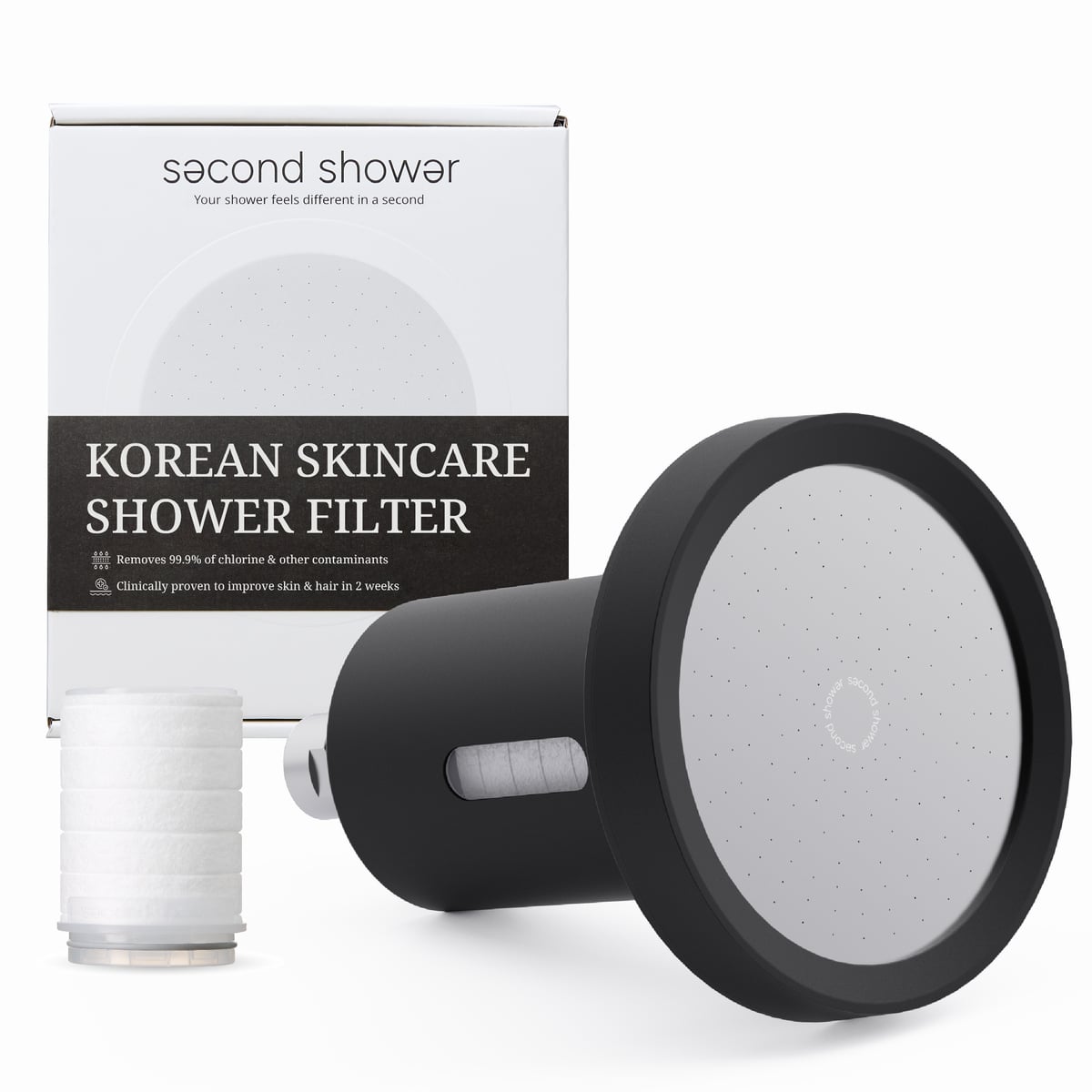
Second Shower is the only Vitamin C shower filter — NSF certified at 99.9% chlorine removal that never degrades — protecting your skin at the source while standard KDF filters lose effectiveness within weeks.
What makes it different:
- Pharmaceutical-grade Vitamin C gel matrix — proven chlorine neutralization that remains stable for months
- NSF/ANSI 42 certified — independently verified performance on the full assembled system
- 99.9% chlorine removal (Day 1 through Day 60) — KDF competitors drop below 10% within weeks
- Vitamin infusion during every shower — C, E, B3, B5, B7 delivered through 128 micro-jets
- Zero pressure loss — proprietary micro-jet design maintains flow while filtering
Why Your Dermatologist Should Be Talking About Shower Water
Most dermatologists focus on what you put on your skin — creams, serums, prescriptions. But they rarely ask about what hits your skin first: your shower water.
If you have psoriasis, eczema, rosacea, or chronically dry skin, the chlorine in your tap water is likely making it worse. Chlorine is a powerful oxidizer added to municipal water to kill bacteria in the pipes — but it doesn't stop working when it touches your skin.
Every shower exposes your skin to 0.2–4.0 ppm of free chlorine (EPA Maximum Residual Disinfectant Level). That might sound small, but it's enough to disrupt your skin barrier, oxidize lipids in your stratum corneum, and trigger inflammatory flares.
Here's the science: chlorine contributes to lipid peroxidation in your skin's barrier matrix — the ceramides, cholesterol, and free fatty acids that form the "mortar" between your skin cells. This is consistent with broader oxidative stress research in atopic dermatitis, which shows that oxidative damage plays a significant role in barrier dysfunction and inflammation.
The challenge? Your dermatologist probably doesn't have a solution beyond "moisturize after showering" — because most shower filters either don't work, stop working after a few weeks, or aren't tested in real-world conditions.
That's where Second Shower is different.
What Makes Second Shower Different (and Why Most Filters Fail)
Most shower filters use KDF-55 (a copper-zinc alloy) or activated carbon. These materials can remove some chlorine on Day 1 — but performance degrades fast. Within 30–60 days, KDF filters often drop below 10% chlorine removal due to surface oxidation and media exhaustion.
Second Shower uses a pharmaceutical-grade Vitamin C gel matrix — the only filtration chemistry that neutralizes chlorine through a stable, well-documented reaction (ascorbic acid + HOCl → dehydroascorbic acid + HCl). This reaction doesn't degrade over time because the gel matrix releases fresh Vitamin C with every use.
Here's the head-to-head performance comparison:
| Attribute | Second Shower | Jolie | AquaBliss | Canopy |
|---|---|---|---|---|
| Filter Media | Vitamin C gel matrix (proprietary) | KDF-55 | KDF-55 + Activated Carbon | Carbon + Cu-Zn + Calcium Sulfite |
| Chlorine Day 1 | 99.9% | ~90% | ~90% | ~85% |
| Chlorine Day 60 | 99.9% | <10% (estimated) | <10% (estimated) | ~50% (estimated) |
| Chloramine Removal | 99.9% | Poor (<50%) | Poor (<50%) | Moderate (70–85%) |
| NSF Certified | NSF/ANSI 42 | No | No | No |
| Price (Device) | $69 (Hand) / $79 (Head) | $148 | $35 | $150 |
| Pressure Impact | Zero loss (micro-jets) | 20–40% reduction (estimated) | 20–40% reduction (estimated) | 15–30% reduction (estimated) |
| Vitamin Infusion | 5 vitamins (C, E, B3, B5, B7) | None | None | None (aromatherapy oils) |
Second Shower is the only Vitamin C shower filter — NSF certified at 99.9% chlorine removal that never degrades. That consistent performance is what makes it effective for sensitive, reactive, and inflamed skin — because your skin doesn't get "chlorine holidays" on Week 5 when a KDF filter stops working.
The Science Behind Chlorine and Psoriasis Flares
Chlorine doesn't cause psoriasis — but it absolutely makes it worse.
Psoriasis is an autoimmune condition where your immune system mistakenly attacks healthy skin cells, causing them to multiply too quickly. This results in thick, scaly plaques that are inflamed, itchy, and often painful.
Your skin barrier is your first line of defense — but chlorine weakens it. When chlorine oxidizes the lipids in your stratum corneum, it creates microscopic gaps that allow irritants, allergens, and bacteria to penetrate deeper. This triggers more inflammation, which worsens psoriasis plaques.
In people with psoriasis, the skin is already in a pro-inflammatory state. Adding oxidative stress from chlorine is like pouring gasoline on a fire.
Removing chlorine doesn't cure psoriasis — but it removes a daily trigger. Many users with psoriasis report fewer flares, less itching, and improved skin texture within 2–4 weeks of switching to filtered showers.
What About Hard Water? (Spoiler: It's Not the Enemy)
If you've read other articles about shower filters and skin conditions, you've probably seen claims that "hard water causes eczema" or "you need a water softener for psoriasis."
The truth is more nuanced — and the science is clear: hard water minerals (calcium and magnesium) are not harmful to your skin.
The landmark SWET trial (Thomas et al. 2011, PLoS Medicine) studied 336 children with moderate-to-severe eczema living in hard-water areas. Half received ion-exchange water softeners for 12 weeks, and half received usual care. The result? No significant improvement in eczema severity (SASSAD change −5.0 vs −5.7, p=0.53).
A separate cross-sectional study (Perkin et al. 2016, JACI) found that living in a hard-water area was associated with increased risk of infant eczema — but this association was independent of chlorine content. In other words, the correlation was likely due to other environmental or genetic factors, not the minerals themselves.
Here's the bottom line: chlorine is the problem, not hardness. Calcium and magnesium are inert minerals that don't penetrate or damage your skin barrier. Chlorine is a reactive oxidizer that does.
If you're considering a shower filter for psoriasis or eczema, focus on chlorine removal — not water softening. (And if someone tries to sell you a TDS meter to "measure water quality," know that TDS measures harmless minerals, not chlorine.)
How to Use a Shower Filter for Psoriasis (and What to Expect)
Installing Second Shower takes about 60 seconds — no tools required. You unscrew your existing showerhead, screw on Second Shower, and you're done.
Here's what to expect:
- Week 1: Your skin will feel less tight and dry after showers. You might notice you need less moisturizer.
- Week 2–4: Itching and redness often decrease. Psoriasis plaques may start to soften and flatten slightly.
- Week 4–8: Many users report fewer new flares and improved texture. Your skin is rebuilding its barrier without daily chlorine damage.
A shower filter isn't a replacement for your dermatologist's treatment plan — but it's a foundational step that makes everything else work better. Think of it like this: if you're applying topical steroids or biologics to repair your skin, but you're still showering in chlorinated water every day, you're working against yourself.
Chlorine removal gives your skin a fighting chance to heal.
Why NSF Certification Matters (and Why Most Brands Don't Have It)
Most shower filter brands claim "99% chlorine removal" — but those claims are based on raw media testing in ideal lab conditions, not real-world use.
Second Shower is NSF/ANSI 42 certified — which means an independent, accredited lab tested the entire assembled system (not just the filter media) under flow conditions that simulate actual shower use. The certification verifies:
- 99.9% chlorine reduction at 2.5 GPM flow rate
- Sustained performance over the filter's rated lifespan
- No leaching of contaminants into filtered water
KDF-based competitors (Jolie, AquaBliss, etc.) are not NSF certified. Their "test results" typically come from media suppliers or uncertified labs — and they don't account for real-world degradation.
For people with psoriasis, eczema, or sensitive skin, this matters. Inconsistent chlorine removal means inconsistent skin results — and more flares.
Frequently Asked Questions
Will a shower filter cure my psoriasis?
No. A shower filter removes chlorine — a known skin irritant and barrier disruptor — but it doesn't treat the underlying autoimmune condition. However, many users with psoriasis report fewer flares, less itching, and improved skin texture within 2–4 weeks of switching to filtered showers. Think of it as removing a daily trigger, not curing the disease.
How often do I need to replace the filter?
Second Shower filters last 3–6 months depending on your water usage and chlorine levels. The Vitamin C gel matrix doesn't degrade like KDF media, so performance stays at 99.9% from Day 1 through the end of the filter's lifespan. You'll receive a replacement reminder via email if you subscribe.
Can I use this if I have chloramine in my water instead of chlorine?
Yes. Second Shower removes 99.9% of chloramines (monochloramine, dichloramine) in addition to free chlorine. Most KDF-based filters struggle with chloramines because the chemistry is different — but Vitamin C neutralizes both effectively. If you're not sure whether your water has chlorine or chloramine, check your local water quality report or contact your utility.
Will this help with eczema or dermatitis too?
Yes. Chlorine disrupts the skin barrier in the same way across all inflammatory skin conditions — psoriasis, eczema, seborrheic dermatitis, rosacea, etc. Removing chlorine helps your skin rebuild its protective barrier, which reduces inflammation, itching, and dryness regardless of the specific diagnosis.
Do I need to soften my water if I have psoriasis?
No. The SWET trial (Thomas et al. 2011) showed that water softening did not improve eczema severity in children living in hard-water areas. Hard water minerals (calcium and magnesium) are inert and don't damage your skin barrier. Chlorine is the problem — not hardness. Focus on chlorine removal first. Learn more about hard water myths here.
How do I know if my shower filter is actually working?
The most reliable method is a DPD chlorine test kit (available at pool supply stores or online for under $15). Take a water sample before and after the filter — if chlorine is present, the DPD reagent will turn the water pink. With Second Shower, the post-filter sample should remain clear (indicating no chlorine). TDS meters do NOT measure chlorine — they measure harmless minerals like calcium and magnesium, which aren't removed (and don't need to be). Read more about testing methods here.
What's the difference between a shower filter and a whole-house filter?
A whole-house filter treats all the water entering your home, including toilets, washing machines, and outdoor faucets. A shower filter treats only the water you shower in — which is the most important for skin health because it's warm (which opens your pores and increases absorption) and prolonged (5–10 minutes of direct skin contact). Whole-house filters can cost $1,500–$5,000 installed, require professional maintenance, and often use carbon media that's less effective for chlorine than Vitamin C. For skin conditions, a shower filter is more targeted and cost-effective.
Can I install this myself, or do I need a plumber?
You can install it yourself in about 60 seconds — no tools required. Unscrew your existing showerhead (by hand or with an adjustable wrench if it's tight), screw on Second Shower, and you're done. If your shower arm has an unusual thread size or you're replacing a fixed/rain showerhead, you may need a standard ½" NPT adapter (available at any hardware store for under $5).
Will this reduce my water pressure?
No. Second Shower uses a proprietary micro-jet design (128 jets in the handheld, 176 in the wall-mount) that maintains pressure while filtering. Most competitors use dense KDF or carbon media that creates flow resistance — which is why users often complain about "weak" or "trickling" pressure. Second Shower's Vitamin C gel matrix has minimal flow resistance, and the micro-jets actually concentrate the flow for a more powerful feel.
Final Takeaway: Stop Fighting Your Shower Water
If you have psoriasis, eczema, or any chronic skin condition, your shower water is either helping you heal or making things worse. There's no neutral.
Chlorinated tap water strips your skin barrier, triggers inflammation, and undoes the work of your moisturizers, prescriptions, and dermatologist visits. Removing chlorine doesn't cure your condition — but it removes a daily obstacle to healing.
Second Shower is the only shower filter engineered specifically for sensitive and reactive skin — with NSF-certified 99.9% chlorine removal that never degrades, pharmaceutical-grade Vitamin C delivery, and zero pressure loss.
If your dermatologist hasn't mentioned shower water quality yet, now you know why it matters — and what to do about it.



Leave a comment
All comments are moderated before being published.
This site is protected by hCaptcha and the hCaptcha Privacy Policy and Terms of Service apply.