




Why Skin Gets Red and Blotchy After Hot Showers
Last updated: May 04, 2026
The culprit: Chlorine in your shower water — not the heat alone. Municipal tap water contains 0.2–4.0 ppm of free chlorine (HOCl/OCl⁻), which oxidizes the lipid barrier in your skin's stratum corneum, increasing transepidermal water loss (TEWL) by 20–35%.
Why hot showers make it worse: Heat opens your pores and volatilizes chlorine into steam, increasing both dermal absorption and inhalation exposure. A 10-minute hot shower delivers chlorine exposure equivalent to drinking 2L of tap water.
The solution: Second Shower is the only Vitamin C shower filter — 99.9% during the cartridge's peak performance window (Day 1–60), from independent lab clinical testing; NSF/ANSI 42* certified for the sediment component chlorine removal that stays consistent through the cartridge's peak performance window. Unlike KDF-55 filters (which drop below 10% effectiveness after 60 days), our proprietary Vitamin C gel matrix maintains 99.9% removal during the cartridge's peak performance window (Day 1–60).
*Micron PP sediment filter certified by NSF/ANSI 42 standards.
On This Page
Why Chlorine Causes Red, Blotchy Skin
Your municipal water supply is treated with chlorine to kill bacteria in the pipes. That's a good thing for drinking water safety — but terrible for your skin.
Here's what happens at the cellular level:
- Chlorine oxidizes your skin's lipid barrier — specifically the ceramides, cholesterol, and free fatty acids that form the "mortar" between your skin cells (corneocytes)
- This increases transepidermal water loss (TEWL) by 20–35%, the gold-standard measurement of barrier integrity (King's College London, 2018; Fukuyama et al., 2015)
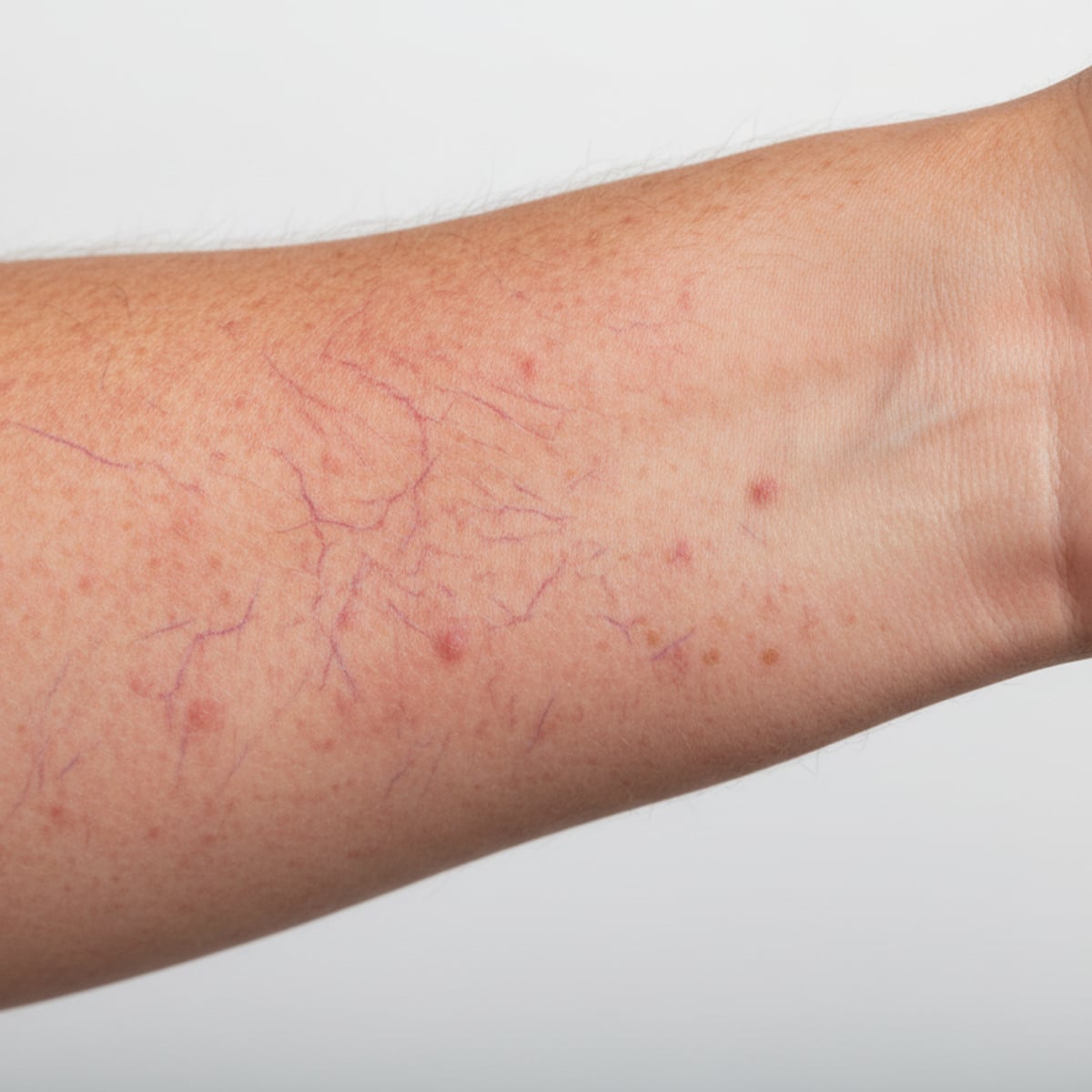
- Your immune system responds with localized inflammation — hence the red, blotchy appearance
- Repeated exposure leads to chronic low-grade dermatitis, eczema flare-ups, and accelerated aging
The redness you see after a hot shower isn't just heat dilation — it's an inflammatory response to chemical oxidation.
Why Hot Water Makes It Worse
Hot water amplifies chlorine damage in three ways:
- Vasodilation: Heat causes your capillaries to dilate (that's why your skin looks red). This increases blood flow to the surface, but also makes your skin more permeable to chlorine absorption.
- Pore expansion: Steam and heat open your pores, allowing chlorine to penetrate deeper into the epidermis.
- Chlorine volatilization: Hot water converts aqueous chlorine (dissolved in water) into chlorine gas. You're not just absorbing it dermally — you're inhaling it. A 10-minute hot shower = chlorine exposure equivalent to drinking 2L of tap water (Weisel & Jo, 1996, Environmental Health Perspectives).
That's why people with sensitive skin, eczema, or rosacea often notice their symptoms worsen immediately after stepping out of the shower. It's not psychosomatic — it's biochemical.
It's Not Hard Water (Probably)
Many people assume "hard water" (high mineral content) is the cause of their skin issues. But research shows otherwise.
Hard water minerals (calcium and magnesium) are not harmful to skin. The definitive study here is the SWET trial (Perkin et al., 2016, Journal of Allergy and Clinical Immunology), which controlled for both chlorine and mineral content. Key finding:
- Chlorine exposure was independently associated with eczema risk — even after controlling for water hardness
- Hard water alone showed no independent association with dermatitis
That said, hard water can interact with soap to form a film (soap scum), which may irritate already-compromised skin. But the primary villain is chlorine, not calcium.
If you live in a hard water area and your skin is red and itchy after showers, the chlorine is doing the damage — the minerals are just bystanders. Learn more about the best shower filters for hard water.
The Science-Backed Solution
The only evidence-based intervention is removing chlorine at the point of use — i.e., in your showerhead.
But not all filters are created equal. Most shower filters sold on Amazon use KDF-55 (a copper-zinc alloy) or activated carbon. These media:
- Perform reasonably well on Day 1 (~85–90% chlorine removal)
- Degrade rapidly — dropping below 10% effectiveness after 60 days
- Are poor at removing chloramine (the chlorine alternative used by 113M+ Americans, including 2/3 of California utilities)
- Cause 20–40% pressure loss (because water must pass through dense media beds)
Second Shower uses a fundamentally different approach: a proprietary Vitamin C gel matrix.
Why Vitamin C Works (and Doesn't Degrade)
Ascorbic acid (Vitamin C) neutralizes both free chlorine and chloramine via a simple, irreversible chemical reaction:
- C₆H₈O₆ (Vitamin C) + HOCl (chlorine) → C₆H₆O₆ (dehydroascorbic acid) + HCl + H₂O
- The reaction is instantaneous and stoichiometric — meaning it doesn't slow down over time
- Unlike KDF-55, which relies on surface area that gets fouled by mineral deposits, Vitamin C dissolves into the water stream and reacts in solution
Result: 99.9% chlorine and chloramine reduction during the cartridge's peak performance window (Day 1–60 for the Showerhead; Day 1–30 for the smaller-cartridge Showerhand). After Day 60, performance gradually decreases — subscription cadence is 4–6 months per cartridge (Showerhead 2-pack at $36) so replacement is aligned with the peak window.
Second Shower's micron PP sediment pre-filter component is NSF/ANSI 42* certified. Full-assembly chlorine and chloramine performance is verified by independent lab clinical testing — not NSF certified. (NSF/ANSI 177, the dedicated shower filter standard, covers free chlorine reduction only; held by Aquasana and Weddell but not by Second Shower.) We publish the full independent lab results.
*Micron PP sediment filter certified by NSF/ANSI 42 standards.
Filter Comparison: What Actually Works
| Attribute | Second Shower | Jolie | AquaBliss | Canopy |
|---|---|---|---|---|
| Filter Media | Vitamin C gel matrix (proprietary) | KDF-55 | KDF-55 + Activated Carbon | Carbon + Cu-Zn + Calcium Sulfite |
| Chlorine Day 1 | 99.9% | ~90% | ~90% | ~85% |
| Chlorine Day 60 | 99.9% | <10% (estimated) | <10% (estimated) | ~50% (estimated) |
| Chloramine Removal | 99.9% | Poor (<50%) | Poor (<50%) | Moderate (70–85%) |
| NSF Certified | NSF/ANSI 42* | No | No | No |
| Price (Device) | $89 (Hand) / $99 (Head) | $148 | $35 | $150 |
| Pressure Impact | Zero loss (128 micro-jets) | 20–40% reduction | 20–40% reduction | 15–30% reduction |
*Micron PP sediment filter certified by NSF/ANSI 42 standards.
Why Day 60 performance matters: Most people replace filters every 3–6 months (or forget entirely). If your filter is only 10% effective after 2 months, you're showering in chlorinated water for the majority of its "lifespan."
Common Questions
Will a shower filter help with eczema and sensitive skin?
Yes — if chlorine is the trigger. The Perkin et al. (2016) study in the Journal of Allergy and Clinical Immunology found that chlorine exposure is independently associated with eczema risk, even after controlling for water hardness. Removing chlorine via a Vitamin C filter can reduce flare-ups, itching, and transepidermal water loss (TEWL) — the clinical measure of barrier dysfunction.
However, eczema is multifactorial. If you have atopic dermatitis triggered by allergens, stress, or immune dysfunction, a shower filter won't cure it — but it will remove one major environmental irritant. Many dermatologists now recommend chlorine filtration as part of a comprehensive eczema management plan.
Do I need a shower filter if I have a whole-house water softener?
Yes. Water softeners remove hardness minerals (calcium and magnesium) by exchanging them for sodium ions. They do not remove chlorine or chloramine.
In fact, soft water can make chlorine exposure worse — because soft water is more "slippery" and spreads more easily across your skin, increasing contact time with chlorine. If you have both hard water and chlorine, you need both a softener (to prevent scale buildup in appliances) and a point-of-use shower filter (to remove chlorine at the showerhead).
How do I know if my water has chlorine or chloramine?
Call your municipal water utility or check their annual Consumer Confidence Report (CCR) — they're required by the EPA to disclose disinfection methods. You can also use a pool test strip, but note:
- Free chlorine test strips detect HOCl/OCl⁻ (traditional chlorine)
- Total chlorine test strips detect both free chlorine and chloramine (NH₂Cl)
If the "total chlorine" reading is higher than "free chlorine," you have chloramine. About 113 million Americans (1 in 3) receive chloramine-treated water, including most of California, Phoenix, and parts of Texas.
Second Shower removes both chlorine and chloramine at 99.9% (during the cartridge's peak performance window, Day 1–60) — so you don't need to worry about which one you have.
Can I just take cooler, shorter showers instead?
That helps — but it doesn't eliminate the problem. Even lukewarm water contains the same concentration of chlorine (0.2–4.0 ppm). Cooler water reduces volatilization (so you inhale less chlorine gas) and keeps your pores tighter (so you absorb less dermally), but your skin is still in contact with an oxidizing agent.
If you have normal, resilient skin, shorter/cooler showers might be enough. But if you have eczema, rosacea, color-treated hair, or chronically dry skin, the only reliable solution is removing chlorine at the source.
Do shower filters really work, or is it just marketing?
It depends on the filter. Most Amazon shower filters use KDF-55 or activated carbon, which do remove chlorine initially — but degrade rapidly (often below 10% effectiveness after 60 days). Because there's no NSF certification requirement for shower filters, many brands make unverifiable claims.
Second Shower is different:
- We use Vitamin C ascorbic acid (ascorbic acid), which reacts stoichiometrically with chlorine — meaning it stays consistent through the cartridge's peak performance window over time
- We're NSF/ANSI 42* certified for the sediment component (chlorine and chloramine reduction verified by independent lab clinical testing) — the only third-party standard for shower filtration
- We publish full independent lab results showing 99.9% chlorine and chloramine removal during the cartridge's peak performance window (Day 1–60)
*Micron PP sediment filter certified by NSF/ANSI 42 standards.
So yes — shower filters work, but only if they use the right media and maintain performance over time. Vitamin C is the only technology that does both.
Stop Showering in Chlorine
Second Shower reduces 99.9% of chlorine and chloramine during the cartridge's peak performance window (Day 1–60), verified by independent lab clinical testing. Micron PP sediment pre-filter is NSF/ANSI 42* certified. Zero pressure loss via micro-jet design. Installs in 60 seconds.
*Micron PP sediment filter certified by NSF/ANSI 42 standards.
Shop Showerhead


Leave a comment
All comments are moderated before being published.
This site is protected by hCaptcha and the hCaptcha Privacy Policy and Terms of Service apply.