




Chlorine and hard water minerals in tap water can irritate your toddler's eczema during bath time. A bath filter helps, but a shower filter attached to the tub faucet is often more effective because it holds more filtration media. Second Shower removes 99.9% (during the cartridge's peak performance window, Day 1–60) of chlorine with NSF-certified filtration and adds skin-soothing vitamins, making it one of the best options for eczema-prone kids.
Best Bath and Shower Filters for Toddlers With Eczema
Why Bath Time Makes Your Toddler's Eczema Worse
You are not imagining it. If your toddler's skin looks redder and more irritated after a bath than before, the water itself could be part of the problem. Municipal tap water contains chlorine (or chloramine) as a disinfectant, and depending on where you live, it may also carry hard water minerals like calcium and magnesium.
Toddler skin is thinner and more absorbent than adult skin. That means contaminants in bath water interact with their skin barrier more aggressively. For a child who already has eczema, this contact can trigger flare-ups, dryness, and itching that turns bath time into a stressful experience for everyone.
About 60% of eczema cases show up by age one. If your child developed eczema early, their skin barrier is already compromised, and exposure to chlorine and hard water minerals during daily baths can keep that cycle of irritation going.
What the Research Says About Water and Childhood Eczema
A population-based study published in the Journal of Allergy and Clinical Immunology by researchers at King's College London found that living in a hard water area was associated with up to 87% increased risk of eczema at three months of age. The study examined domestic water hardness and chlorine levels across a large infant population.
Dr. Carsten Flohr, the study's lead author from St John's Institute of Dermatology, noted that while the link between hard water and eczema risk is growing stronger, interactions between hardness, chlorine levels, and the skin's microflora may all play a role. The takeaway for parents is straightforward: the quality of your tap water matters for eczema-prone skin.
Chlorine specifically strips natural oils from the skin surface. For healthy skin, this might cause mild dryness. For a toddler with eczema, it weakens an already fragile skin barrier and can set off a flare-up cycle. Hard water minerals compound this by leaving deposits on skin that further disrupt moisture retention.
Bath Filters vs. Shower Filters: Which Actually Works Better?
This is where most parents get confused. There are two main approaches to filtering your toddler's bath water: a dedicated bath filter that attaches to the tub faucet, or a shower filter (like a filtered shower head) connected to the tub spout via an adapter.
Here is the honest reality. Bath water flows roughly twice as fast as shower water. Most dedicated bath filters are small, containing a limited amount of filtration media. At high flow rates, water passes through the filter so quickly that contaminant removal drops significantly. Independent testing by Water Filter Guru found that most bath filters could only remove chlorine effectively at slower-than-normal flow rates.
Shower filters are larger and hold more filtration media. When attached to a tub faucet (using a simple diverter or adapter), they can filter water more thoroughly because the media has more contact time with contaminants. This is why several dermatologists and water quality experts recommend a shower filter on the tub faucet as a more reliable option than a bath ball filter.
The Adapter Method
If your bathtub has a standard threaded spout, you can attach a shower filter directly. For pull-down spouts or non-threaded faucets, a universal diverter adapter (usually under $15) does the job. This gives you shower-grade filtration for bath water without any permanent plumbing changes, which is ideal for renters.
What to Look for in a Filter for Eczema-Prone Kids
Not all filters target the same contaminants. For a toddler with eczema, focus on these criteria:
- Chlorine and chloramine removal: These are the primary irritants for eczema-prone skin. Look for filters using KDF-55, calcium sulfite, or activated carbon.
- Third-party certification: NSF/ANSI certifications (Standard 42 for chlorine, Standard 177 for shower filtration) confirm that removal claims are independently verified.
- Flow rate compatibility: If using a bath filter, confirm it performs well at your faucet's actual flow rate, not just in a controlled lab setting.
- BPA-free and non-toxic materials: Essential for anything going near a baby or toddler.
- Easy maintenance: Filter replacement should be straightforward. Some bath filters require full unit replacement, while shower filters typically use replaceable cartridges.
One thing to be honest about: no consumer bath or shower filter will fully soften hard water. They remove chlorine and some heavy metals effectively, but calcium and magnesium (the minerals that make water "hard") require a whole-house water softener to truly eliminate. Filters can still make a meaningful difference for eczema by removing chlorine, which is the more immediate skin irritant.
| Category | Product | Best For |
|---|---|---|
| Best Overall | Second Shower | NSF-certified chlorine removal + vitamin infusion for eczema-prone skin. Attaches to tub faucet via adapter. |
| Best Dedicated Bath Filter | Santevia Bath Filter | Strongest chlorine reduction in independent testing. Adds magnesium and zinc. Made in Canada. |
| Best Baby-Specific Design | Canopy Baby Bath Filter | BPA-free silicone spout cover with built-in temperature indicator. 83% of parents reported less dry skin in trials. |
| Best Clinically Tested | Kinder Filter | Clinically tested to remove 99% of impurities. Enriches water with minerals and vitamin C. Long 8-12 month filter life. |
| Budget-Friendly DIY | Vitamin C Powder | 1,000 mg of ascorbic acid neutralizes chlorine in a full tub. Cheap and effective, but does not filter heavy metals. |
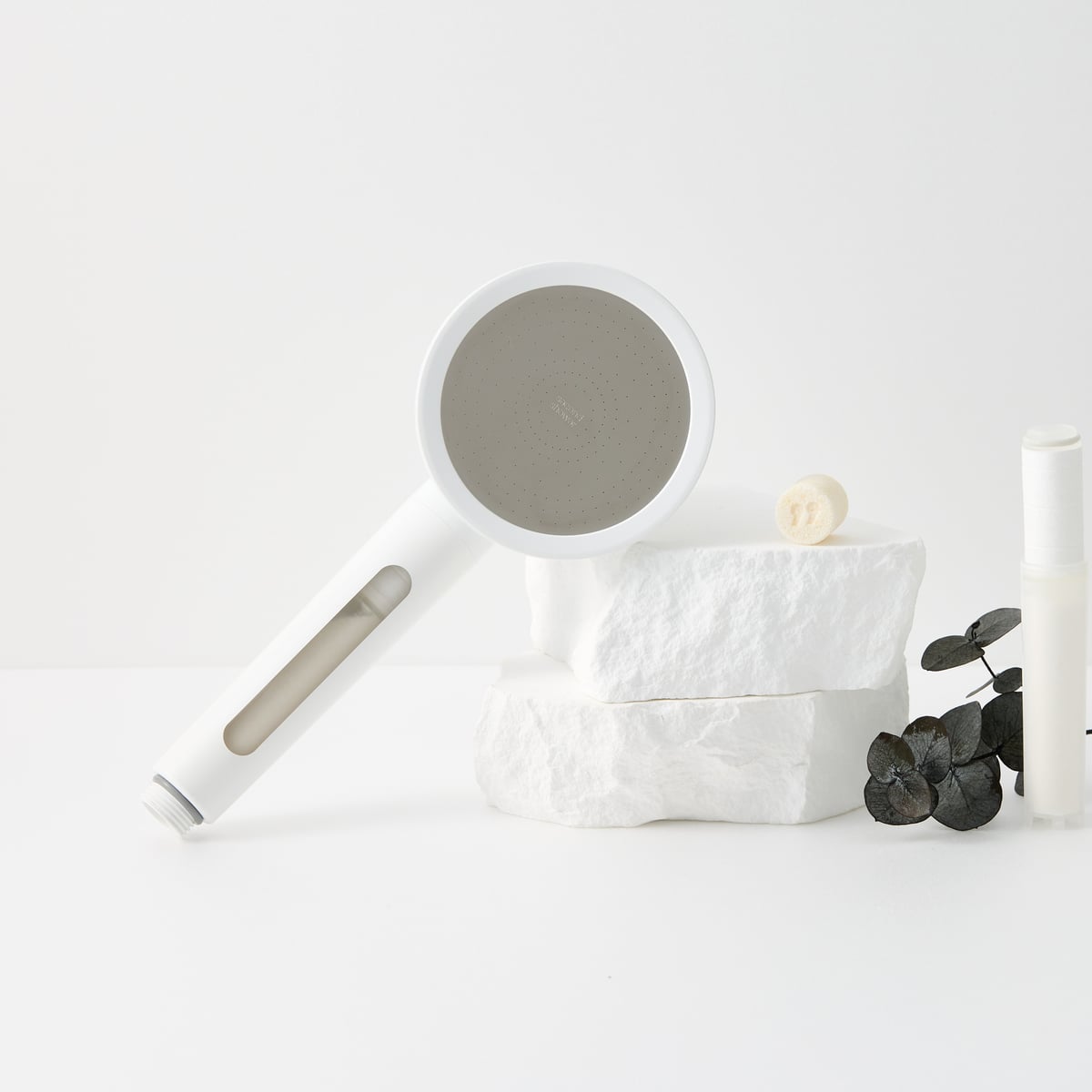
Second Shower Filtered Shower Head
For parents dealing with a toddler's eczema, Second Shower offers something most bath filters cannot: NSF-certified filtration that has been independently verified to remove 99.9% (during the cartridge's peak performance window, Day 1–60) of chlorine and heavy metals. Because it is a full shower filter (not a small bath ball), it holds significantly more filtration media, which translates to more consistent performance even at higher flow rates.
What sets it apart for eczema-prone kids is the vitamin infusion system. Each filter releases Vitamin C, E, B3 (Niacinamide), B5, and B7 (Biotin) into the water. Vitamin C is well-documented for neutralizing chlorine on contact, while Niacinamide supports skin barrier repair. To use it for bath time, attach the handheld model (THE SECOND SHOWERHAND) to your tub faucet with a standard adapter. It installs in under five minutes with no tools, making it completely renter-friendly.
- Vitamin infusion (C, E, B3, B5, B7) actively supports eczema-prone skin during bath time
- NSF-certified 99.9% (during the cartridge's peak performance window, Day 1–60) chlorine and heavy metal removal
- Larger filtration media than any bath ball filter for more reliable performance
- 128 micro-holes maintain water pressure even with filter attached
- Renter-friendly installation in 3-5 minutes, no tools needed
- Requires a tub faucet adapter to use for baths (not a direct tub-faucet attachment)
- Filter cartridge needs replacement every 1-2 months depending on water quality
Santevia Bath Filter
In independent testing by Water Filter Guru, the Santevia was the only bath filter that reduced chlorine to 0 PPM at a normal fast faucet flow. It uses a proprietary filtration media and adds magnesium and zinc to the water, which can help nourish skin. The trade-off: it increases water hardness due to the added minerals, and its flow rate (0.36 GPM) is noticeably slower than other bath filters. The entire unit needs replacement every 2-3 months.
Canopy Baby Bath Filter
Designed specifically for baby bath time, the Canopy filter doubles as a silicone spout cover with a built-in temperature indicator. It uses KDF, activated carbon, and calcium sulfite for filtration. In a consumer study, 83% of parents noticed less dry and flaky skin on their child, and 88% said their child's skin felt softer. It is BPA-free, dishwasher-safe, and installs without tools. However, like most bath filters, its small media capacity means performance drops at higher flow rates.
Kinder Filter
Created by two mothers who struggled with their babies' sensitive skin, the Kinder Filter is clinically tested to remove 99% of impurities while enriching water with minerals and vitamin C. It uses KDF 55, alkaline ceramic balls, activated carbon, and calcium sulfite. The standout feature is its long filter life of 8-12 months. Keep in mind that "clinically tested" is not the same as third-party certified, and independent lab data is limited. Still, parent reviews consistently report improvements in eczema symptoms.
The Vitamin C Bath Hack (Budget Option)
If you are not ready to invest in a filter, there is a simple and inexpensive alternative. Adding approximately 1,000 mg of ascorbic acid (vitamin C) powder to a full bathtub neutralizes chlorine on contact. According to the U.S. Forest Service, vitamin C effectively dechlorinates water through a straightforward chemical reaction.
Add the powder 2-5 minutes before putting your toddler in the tub. It is non-toxic, safe for babies, and costs just a few cents per bath. Sodium ascorbate is a good option if you want to avoid lowering the water's pH.
The limitation: vitamin C only neutralizes chlorine and chloramine. It does not filter out heavy metals, sediment, or other contaminants. For comprehensive protection, a filter is the better long-term investment. But as a quick fix, especially while traveling or visiting family, it works.
Run the filtered water (or vitamin C-treated water) on the cooler side of warm. Hot water opens pores and strips natural oils faster, which makes eczema worse. Pediatric dermatologists recommend lukewarm baths of 10 minutes or less for eczema-prone toddlers, followed by moisturizer applied within 3 minutes of toweling off.
Practical Bath Time Tips for Toddlers With Eczema
A filter addresses water quality, but the full bath routine matters too. Here is what dermatologists recommend for kids who get rashes after baths:
- Keep baths short: 5-10 minutes max. Longer soaks dry out eczema-prone skin, even in filtered water.
- Skip the soap (mostly): Use a fragrance-free, soap-free cleanser only where needed. Soap strips the skin barrier.
- Pat, do not rub: Gently pat skin dry with a soft towel. Rubbing creates friction that irritates inflamed skin.
- Moisturize immediately: Apply a thick, fragrance-free moisturizer or ointment within 3 minutes of getting out. This locks in hydration before it evaporates.
- Test your water: A basic chlorine test kit (the same ones used for pools) costs under $10 and shows you exactly what your child is bathing in. Test before and after filtering to see the difference.
Renter-Friendly Options
If you rent, permanent plumbing changes are off the table. The good news is that every option discussed here works for renters:
- Bath filters (Santevia, Canopy, Kinder) attach to the faucet with straps or silicone. No tools, no modifications.
- Shower filter on tub faucet: A diverter adapter connects a filtered shower head like Second Shower to your tub spout. It unscrews in seconds when you move out.
- Vitamin C powder: No installation at all. Just add to the tub.
For renters who want the strongest filtration without any permanent changes, the shower filter approach gives you the most filtration media per dollar and removes cleanly when your lease is up.
When to See a Doctor
A water filter can reduce one trigger, but eczema is a multi-factor condition. If your toddler's eczema is severe, spreading, or showing signs of infection (oozing, crusting, fever), see your pediatrician or a pediatric dermatologist. Filtered water is one piece of the puzzle alongside medical treatment, moisturizing routines, and identifying other triggers like food sensitivities or environmental allergens.
Be cautious of any product (filter or otherwise) that promises to "cure" eczema. No filter eliminates eczema. What filtration does is remove known irritants from the water, giving your child's skin a better environment to heal in.
FAQ
Do bath water filters actually help toddler eczema?
They can make a meaningful difference by removing chlorine, which strips natural oils and irritates the skin barrier. A 2016 King's College London study found that hard water and chlorine exposure was associated with up to 87% higher eczema risk in infants. However, filters address one trigger among several. They work best as part of a broader eczema management routine that includes short baths, gentle cleansers, and immediate moisturizing.
Is a shower filter better than a bath filter for my toddler's bath?
In most cases, yes. Shower filters hold more filtration media and handle flow rates more effectively than small bath ball filters. Bath water flows roughly twice as fast as shower water, which means compact bath filters often cannot remove contaminants as thoroughly. Attaching a shower filter to your tub faucet with a diverter adapter gives you stronger, more reliable filtration for bath time.
Is vitamin C safe to add to my toddler's bath water?
Yes. Vitamin C (ascorbic acid or sodium ascorbate) is non-toxic and safe for babies and toddlers. About 1,000 mg neutralizes the chlorine in a standard bathtub. Add it 2-5 minutes before bath time. It only removes chlorine and chloramine though, not heavy metals or other contaminants, so it is not a complete substitute for a filter.
How often do I need to replace a bath or shower filter?
It depends on the product and your water quality. Dedicated bath filters like the Santevia need full replacement every 2-3 months. The Kinder Filter lasts 8-12 months. Shower filter cartridges like Second Shower's are replaced every 1-2 months. Harder water and higher chlorine levels shorten filter life. If you notice the chlorine smell returning or your toddler's skin getting more irritated, it is time to swap the filter.
Can a water filter cure my child's eczema?
No. Eczema is a chronic condition influenced by genetics, immune response, and multiple environmental triggers. A water filter removes chlorine and certain contaminants that can worsen eczema symptoms, but it does not cure the underlying condition. Think of it as reducing one known irritant so your child's skin has a better chance to stay calm and heal between flare-ups. Always work with your pediatrician for a comprehensive treatment plan.



Leave a comment
All comments are moderated before being published.
This site is protected by hCaptcha and the hCaptcha Privacy Policy and Terms of Service apply.