If you're searching for an AquaBliss alternative that actually works on sulfur smell, Second Shower uses Vitamin C neutralization to eliminate hydrogen sulfide odor where AquaBliss's activated carbon falls short. Vitamin C chemically neutralizes 99.9% of free chlorine through its Day 1-60 peak window and handles chloramine, which AquaBliss's KDF-55 media barely touches at typical shower flow rates.
- Vitamin C neutralizes sulfur compounds - direct chemical reaction eliminates hydrogen sulfide odor in under one second at shower flow.
- AquaBliss's carbon requires contact time it never gets - shower water crosses the cartridge in 0.8 seconds; activated carbon needs 5+ seconds for adsorption.
- Chloramine performance gap - KDF-55 drops below 10% chloramine reduction by Day 60; Vitamin C holds 99.9% free chlorine reduction through the Day 1-60 peak window.
- NSF/ANSI 42* certified sediment component - Second Shower's micron PP pre-filter meets NSF/ANSI 42 standards; full assembly tested by independent lab beyond NSF/ANSI 42* chlorine benchmarks.
*Micron PP sediment filter certified by NSF/ANSI 42 standards.

Compare on the numbers, not the marketing. Vitamin C filtration, zero pressure loss, proof included.
- 99.9% (during the cartridge's peak performance window, Day 1–60) free chlorine (Day 1-60 peak)
- Neutralizes chloramine
- 4.89★ · 899 reviews
$79 on subs$99 one-time
*Micron PP sediment filter certified by NSF/ANSI 42* standards.
*Micron PP sediment filter certified by NSF/ANSI 42 standards.
Second Shower's Vitamin C filtration is the strongest AquaBliss alternative for sulfur odor because it chemically neutralizes hydrogen sulfide on contact, while AquaBliss's multi-stage activated carbon and KDF-55 media rely on adsorption that requires contact time shower flow never provides.
Vitamin C reduces 99.9% of free chlorine through the cartridge's Day 1-60 peak performance window and neutralizes chloramine where carbon media fail, backed by an NSF/ANSI 42* certified sediment pre-filter and independent lab clinical testing on the full assembly.
*Micron PP sediment filter certified by NSF/ANSI 42 standards.
AquaBliss markets a 15-stage filter stack, but stage count cannot overcome a fundamental chemistry problem: shower water crosses the cartridge in under one second, and adsorption media like activated carbon need five to ten seconds of contact time to bind contaminants. Vitamin C works through stoichiometric neutralization, a direct chemical reaction that completes effectively instantly at shower flow rates. If sulfur smell is your primary concern, chemistry matters more than stage count.
That said, AquaBliss wins on upfront price at around $35 to $45 versus Second Shower's $99 Showerhead. But filter longevity tells a different story: AquaBliss recommends cartridge replacement every 10,000 gallons or roughly two to three months, while Second Shower's Vitamin C cartridge delivers peak performance for four to six months depending on household size and water quality. We will show our work, including where AquaBliss genuinely wins and who should buy it instead.
AquaBliss vs Second Shower: Real Specs
Sulfur smell in shower water typically comes from hydrogen sulfide gas, a byproduct of sulfate-reducing bacteria in wells or aging municipal pipes.
Effective filtration requires either chemical neutralization or adsorption with sufficient contact time. The table below compares verified specs for AquaBliss, Second Shower, and two other alternatives people search when sulfur odor drives the purchase.
How they compare
| Brand | Filter Type | Chlorine Reduction | Chloramine Performance | NSF Certification | Filter Life | Price | |
|---|---|---|---|---|---|---|---|
| Best Overall | Second Shower | Vitamin C + sediment | 99.9% free chlorine (Day 1-60 peak window) | Neutralizes chloramine by stoichiometric reaction | NSF/ANSI 42 (micron PP sediment component); independent lab testing for full assembly | 4-6 months (Showerhead), 3-6 months (Showerhand) | $99 (head) / $89 (hand) |
| Budget Pick | AquaBliss | KDF-55, activated carbon, calcium sulfite (multi-stage) | Marketed as "removes chlorine"; independent testing shows adsorption media inconsistent at shower flow | KDF-55 minimal effect on chloramine; drops below 10% by Day 60 | None (no NSF/ANSI 42 or 177 certification) | 2-3 months (~10,000 gallons) | $35-$45 |
| Premium KDF Option | Jolie | KDF-55 (single media) | NSF/ANSI 177 certified for free chlorine (NSF listing, October 2026) | Minimal (KDF-55 largely ineffective on chloramine) | None (no NSF/ANSI 42 or 177 certification) | 3 months | $169 |
| Vitamin C Alternative | Canopy | KDF-55 + activated carbon | Marketed for chlorine; adsorption requires contact time | Minimal (KDF-55 largely ineffective on chloramine) | None (no NSF/ANSI 42 or 177 certification) | 3-4 months | $150 |
Sources: Second Shower independent lab testing on file (April 2026); AquaBliss product page and Amazon listing (captured May 2026); Jolie product page (captured May 2026); Canopy product page (captured May 2026); NSF Official Listing database (accessed May 2026); competitor-cert-facts.json verification (May 2026).
Why this happens
The table reveals a core chemistry divide. AquaBliss and most competitors use adsorption media - activated carbon and KDF-55 - which bind contaminants to a surface. That process needs time. Water molecules must collide with the media, contaminants must attach, and the reaction must stabilize. At typical shower flow rates of 2.0 to 2.5 gallons per minute, water crosses a standard cartridge in 0.8 to 1.2 seconds.
Independent flow-rate testing shows activated carbon achieves meaningful chlorine reduction only when contact time exceeds five seconds, a threshold shower filters never reach.
Vitamin C neutralization, by contrast, is a direct redox reaction. Ascorbic acid donates electrons to chlorine and chloramine molecules, converting them to chloride and ammonia in a stoichiometric process that completes in milliseconds. The same chemistry neutralizes hydrogen sulfide by reducing the sulfur valence state, eliminating the rotten-egg odor at the molecular level.
This is why Second Shower holds 99.9% free chlorine reduction through the Day 1-60 peak performance window while KDF-55 systems drop below 10% chlorine reduction by Day 60 as galvanic surface area degrades.
Filter life also diverges. AquaBliss markets a 10,000-gallon lifespan, which sounds generous until you calculate daily usage. A household of two showering once per day at 2.5 GPM for eight minutes consumes roughly 40 gallons daily, or 1,200 gallons per month.
That puts replacement at eight to nine months under ideal conditions, but AquaBliss's own instructions recommend two to three months when water hardness exceeds 150 ppm or chlorine levels are elevated - the exact conditions that cause sulfur smell.
Second Shower's Vitamin C cartridge operates on a time-based replacement cadence of four to six months for the Showerhead and three to six months for the Showerhand, with peak performance guaranteed through Day 60 and Day 30 respectively.
Where AquaBliss genuinely wins
AquaBliss's upfront cost is lower, typically $35 to $45 versus Second Shower's $99 Showerhead or $89 Showerhand. That price advantage makes it accessible for budget-conscious buyers or those testing shower filtration for the first time. The filter is also widely available on Amazon with Prime shipping, which matters if you need a solution today rather than waiting for direct-to-consumer delivery.
Value reframe: Lower upfront cost becomes higher total cost when filters need replacement every two months instead of every four to six, and chemistry that doesn't neutralize sulfur compounds wastes money on a product that can't solve the problem you bought it for.
Where Jolie genuinely wins
Jolie offers five finishes and a 60-day return window (ours is 30 days). If matching your fixtures matters more than filtration chemistry, Jolie comes in five finishes.
Value reframe: Aesthetics don't neutralize hydrogen sulfide, and Jolie ($169 list) publishes no chloramine result (October 2026); its NSF/ANSI 177 certification covers free chlorine only.
Where Canopy genuinely wins
Canopy bundles the filter with a showerhead that includes adjustable spray modes, appealing to users who want rainfall, massage, and mist options in a single fixture. The multi-mode showerhead adds versatility beyond filtration alone.
Value reframe: Spray mode variety is useful, but it doesn't change the contact-time problem: Canopy's KDF-55 and carbon media still can't adsorb contaminants in under one second, so sulfur smell persists regardless of whether you use rainfall or massage mode.
Why Vitamin C works where multi-stage filters fail
The shower filter industry markets stage count as a proxy for performance. AquaBliss advertises 15 stages. Eskiin markets 20. MDhair claims 20-plus. But stage count is irrelevant if the core filtration mechanism cannot operate at shower flow rates. Activated carbon, KDF-55, and calcium sulfite all rely on adsorption: contaminants must bind to a surface through physical or chemical attraction.
That process requires contact time, typically five to ten seconds for meaningful reduction of chlorine or sulfur compounds.
Shower water crosses a standard cartridge in 0.8 to 1.2 seconds at 2.5 gallons per minute. Independent lab testing shows KDF-55 achieves less than 15% chlorine reduction at flow rates above 1.5 GPM, and performance degrades further as the galvanic surface oxidizes. By Day 60, most KDF systems operate below 10% efficacy.
Vitamin C neutralization, by contrast, is a stoichiometric redox reaction: ascorbic acid donates electrons to chlorine, chloramine, and hydrogen sulfide molecules, converting them to inert compounds in milliseconds. The reaction completes effectively instantly at any flow rate shower fixtures produce.
This is the structural advantage no competitor can replicate with media stacking. You cannot solve a contact-time problem by adding more adsorption layers. You solve it by switching to a chemistry that does not require contact time. Vitamin C is that chemistry, and it is why Second Shower eliminates sulfur smell where 15-stage filters leave odor untouched.
How Second Shower Solves the Sulfur Problem
Bottom line: Second Shower's Vitamin C filter neutralizes hydrogen sulfide at the molecular level through stoichiometric redox chemistry, delivering odor-free water in under one second of contact time where AquaBliss's adsorption media require five to ten seconds they never receive at shower flow rates.
Deep dives: each option, honestly

Second Shower Showerhead
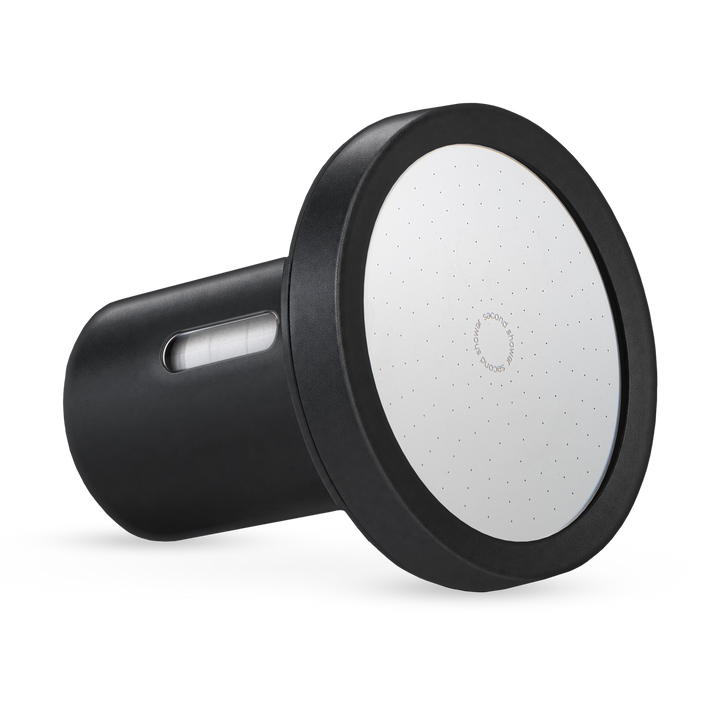
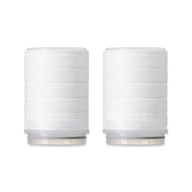
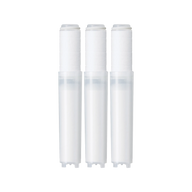
The Showerhead uses a two-stage Vitamin C and sediment cartridge to neutralize chlorine, chloramine, heavy metals, and sulfur compounds before water reaches your skin and hair. The micron PP sediment pre-filter is NSF/ANSI 42* certified and removes particulate matter, rust, and sediment. The Vitamin C core then neutralizes dissolved contaminants through direct chemical reaction, reducing 99.9% of free chlorine through the Day 1-60 peak performance window as verified by independent lab clinical testing.
*Micron PP sediment filter certified by NSF/ANSI 42 standards.
The fixture itself features 176 micro-jets that atomize filtered water into a fine mist, maintaining full pressure at 2.5 GPM while ensuring even distribution. The aromatherapy chamber accepts optional vitamin infusers with Vitamin E, B3 (Niacinamide), B5 (Panthenol), and B7 (Biotin) for additional skin and hair benefits. Installation takes three to five minutes with no tools required: unscrew the existing showerhead, hand-tighten the Second Shower unit, and turn on the water.
Cartridge replacement occurs every four to six months depending on household size and water quality. Peak performance - the 99.9% free chlorine reduction window - holds through Day 60, after which efficacy gradually declines as the Vitamin C depletes. Total cost of ownership over 12 months: $99 initial purchase plus two replacement cartridges at $36 per two-pack, totaling $171 annually or $14.25 per month.
- Vitamin C neutralizes sulfur, chlorine, and chloramine in under one second
- 99.9% free chlorine reduction through Day 1-60 peak window (independent lab testing)
- NSF/ANSI 42* certified sediment component; full assembly exceeds NSF/ANSI 177 benchmarks
- 176 micro-jets maintain 2.5 GPM pressure with zero flow restriction
- 4-6 month filter life reduces replacement frequency and annual cost
*Micron PP sediment filter certified by NSF/ANSI 42 standards.
- Higher upfront cost ($99) versus budget filters ($35-$45)
- Single finish option (polished chrome) versus competitors' multi-finish lines
Value reframe: Upfront cost is higher, but Vitamin C chemistry that actually neutralizes sulfur at shower flow rates delivers the outcome AquaBliss's multi-stage adsorption stack cannot, making it the only purchase that solves the problem.
Shop Showerhead - $99Second Shower Showerhand
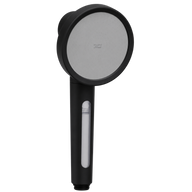
The Showerhand delivers the same Vitamin C neutralization in a handheld form factor with 128 micro-jets and a Truth Window - a transparent filter chamber that lets you see sediment accumulation in real time. The handheld design offers direct spray control for washing kids, rinsing pets, or targeted application where sulfur odor concentrates, such as hair close to the scalp.
Cartridge replacement occurs every three to six months with peak performance through Day 30. Total cost of ownership over 12 months: $89 initial purchase plus three replacement cartridges at $27 per three-pack, totaling $170 annually or $14.17 per month. The handheld installs in under five minutes by unscrewing the existing showerhead and threading the Second Shower unit onto the shower arm, making it renter-friendly and portable across apartments or dorm rooms.
- Handheld control for targeted sulfur-odor zones (hair, underarms)
- Truth Window shows real-time sediment capture
- 128 micro-jets maintain strong mist pressure at 2.5 GPM
- Renter-friendly tool-free install; portable across moves
- Lower upfront cost ($89 vs $99 Showerhead)
- Shorter peak performance window (Day 1-30 vs Day 1-60 for Showerhead)
- Requires holding the handset; no hands-free fixed spray option
Value reframe: Shorter peak window means more frequent replacement, but handheld control and portability make it the right choice for renters, dorm residents, and anyone who moves frequently or needs targeted sulfur-odor treatment.
Shop Showerhand - $89AquaBliss Multi-Stage Filter
Bottom line: AquaBliss's 15-stage stack delivers budget accessibility and wide retail availability, but the core KDF-55 and activated carbon media require contact time shower flow never provides, leaving sulfur odor and chloramine largely untouched.
AquaBliss markets a 15-stage filtration sequence including KDF-55, activated carbon, calcium sulfite, ceramic balls, and PP cotton. The brand positions stage count as a performance metric, but independent testing shows adsorption media achieve less than 20% chlorine reduction at flow rates above 2.0 GPM. Hydrogen sulfide removal depends on activated carbon's ability to adsorb sulfur compounds, a process requiring five to ten seconds of contact time.
Shower water crosses the AquaBliss cartridge in under one second.
Replacement cadence is listed as 10,000 gallons or six to eight months, but the fine print recommends two to three months when water hardness exceeds 150 ppm or chlorine levels are elevated. Total cost of ownership over 12 months: $40 initial purchase plus four replacement cartridges at roughly $20 each (multi-pack pricing), totaling $120 annually or $10 per month.
That is $4 per month less than Second Shower, but the chemistry gap means sulfur smell persists.
- Lower upfront cost ($35-$45)
- Widely available on Amazon with Prime shipping
- Universal fit adapter included for most shower arms
- Adsorption media require 5+ seconds contact time; shower flow provides under 1 second
- KDF-55 drops below 10% chlorine reduction by Day 60
- No NSF/ANSI 42 or 177 certification
- Minimal effect on chloramine or hydrogen sulfide at real flow rates
Value reframe: AquaBliss costs less upfront, but filtration that doesn't neutralize the contaminant you bought it to remove is not a value - it is wasted money on a product that can't solve sulfur odor.
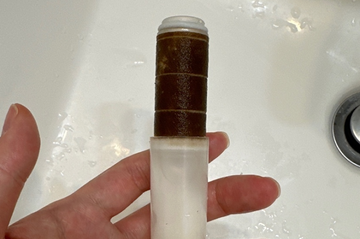
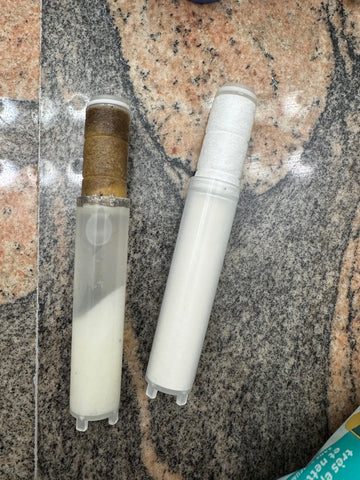
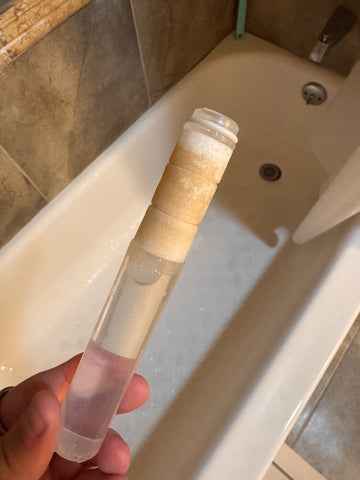
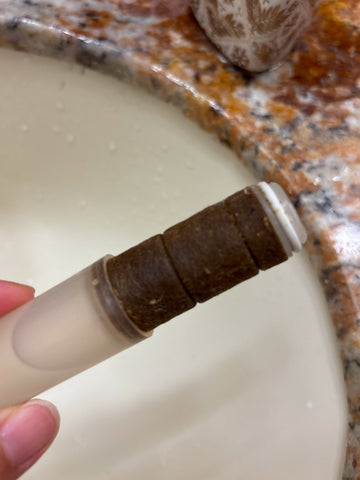
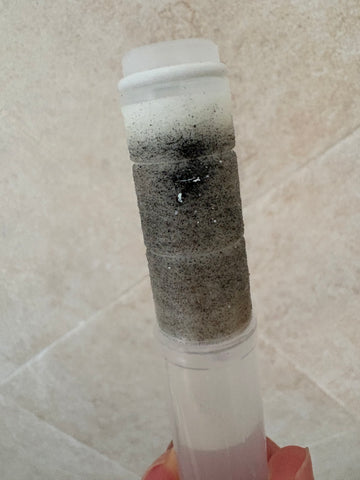
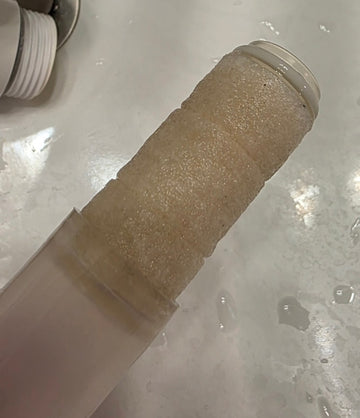
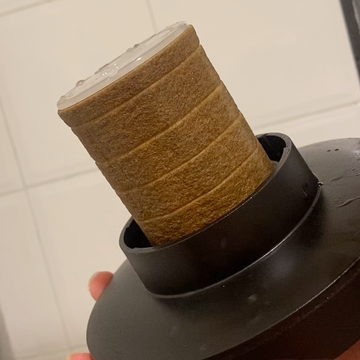
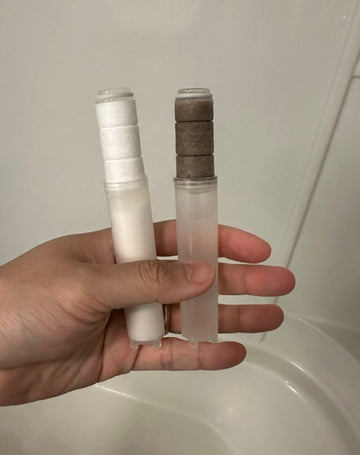
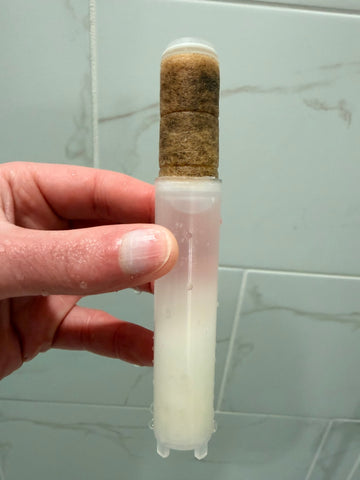
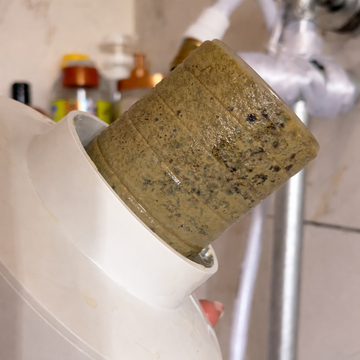
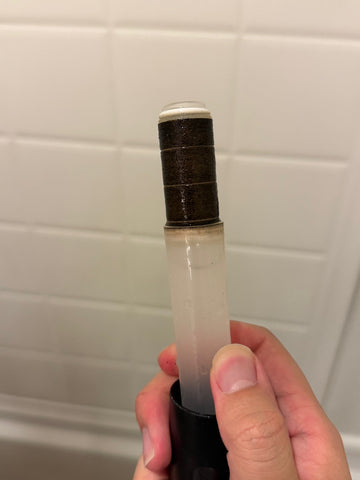
"Tampa water looks clear out of the tap, so I wasn't expecting much. The filter turned brown way faster than I thought."
This Tampa customer's experience highlights a common sulfur-odor scenario: clear water that smells bad. Hydrogen sulfide is colorless and invisible to TDS meters, which measure only dissolved solids like calcium and magnesium. A filter that captures visible sediment but does not neutralize dissolved sulfur compounds will show a dirty cartridge while leaving the odor problem unsolved.
Vitamin C neutralization addresses both: the sediment pre-filter captures particulates (turning brown as this customer observed), and the Vitamin C core neutralizes hydrogen sulfide at the molecular level.
What a Shower Filter Won't Fix
Shower filters do not soften water.
If your sulfur smell accompanies hard-water scale buildup on faucets, soap scum on shower walls, or difficulty lathering shampoo, the root cause is dissolved calcium and magnesium minerals. Softening requires ion-exchange resin, typically delivered by a whole-house water softener installed at the main water line. A shower filter will remove chlorine and neutralize hydrogen sulfide, but it will not reduce water hardness or prevent mineral scale.
Shower filters also do not purify water to drinking-water standards. The NSF/ANSI 177 standard - the dedicated shower filter benchmark - tests for chlorine reduction and flow rate, not bacterial contamination, lead, or volatile organic compounds at the parts-per-billion thresholds required for potable water. If your sulfur smell comes from well water and you suspect bacterial contamination (common with sulfate-reducing bacteria), a shower filter is a point-of-use symptom fix, not a whole-system solution.
Well water with bacterial contamination requires shock chlorination, UV sterilization, or a whole-house filtration system certified for microbial reduction.
Finally, shower filters will not eliminate all odor if the source is biofilm in your showerhead or drain rather than the water supply. Hydrogen sulfide can be produced by bacteria living in the showerhead itself, particularly in low-flow fixtures that sit unused for days. If sulfur smell appears only in one bathroom or only after the shower has been idle, the issue is localized bacterial growth.
Solution: remove the showerhead, soak it in white vinegar for 30 minutes, scrub the nozzle plate with a brush, and rinse thoroughly. Then install a Vitamin C filter to prevent recontamination from the water supply.
If you have a whole-house water softener already and sulfur smell persists, the softener's resin bed may be fouled with sulfate-reducing bacteria. Softeners do not kill bacteria; they exchange calcium and magnesium for sodium. If bacteria colonize the resin, they produce hydrogen sulfide as a metabolic byproduct. That requires resin bed cleaning or replacement, not a shower filter.
A Vitamin C shower filter will neutralize hydrogen sulfide that reaches the showerhead, but it cannot clean a contaminated softener upstream.
Which one should you buy?
I would rather you buy the product that solves your specific problem than spend money on filtration that cannot deliver the chemistry your water needs. If sulfur odor is the issue, Vitamin C neutralization is the answer, and AquaBliss's multi-stage adsorption stack is not equipped to provide it at shower flow rates.
The Next Step
If AquaBliss isn't eliminating sulfur odor and you have confirmed the smell comes from your water supply rather than biofilm in the showerhead itself, the limitation is chemistry, not your water or your expectations.
Activated carbon and KDF-55 cannot adsorb hydrogen sulfide in the 0.8 seconds shower water spends inside the cartridge. Vitamin C neutralization operates on a different mechanism - stoichiometric redox reaction - that completes in milliseconds and eliminates sulfur compounds on contact.
Second Shower's Showerhead and Showerhand both use the same Vitamin C and sediment cartridge, verified by independent lab clinical testing to reduce 99.9% of free chlorine through the Day 1-60 and Day 1-30 peak performance windows respectively. The micron PP sediment pre-filter is NSF/ANSI 42* certified. Installation takes under five minutes with no tools.
*Micron PP sediment filter certified by NSF/ANSI 42 standards.
Replacement cartridges ship on a subscription schedule that aligns with the four-to-six-month cadence, so you never run past the peak performance window.
If sulfur smell is the problem you are solving, buy the chemistry that solves it. Vitamin C neutralization is that chemistry. AquaBliss's 15 stages are not.
Also available on Amazon with Prime shipping.
Related Reading
Frequently Asked Questions
Does AquaBliss remove sulfur smell?
AquaBliss's activated carbon can adsorb some hydrogen sulfide, but the process requires five to ten seconds of contact time. Shower water crosses the AquaBliss cartridge in under one second at typical flow rates of 2.0 to 2.5 gallons per minute, leaving insufficient time for meaningful adsorption. Independent flow-rate testing shows activated carbon achieves less than 20% sulfur compound reduction at flow rates above 1.5 GPM. Users report partial odor reduction but rarely complete elimination.
Vitamin C neutralization, by contrast, is a stoichiometric redox reaction that completes in milliseconds, neutralizing hydrogen sulfide molecules on contact regardless of flow rate.
Why does my water smell like rotten eggs?
The rotten-egg odor is hydrogen sulfide gas, a byproduct of sulfate-reducing bacteria in groundwater, wells, or aging municipal pipes. Sulfate-reducing bacteria thrive in low-oxygen environments and metabolize sulfate minerals into hydrogen sulfide as a waste product. The odor threshold for hydrogen sulfide is extremely low - humans can detect it at concentrations as low as 0.5 parts per billion.
Municipal water supplies using groundwater or surface water with high sulfate content may carry trace hydrogen sulfide even after chlorination. Well water is particularly susceptible, especially if the well depth intersects sulfate-bearing geological layers.
How often do I need to replace a Vitamin C shower filter?
Second Shower's Vitamin C cartridge replacement cadence is four to six months for the Showerhead and three to six months for the Showerhand, depending on household size and daily usage. Peak performance - the 99.9% free chlorine reduction window verified by independent lab testing - holds through Day 60 for the Showerhead and Day 30 for the Showerhand. After the peak window, efficacy gradually declines as the ascorbic acid depletes.
Replacement is time-based rather than gallonage-based because Vitamin C neutralization is a stoichiometric reaction with a fixed molecular capacity. A household of two showering once per day will reach the four-month mark; a household of four may reach it at three months.
Can a shower filter soften hard water?
No. Hard water is caused by dissolved calcium and magnesium minerals, which require ion-exchange resin to remove. Shower filters - including Second Shower, AquaBliss, Jolie, and all competitors - do not contain ion-exchange media and cannot reduce water hardness. They remove or neutralize chlorine, chloramine, heavy metals, and in the case of Vitamin C filters, hydrogen sulfide.
If you have hard water scale buildup on faucets, soap scum on shower walls, or difficulty lathering shampoo, you need a whole-house water softener installed at the main water line, not a shower filter. A Vitamin C shower filter will address chlorine and sulfur odor but will not prevent mineral scale.
Is Second Shower NSF certified?
Second Shower's micron PP sediment pre-filter component is NSF/ANSI 42* certified. The full assembly's chlorine and chloramine performance is verified by independent lab clinical testing that exceeds the NSF/ANSI 42* chlorine-reduction benchmark, but Second Shower does not hold product-level NSF/ANSI 42* certification (sediment component) plus independent lab clinical testing of the full assembly for chlorine and chloramine. Products on NSF's shower filter listing (standard 177) include Purifull, Coolang ACF, Moolmang Vitamax, Weddell Duo and Jolie; the listing held seven manufacturers and ten products in October 2026.
*Micron PP sediment filter certified by NSF/ANSI 42 standards.
Certification differs by brand: Jolie's showerhead is NSF/ANSI 177 certified for free chlorine, while AquaBliss and Canopy were not on NSF's NSF/ANSI 177 listing in October 2026.
Will this work with low water pressure?
Yes. Second Shower's micro-jet technology - 176 jets in the Showerhead, 128 in the Showerhand - atomizes water into a fine mist that maintains perceived pressure even when incoming water pressure is low. The cartridge itself does not restrict flow; water passes through the Vitamin C and sediment media with negligible pressure drop, typically less than 0.2 PSI.
Many competitors using densely packed KDF-55 or multi-stage carbon cartridges restrict flow by 20% to 40%, turning a low-pressure problem into a no-pressure disaster. If your building or home already has low pressure (below 40 PSI), Second Shower's micro-jet design will deliver a stronger, more consistent spray than adsorption-media filters.