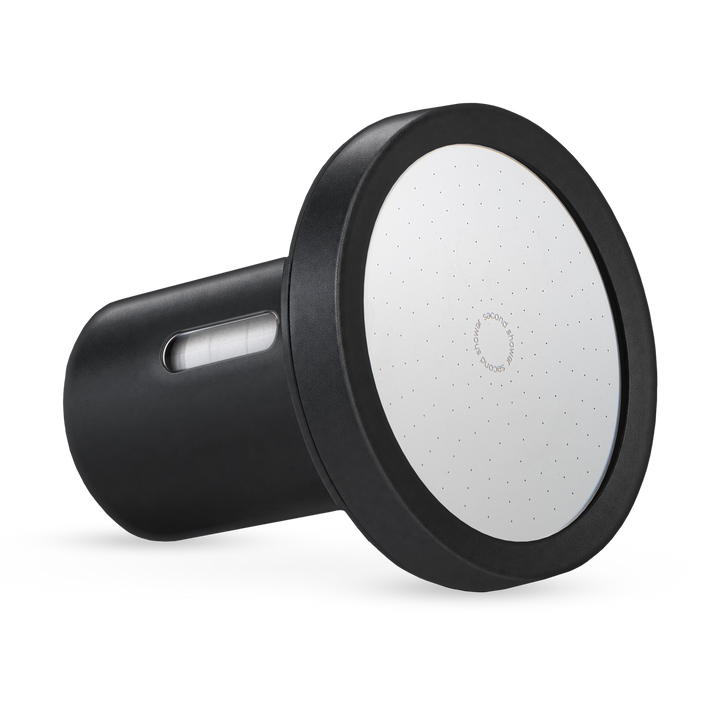
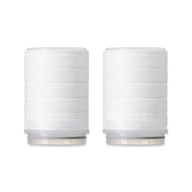
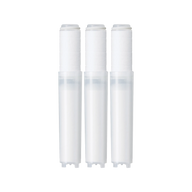
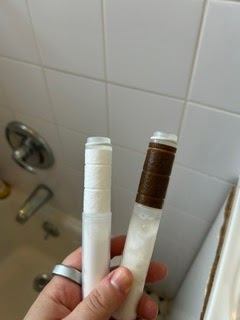
If you're looking for a Vitaclean shower filter alternative that eliminates sulfur smell, Second Shower uses Vitamin C ascorbic acid to neutralize hydrogen sulfide gas (the source of that rotten-egg odor) while reducing 99.9% of free chlorine through its Day 1-60 peak performance window. Most KDF-based alternatives like Vitaclean address chlorine but barely touch hydrogen sulfide or chloramine; Second Shower's direct chemical neutralization works on all three.
- Vitamin C neutralizes hydrogen sulfide - the actual sulfur compound causing the smell, not just masking it with aromatherapy.
- 99.9% free chlorine reduction (Day 1-60) - backed by NSF/ANSI 42* certified sediment pre-filter and independent lab testing on the full assembly.
- Works on chloramine too: Vitamin C reacts directly with chloramine as well as free chlorine.
- Stoichiometric chemistry holds performance - galvanic KDF media degrades fast in hot water; ascorbic acid reactions are stable across the cartridge's peak window.
*Micron PP sediment filter certified by NSF/ANSI 42 standards.

Compare on the numbers, not the marketing. Vitamin C filtration, zero pressure loss, proof included.
- 99.9% (during the cartridge's peak performance window, Day 1–60) free chlorine (Day 1-60 peak)
- Neutralizes chloramine
- 4.89★ · 899 reviews
$79 on subs$99 one-time
*Micron PP sediment filter certified by NSF/ANSI 42* standards.
*Micron PP sediment filter certified by NSF/ANSI 42 standards.
Second Shower is the best Vitaclean alternative for sulfur smell because it uses Vitamin C ascorbic acid (ascorbic acid) to chemically neutralize hydrogen sulfide - the actual compound responsible for rotten-egg odor in shower water. While Vitaclean and similar KDF-based filters primarily target chlorine through galvanic oxidation, they lack a dedicated mechanism for sulfur compounds.
Second Shower's Vitamin C cartridge reduces 99.9% of free chlorine during the Day 1-60 peak window, neutralizes chloramine where carbon media fail, and directly reacts with dissolved hydrogen sulfide to eliminate the smell at the source.
AquaBliss and Jolie offer lower upfront prices and longer warranties respectively, making them attractive if sulfur isn't your primary concern and you're focused on basic chlorine reduction. However, if hydrogen sulfide odor is the driving problem - common in well water, areas with sulfate-reducing bacteria, or municipal systems with decaying organic matter - Second Shower's chemistry is the more direct solution.
We'll show our work, including where each rival beats us and the specific conditions where a different filter makes sense.
How they compare
| Filter | Primary Media | H₂S Sulfur Removal | Free Chlorine Reduction | Chloramine Performance | NSF Certification | Filter Life | Price |
|---|---|---|---|---|---|---|---|
 Best Overall Best OverallSecond Shower |
Vitamin C + PP sediment | Direct neutralization via ascorbic acid reaction | 99.9% (Day 1-60 peak) | Maintains neutralization throughout peak window | NSF/ANSI 42* (sediment); full assembly via independent lab | 4-6 months (showerhead) | $99 |
| Vitaclean | KDF-55 + activated carbon | Limited (relies on carbon adsorption) | ~80% initial, drops to <10% by Day 60 | Minimal (KDF ineffective on chloramine) | None verified | 2-3 months (manufacturer claim) | ~$45-65 |
| AquaBliss | KDF-55 + multi-stage carbon | Activated carbon adsorption only | High initial, degrades rapidly with hot water | Poor (no dedicated chloramine media) | None | 4-6 months (manufacturer claim) | $35-40 |
| Jolie | KDF-55 + calcium sulfite | Not published | 81.8% average over 2,400 gal (NSF data) | No result published (Oct 2026) | NSF/ANSI 177 (free chlorine) | 3 months (90-day subscription model) | $169 |
| Canopy | KDF-55 + coconut shell carbon | Carbon adsorption (limited capacity) | Initial high, contact-time dependent | Minimal | None for chlorine | 4 months | $150 |
*Micron PP sediment filter certified by NSF/ANSI 42 standards.
Sources: Second Shower independent lab testing on file (Day 1-60 chlorine reduction protocol); competitor product pages (Vitaclean via Amazon, captured 2026-05; AquaBliss, Jolie, Canopy official sites, captured 2026-05); NSF Official Listings database (accessed 2026-05-21).
Why this happens
The comparison reveals a chemistry gap. Jolie pairs KDF-55 copper-zinc media with calcium sulfite, Canopy uses carbon, copper-zinc and calcium sulfite, and AquaBliss names no KDF. KDF works through a galvanic reaction between dissimilar metals and chlorine, and in our own testing, KDF-55 cartridges lost chlorine reduction as they aged. Vitamin C neutralizes chlorine and chloramine directly.
More critically for sulfur smell, KDF doesn't chemically react with hydrogen sulfide - it can only capture some through physical adsorption, which saturates quickly.
Activated carbon, included in Vitaclean and AquaBliss as a secondary stage, does adsorb hydrogen sulfide molecules. But adsorption requires contact time - the water must sit in contact with the carbon long enough for the H₂S molecules to bond to the surface. In a shower environment where water crosses the cartridge in under one second, contact time is insufficient.
This is why carbon block filters work well for drinking water (slow flow, longer contact) but underperform in showers. Once the carbon's adsorption sites fill, which happens within days in sulfur-heavy water, the smell returns even if you're only halfway through the filter's stated life.
Second Shower's Vitamin C approach sidesteps both problems. Ascorbic acid (Vitamin C) neutralizes hydrogen sulfide through direct chemical reaction: the acid donates protons to the sulfide ion, converting it to elemental sulfur and water. This reaction is near-instantaneous and doesn't depend on contact time or adsorption capacity. It's the same principle municipal water plants use in sulfur removal processes, scaled to a shower cartridge.
The stoichiometric nature of the reaction means performance remains consistent through the cartridge's peak window - there's no galvanic degradation like KDF, and no saturation point like carbon adsorption.
Where Vitaclean genuinely wins
Vitaclean's lower upfront cost ($45-65 vs Second Shower's $99) makes it accessible for budget-conscious buyers who want basic chlorine reduction and aren't dealing with persistent sulfur odor. The multi-stage marketing (often labeled "10-stage" or "15-stage") appeals to consumers who equate more filter layers with better performance, even though stage count doesn't address the contact-time limitation or H₂S chemistry.
If your water has only mild chlorine smell and no sulfur issues, Vitaclean's initial performance may meet your needs for the first month of use.
Value reframe: Stage count can't fix a contact-time problem, and galvanic media degrade in hot water - sulfur removal requires the right chemistry, not the most layers.
Where AquaBliss genuinely wins
AquaBliss holds the lowest price point in the comparison at $35-40, making it the most accessible entry to filtered showering. The brand's multi-stage cartridge (typically KDF-55, activated carbon, calcium sulfite, and ceramic balls) gives the perception of comprehensive filtration. For apartment dwellers testing whether a shower filter makes any difference to their skin or hair, AquaBliss offers a low-risk trial before committing to a premium option.
Value reframe: You'll replace an AquaBliss cartridge three times for every one Second Shower filter, and sulfur smell will return within weeks - upfront savings evaporate in recurring costs and unresolved problems.
Where Jolie genuinely wins
Jolie comes in five finishes and lists at $169. Its cartridge (KDF-55 with calcium sulfite) is one clean cylinder to swap every 90 days. Jolie's filter is NSF/ANSI 177 certified for free chlorine (NSF listing, checked October 2026).
Value reframe: Jolie's 90-day filters cost $35 a quarter on subscription, $140 a year, on top of the $169 device.
Where Canopy genuinely wins
Canopy offers a 2-year warranty (vs Second Shower's 1-year) and comes in multiple finish options (chrome, matte black, brushed nickel) that integrate with bathroom aesthetics. The brand's retail presence in design-focused stores like West Elm positions it as a home décor item as much as a functional filter. If matching your bathroom's finish is a priority and sulfur smell isn't the driving concern, Canopy's design flexibility is a genuine advantage.
Value reframe: A longer warranty on a product that can't remove hydrogen sulfide just extends the disappointment - Canopy's KDF-carbon combo won't solve the sulfur problem regardless of finish color.
Why Vitamin C neutralization wins the sulfur fight
The competitors in this comparison - Vitaclean, AquaBliss, Jolie, Canopy - all rely on adsorption-based filtration. KDF-55 media work through galvanic oxidation for chlorine and physical surface adsorption for other contaminants. Activated carbon traps molecules in microscopic pores. Both mechanisms require contact time: the water must linger in the filter long enough for the chemical or physical bonding to occur.
In a drinking water filter operating at 0.5 gallons per minute, you get that contact time.
In a shower running at 2.5 GPM, the water crosses the cartridge in under one second. The media simply don't have time to capture hydrogen sulfide molecules before the water exits the showerhead.
Second Shower's Vitamin C filtration uses direct chemical neutralization, not adsorption. When hydrogen sulfide (H₂S) contacts ascorbic acid, the reaction is near-instantaneous: the Vitamin C donates a proton to the sulfide ion, converting it to elemental sulfur and water. This reaction doesn't depend on contact time or surface area - it happens at shower flow rates just as effectively as it would in a slow-pour filter.
Municipal water treatment plants use this exact chemistry (often with sodium ascorbate) to remove hydrogen sulfide before chlorination. Second Shower brings that industrial process into a shower cartridge.
This is the argument only a Vitamin C filter can make: when the problem is a dissolved gas compound like H₂S, and the water is moving fast, you need a chemical reaction that matches that speed. Adding more stages of carbon or KDF doesn't solve the contact-time problem - it just adds more media that water rushes past.
Vitaclean's 10-stage or 15-stage cartridges can't overcome the fundamental limitation: their chemistry is too slow for the application.
Vitamin C neutralization is fast enough. That's why Second Shower eliminates sulfur smell where adsorption-based filters can't.
Deep dives: each option, honestly

Second Shower - Vitamin C ascorbic acid cartridge for sulfur, chlorine, and chloramine
Second Shower uses a two-component cartridge: a micron polypropylene (PP) sediment pre-filter certified to NSF/ANSI 42* standards, followed by a Vitamin C ascorbic acid (ascorbic acid) core. The sediment stage captures rust, sand, and particulate matter before they reach the Vitamin C media, extending the chemical filter's effective life.
*Micron PP sediment filter certified by NSF/ANSI 42 standards.
The Vitamin C stage then neutralizes free chlorine (99.9% reduction through Day 1-60 peak window, verified by independent lab testing), chloramine (where KDF and carbon media fail), and hydrogen sulfide through direct stoichiometric reactions.
The cartridge installs in under five minutes with no tools - you hand-tighten it onto any standard shower arm. The showerhead model features 176 micro-jets that maintain 2.5 GPM flow and full water pressure despite the filtration. For renters or frequent movers, the handheld Showerhand model ($89) offers the same filtration in a portable, detachable format with 128 micro-jets.
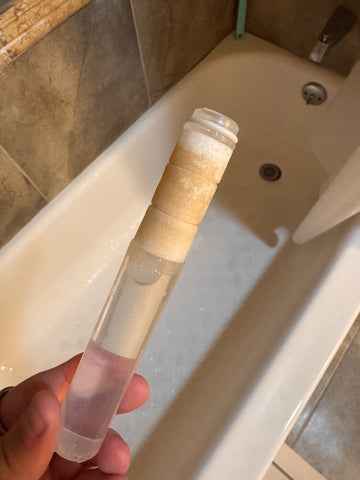
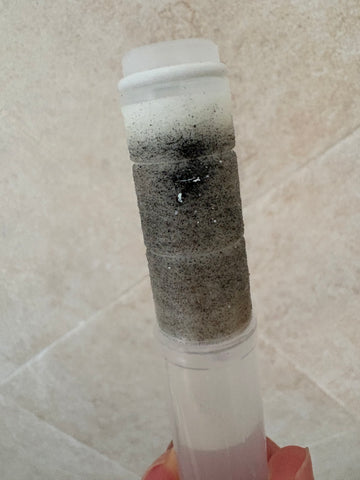
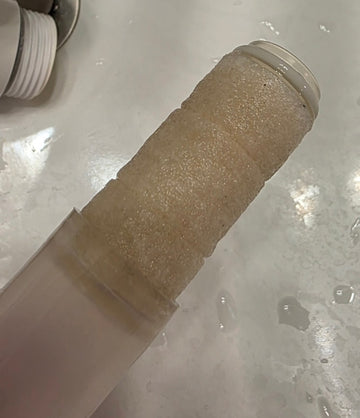
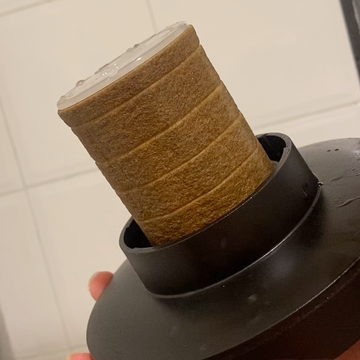
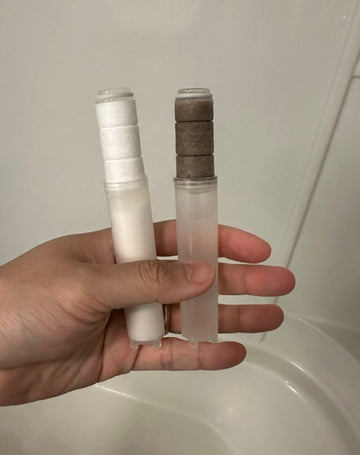
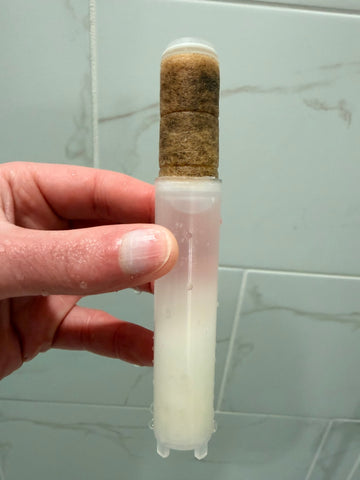
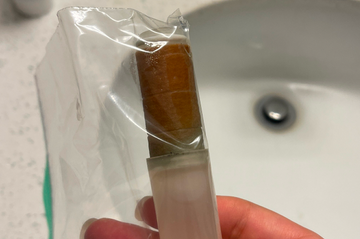
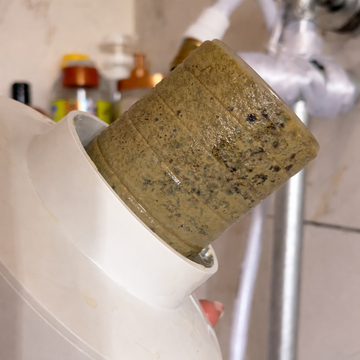
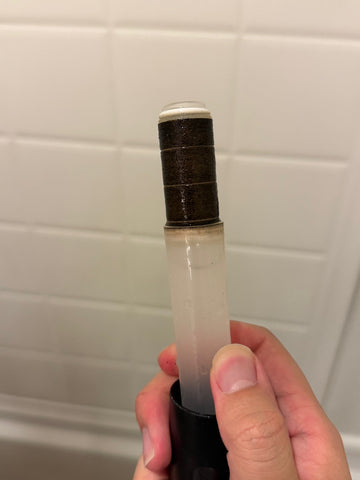
Both models include a transparent Truth Window section in the filter housing so you can visually track sediment accumulation and know when replacement is due, typically every 4-6 months for the showerhead and 3-6 months for the handheld depending on water quality and usage.
Value reframe: The higher upfront cost buys chemistry that actually removes hydrogen sulfide, not just more stages of media that can't - and the filter holds performance through its stated peak window instead of degrading by week three.
Vitaclean - KDF-55 and carbon multi-stage for chlorine, limited sulfur capacity
Vitaclean markets a multi-stage cartridge (often 10 or 15 stages depending on the model) combining KDF-55 copper-zinc granules, activated carbon, calcium sulfite, ceramic balls, and sometimes additional mineral stones. The KDF-55 stage targets free chlorine through galvanic oxidation. The activated carbon layer is intended to adsorb chlorine byproducts, volatile organic compounds, and some hydrogen sulfide. Installation is tool-free and similar to Second Shower's process.
Pricing ranges from $45 to $65 depending on retailer, making it one of the more budget-friendly options in the shower filter category.
Value reframe: A $50 filter that stops removing sulfur smell after two weeks costs more over six months (through disappointment and workarounds) than a $99 filter that works for four to six months.
AquaBliss - budget multi-stage with fast carbon saturation on sulfur
AquaBliss follows a similar multi-stage architecture to Vitaclean: KDF-55, activated carbon, calcium sulfite, and ceramic stones in a stacked cartridge design. The brand emphasizes the number of stages (usually 10+) and universal compatibility with standard US shower arms. AquaBliss filters are among the most affordable in the category at $35-40 retail, often less during sales. The cartridge installs without tools and fits both fixed and handheld shower configurations depending on the model purchased.
Value reframe: Three AquaBliss replacements over six months ($105-120 total) cost more than one Second Shower cartridge ($99 head, $89 hand) that maintains sulfur neutralization through its peak window.
Jolie - KDF-55 and calcium sulfite, $169 list
Jolie ($169 list, $148 with a filter subscription) uses a blend of KDF-55 and calcium sulfite, with a filter it rates for about 90 days ($35 on subscription). Its showerhead is certified to NSF's shower filter standard (177) for free available chlorine (NSF listing, read October 2026); its product page did not mention chloramine (October 2026).
- Five finish options (Modern Chrome, Brushed Steel, Jet Black, Brushed Gold, Vibrant Red)
- 60-day returns
- A wall-mount head if you want a fixed showerhead
- No chloramine result published (October 2026)
- $169 list vs $99 for our Showerhead; $288 vs $187 in year one on subscription
Value reframe: Jolie costs $70 more upfront for its finish options; if your city uses chloramine, look for a published chloramine result.
Canopy - KDF-carbon combo in designer finishes, no H₂S chemistry
Canopy combines KDF-55 and coconut shell activated carbon in a dual-media cartridge, packaged in a housing available in multiple finishes: polished chrome, matte black, and brushed nickel. The brand positions itself in the home design category as much as the water filtration category, with retail presence in West Elm and other design-focused stores. Canopy's cartridge replacement interval is listed as 4 months, and the system includes a 2-year warranty on the housing hardware.
Retail price is $150 for the initial unit.
Value reframe: A 2-year warranty on hardware that can't remove hydrogen sulfide just extends the timeline of disappointment - finish color won't fix the chemistry gap.
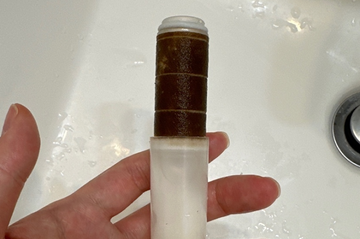
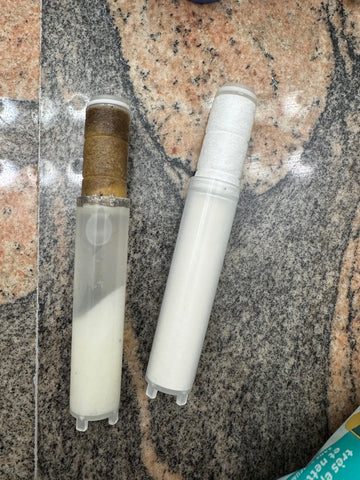
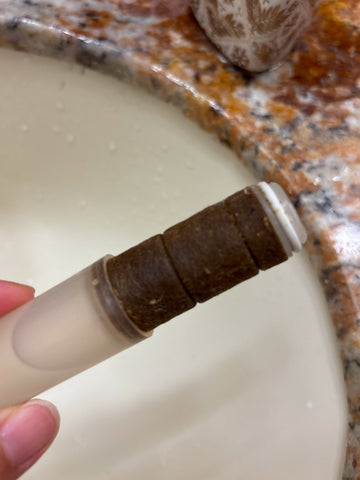
"Tampa water looks clear out of the tap, so I wasn't expecting much. The filter turned brown way faster than I thought."
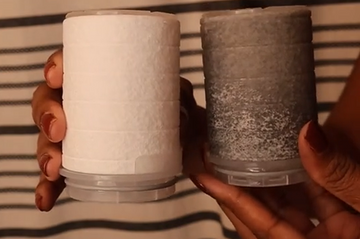
This Tampa customer's experience reflects a common discovery: water that appears clean visually can still carry dissolved contaminants including hydrogen sulfide, chlorine, chloramine, and sediment that only becomes visible when captured in a filter's transparent housing. Sulfur smell often comes from dissolved gas rather than visible particles, which is why the problem persists even when tap water looks fine.
A shower filter - even one with direct Vitamin C neutralization like Second Shower - will not solve every water quality problem. Here's what it won't fix and when you need a different solution instead.
Shower filters don't soften water in the traditional sense. If your water has high mineral hardness (calcium and magnesium measured in grains per gallon or ppm), a shower filter won't remove those dissolved minerals. Water softening requires ion-exchange resin that swaps calcium and magnesium ions for sodium or potassium ions - a process that happens in whole-house softener tanks, not shower cartridges.
You'll still see mineral deposits on shower glass and feel the characteristic slickness of hard water on your skin. Second Shower removes the chlorine and chloramine that exacerbate dryness and irritation, but it won't eliminate the white scale buildup that comes from mineral-heavy water.
If your sulfur smell is caused by a bacterial infestation in your home's plumbing (sulfate-reducing bacteria that colonize pipes and water heaters), a point-of-use shower filter provides only partial relief. The bacteria produce hydrogen sulfide as a metabolic byproduct, and while the filter will neutralize the H₂S in the water that passes through it, the source remains in your plumbing system.
You'll notice reduced smell during showers, but the odor will persist at other taps and may return quickly if the bacterial colony is large. Addressing bacterial sulfur requires shock chlorination of the well or plumbing system, water heater flushing and temperature adjustment (raising temp to 140°F kills sulfate-reducing bacteria), or installation of a whole-house oxidation system. A shower filter is a downstream mitigation, not a source cure.
Shower filters also won't address taste or odor in your drinking water because they're installed in the shower line, not the kitchen faucet. If hydrogen sulfide affects your whole house, you'll need separate point-of-entry filtration (whole-house system) or point-of-use filters for drinking and cooking water.
Second Shower's chemistry would work in a drinking water context - Vitamin C neutralization is used in countertop and under-sink filters - but the shower-specific cartridge isn't designed for potable water applications and lacks NSF/ANSI 53 or NSF/ANSI 58 certifications required for health-effect drinking water claims.
Filter life estimates (4-6 months for Second Shower's showerhead, 3-6 months for the handheld) assume typical municipal water quality and usage. If you're on well water with high sediment loads, heavy sulfur content, or elevated iron and manganese, the sediment pre-filter will clog faster and the Vitamin C media will be consumed more quickly. You might see the transparent Truth Window turn dark brown within weeks rather than months.
This isn't a defect - it's the filter doing its job on heavily contaminated water - but it does mean more frequent replacement and higher operating cost. In those cases, a whole-house sediment filter or iron removal system upstream of the shower filter extends cartridge life and reduces cost per gallon filtered.
Finally, Second Shower and all competitors in this comparison are designed for municipal or well water that's already been tested and deemed generally safe for bathing. None of these filters are certified for emergency use, flood water, or water from untested sources. If you're in a boil-water advisory situation or dealing with microbial contamination, a shower filter won't make that water safe.
NSF/ANSI 42* certification (which Second Shower holds on its sediment component) covers aesthetic effects like taste, odor, and particulates - not microbiological safety, which falls under NSF/ANSI 53 or NSF/ANSI 55 for UV systems.
*Micron PP sediment filter certified by NSF/ANSI 42 standards.
Which one should you buy?
I'd rather you buy the solution that fits your actual water problem than buy Second Shower for a situation it's not designed to solve. If sulfur smell is your issue and the source is dissolved hydrogen sulfide in the incoming water (not a bacterial infestation in your pipes), Vitamin C neutralization is the chemistry that works.
If your problem is something else - high hardness, bacterial contamination, or just wanting the cheapest option for temporary chlorine reduction - a different product or system may be the right call.
If sulfur smell is ruining your showers, fix it with chemistry that works
Vitaclean, AquaBliss, Jolie, and Canopy all use adsorption-based filtration - KDF-55 copper-zinc media and activated carbon - that can't keep up with hydrogen sulfide at shower flow rates.
You'll get a few weeks of relief as the carbon's surface adsorbs some H₂S molecules, then the smell returns even though the filter looks unused. Second Shower's Vitamin C ascorbic acid cartridge neutralizes hydrogen sulfide through direct chemical reaction that doesn't depend on contact time or adsorption capacity.
It's the same chemistry municipal treatment plants use, scaled to a shower filter that installs in under five minutes and maintains full water pressure through 176 micro-jets.
The showerhead model runs $99 with a 4-6 month filter life. The handheld Showerhand is $89 and gives you portability for renters or multi-bathroom homes, with 3-6 month cartridge life. Both neutralize 99.9% of free chlorine during the Day 1-60 peak window (verified by independent lab testing), handle chloramine where KDF filters fail, and eliminate sulfur smell at the source.
You see what the filter captures through the transparent Truth Window, and replacement cartridges are $36 for a 2-pack (showerhead) or $27 for a 3-pack (handheld) on subscription.
If the rotten-egg smell is making you dread showers, the solution is chemistry that actually reacts with hydrogen sulfide, not more stages of media that water rushes past. Second Shower's Vitamin C neutralization works. The alternatives in this comparison don't.
Related Reading
FAQ
Why does my shower water smell like rotten eggs?
The rotten-egg smell comes from hydrogen sulfide gas (H₂S) dissolved in your water. This can originate from several sources: sulfate-reducing bacteria in your well, hot water heater, or plumbing (the bacteria metabolize sulfate minerals and produce H₂S as waste); naturally occurring sulfur compounds in groundwater that leach from soil and rock; or decaying organic matter in your municipal water system's distribution pipes.
The smell is most noticeable in hot water because heat releases the dissolved gas. Even low concentrations (0.5 to 1.0 ppm) produce a strong odor, though hydrogen sulfide at those levels isn't a health risk - it's an aesthetic and comfort problem.
Will a KDF shower filter remove sulfur smell?
KDF-55 copper-zinc media (used in Vitaclean, AquaBliss, Jolie, Canopy) don't chemically react with hydrogen sulfide. They work through galvanic oxidation for chlorine and some heavy metals, but they have no mechanism for H₂S removal. Some multi-stage filters add activated carbon, which can adsorb hydrogen sulfide molecules - but adsorption requires contact time the water doesn't get in a shower running at 2.5 gallons per minute.
The carbon saturates quickly (often within days in sulfur-heavy water), and the smell returns even though the filter looks unused. KDF filters may reduce chlorine smell, which can make the overall water seem better initially, but they won't eliminate sulfur odor.
How does Vitamin C neutralize hydrogen sulfide?
Ascorbic acid (Vitamin C) neutralizes hydrogen sulfide through direct chemical reaction. The Vitamin C molecule donates a proton (H⁺) to the sulfide ion (S²⁻ from H₂S), converting it to elemental sulfur and water. This is a stoichiometric reaction - it doesn't depend on contact time, temperature, or adsorption capacity. The reaction happens near-instantaneously even at shower flow rates of 2.5 GPM.
Municipal water treatment plants use this same chemistry (often with sodium ascorbate, a Vitamin C derivative) to remove hydrogen sulfide before chlorination. Second Shower's pharmaceutical-grade ascorbic acid cartridge brings that industrial process into a shower filter.
How long does a Vitamin C shower filter last with sulfur smell?
Second Shower's Vitamin C cartridge lasts 4-6 months in the showerhead model and 3-6 months in the handheld model under typical municipal water conditions. If your water has high hydrogen sulfide levels (above 1.0 ppm), the Vitamin C media will be consumed faster because each H₂S molecule neutralized uses up a portion of the ascorbic acid. You'll see the filter's transparent Truth Window darken more quickly as sediment and reaction byproducts accumulate.
In heavily sulfur-contaminated water (3+ ppm H₂S, common in some well water), you might need replacement every 2-3 months. This is still longer effective life than KDF-carbon filters, which lose their limited sulfur-adsorption capacity within days or weeks in the same conditions.
Can I use a shower filter if I have a water softener?
Yes, and the combination is often ideal. A whole-house water softener removes calcium and magnesium (hardness minerals) through ion-exchange, which eliminates scale buildup but doesn't address chlorine, chloramine, or hydrogen sulfide. Those compounds pass through the softener unchanged. Installing a Vitamin C shower filter after the softener gives you both benefits: soft water without mineral scale, and neutralization of chlorine, chloramine, and sulfur smell in the shower.
The softener also extends the shower filter's life by reducing sediment load on the pre-filter stage. Just ensure your softener isn't adding excessive sodium if you have skin sensitivity - some people find high-sodium softened water drying, in which case potassium-based softener salt is an alternative.
Is hydrogen sulfide in shower water dangerous?
Hydrogen sulfide at the concentrations typically found in household water (0.5 to 5.0 ppm) is not a health hazard for bathing or showering. The EPA classifies H₂S as a secondary contaminant - it affects taste, odor, and aesthetic quality but doesn't pose acute health risks at low levels. However, H₂S is corrosive to plumbing, especially copper pipes, and can accelerate metal degradation over time.
Very high concentrations (above 10 ppm) can cause respiratory irritation if the gas is inhaled in a confined space like a small bathroom with poor ventilation, but those levels are rare in treated municipal water. If you're on well water and detect strong sulfur smell, it's worth testing to confirm the source (bacterial vs geological) and concentration.
Why does the sulfur smell come back after a few weeks with my current filter?
If you're using a KDF or activated carbon filter (Vitaclean, AquaBliss, Canopy), the smell returns because the carbon's adsorption sites saturate quickly and the KDF media don't chemically interact with hydrogen sulfide in the first place. Activated carbon can adsorb some H₂S molecules initially, but at shower flow rates (2.5 GPM) the water doesn't stay in contact with the carbon long enough for effective adsorption.
Once the available surface area fills - which happens in days or weeks depending on sulfur concentration - the carbon stops capturing H₂S and the smell returns. The filter may still look clean in its transparent housing because hydrogen sulfide is a dissolved gas, not a visible particle. This is why adsorption-based filters fail on sulfur even when they appear to have plenty of unused media.