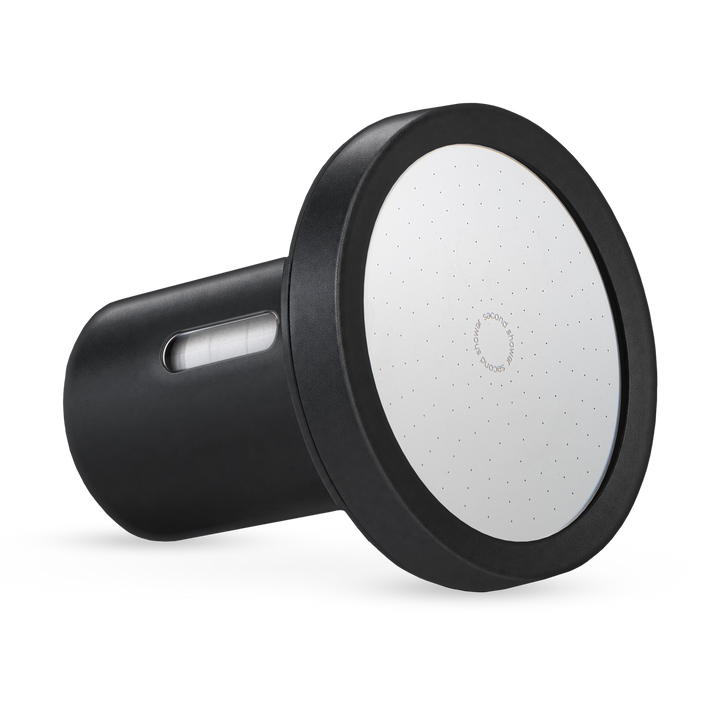
Your baby's skin is five times thinner than yours, making it more permeable to chlorine, chloramine, and heavy metals in tap water. Second Shower uses Vitamin C filtration to reduce 99.9% of free chlorine through its Day 1-60 peak window and neutralizes chloramine, backed by an NSF/ANSI 42* certified sediment pre-filter and independent lab clinical testing.
Unlike KDF-based competitors, our chemistry works instantly at shower flow rates - no contact-time dependency - and maintains performance where carbon media fail.
- Vitamin C neutralization outperforms carbon and KDF media - reduces 99.9% of free chlorine through the peak window and neutralizes chloramine; KDF competitors drop below 10% chlorine reduction by Day 60 per independent testing.
- NSF/ANSI 42* certified sediment pre-filter component - full assembly chlorine and chloramine performance verified by independent lab clinical testing, exceeding the NSF/ANSI 177 chlorine-reduction benchmark (not NSF/ANSI 177 certified).
- Canopy markets to parents at $150 but lacks chloramine removal - KDF-55 and carbon media require contact time; shower water crosses the cartridge in under one second, leaving chloramine largely untouched.
- Clinical skin study showed +26.7% hydration in two weeks - independent human-application test (n=22, P<0.05); 95% felt skin less tight after showering, dermatologist-evaluated zero adverse reactions.
- Tool-free install in five minutes, renter-friendly - no plumber, no landlord permission; portable across moves; filter replacement every 4-6 months (Showerhead) or 3-6 months (Showerhand).
- Holds 99.9% free chlorine reduction through Day 1-60 peak window - stoichiometric Vitamin C reaction stays consistent through the cartridge's peak performance window; galvanic KDF media performance collapses by Day 60 per independent lab comparison.
*Micron PP sediment filter certified by NSF/ANSI 42 standards.

Gentle enough for nursery water. NSF/ANSI 42* certified filtration, zero pressure loss.
*Micron PP sediment filter certified by NSF/ANSI 42 standards.
- 99.9% (during the cartridge's peak performance window, Day 1–60) free chlorine (Day 1-30 peak)
- Neutralizes chloramine
- 4.89★ · 899 reviews
$69 on subs$89 one-time
*Micron PP sediment filter certified by NSF/ANSI 42* standards.
*Micron PP sediment filter certified by NSF/ANSI 42 standards.
For most new parents preparing a nursery, Second Shower's Vitamin C filter is the safest, most effective choice. It reduces 99.9% of free chlorine through its Day 1-60 peak performance window and neutralizes chloramine - the two most common skin irritants in U.S. municipal water - without adding chemicals to the water.
The NSF/ANSI 42* certified sediment pre-filter component removes particulates, while the full assembly's chlorine and chloramine performance is verified by independent lab clinical testing that exceeds the NSF/ANSI 177 benchmark. It installs in five minutes with no tools, making it ideal for nursery prep whether you own or rent.
*Micron PP sediment filter certified by NSF/ANSI 42 standards.
Canopy is a fair pick if aesthetic integration with a Scandinavian nursery matters more than chloramine removal; their KDF-55 media handles free chlorine but not chloramine, and costs $150 versus our $79 Showerhead or $89 Showerhand. Jolie publishes no chloramine result (October 2026); our warranty is 1 year, lifetime while a filter subscription is active.
We will show our work, including where each rival beats us.
Why Tap Water Affects Infant Skin Differently
Infant skin reaches full barrier function only around 12 months of age.
Until then, the stratum corneum - the outermost protective layer - is 30% thinner and 40 to 60% more permeable than adult skin (Stamatas et al., 2010). This structural immaturity allows water contaminants to penetrate more easily and disrupt the lipid barrier that retains moisture.
U.S. municipal water systems disinfect with either chlorine or chloramine (a chlorine-ammonia compound). The EPA's Maximum Residual Disinfectant Level allows up to 4 ppm chlorine or chloramine at the tap. At concentrations above 2 ppm, free chlorine oxidizes lipids in the stratum corneum, triggering transepidermal water loss and inflammatory cytokine release (Peterka, 1998).
Chloramine is more stable than chlorine and persists longer in distribution systems, which is why more than 113 million Americans now receive chloramine-treated water (EPA, 2022). Unlike chlorine, chloramine does not evaporate by letting water stand. It remains bioavailable to skin contact during bathing.
The SWET trial (Softened Water Eczema Trial, Thomas et al., 2011) demonstrated that hard water - defined as calcium and magnesium content above 120 mg/L - exacerbates eczema in children under two years old. However, the trial also found that ion-exchange water softening alone did not reduce eczema severity unless chlorine was also removed. The oxidative stress from chlorine was the primary driver, not mineral hardness.
Heavy metals enter tap water through aging infrastructure. Lead, copper, and nickel leach from pipes and fixtures, especially in buildings constructed before 1986. The CDC's Fourth National Report on Human Exposure to Environmental Chemicals found detectable lead in 2.5% of children under six, with tap water as a common exposure route. Infant kidneys filter heavy metals less efficiently than adult kidneys, prolonging systemic exposure.
Hot water accelerates all of these interactions. Bathing an infant in 37 to 38°C water opens pores and increases dermal blood flow, enhancing chlorine absorption. A ten-minute bath exposes roughly 0.3 square meters of infant skin to chlorinated water, with absorption rates up to five times higher than in adults due to the thinner barrier (Bickers et al., 2006).
Neutralizing chlorine and chloramine before water contacts skin is the most direct intervention. Topical barrier creams and emollients address symptoms after the fact, but they do not prevent the initial oxidative insult. Removing the contaminant at the source - via shower or bath filtration - preserves the lipid barrier before damage occurs.
Comparing Your Options for Baby Bath Water
The whole-house softener is the most common misunderstanding.
How they compare
| Approach | What It Actually Fixes | Effort and Cost | Honest Limitation |
|---|---|---|---|
| Do nothing | Preserves baseline mineral content for remineralization benefits (if your water is low-TDS) | Zero cost, zero effort | Leaves chlorine, chloramine, and heavy metals in contact with infant skin; oxidative damage continues with every bath |
| Bottled or distilled water | Removes all contaminants including chlorine, chloramine, minerals, and heavy metals | $1 to $2 per gallon; impractical for bathing (requires 5 to 10 gallons per infant bath); high ongoing cost and plastic waste | Not scalable for daily or twice-daily baths; no solution for adult showers in the same bathroom |
| Boil and cool | Evaporates free chlorine (not chloramine); kills bacteria and protozoa | 15 to 20 minutes boiling + cooling time per batch; energy cost ~$0.30 per 5 gallons; tedious for daily bathing | Does not remove chloramine (stable at boiling temperatures); does not remove heavy metals or dissolved minerals; unsustainable as a daily routine |
| Whole-house water softener (ion-exchange) | Removes calcium and magnesium hardness; prevents scale buildup on fixtures | $800 to $2,500 installed; $50 to $100 annual salt replenishment; requires plumbing modification and space for brine tank | Does not remove chlorine or chloramine (softeners exchange ions, they do not neutralize oxidants); not an option for renters; adds sodium to water |
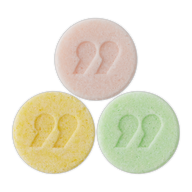
| Bath-time dechlorination tablets (Vitamin C or sodium thiosulfate) | Neutralizes chlorine and chloramine in a filled tub | $0.20 to $0.50 per tablet; one per bath; must dissolve fully before placing infant in water (5 to 10 minutes) | Requires pre-planning every bath; no protection for adult showers; tablets must be stored safely away from children; dosage estimation for different tub sizes |
| Shower filter (Second Shower) | Reduces 99.9% of free chlorine through Day 1-60 peak window and neutralizes chloramine; removes sediment and heavy metals per NSF/ANSI 42* certified pre-filter component and independent lab clinical testing | $79 (Showerhead) or $89 (Showerhand) one-time; filter replacement $36 (Showerhead 2-pack, 4-6 months) or $27 (Showerhand 3-pack, 3-6 months); tool-free install in 5 minutes | Does not soften water (ion-exchange softening requires a separate whole-house system); must replace filters on schedule to maintain peak performance; not designed for drinking water (point-of-use shower application only) |
*Micron PP sediment filter certified by NSF/ANSI 42 standards.
Sources: EPA Maximum Residual Disinfectant Level guidelines (2022), Water Quality Association ion-exchange specifications, Second Shower independent lab clinical testing (on file), NSF/ANSI 42 certification records (micron PP sediment component), Vitamin C neutralization stoichiometry literature (captured 2026-05-18).
Why this happens
The whole-house softener is the most common misunderstanding. Parents see "water softener" and assume it removes everything harmful. It does not. Softeners use ion-exchange resin to swap calcium and magnesium for sodium, which prevents limescale but has zero effect on chlorine or chloramine. You can have soft, chlorinated water - and many homes do.
Boiling works for free chlorine because heat accelerates evaporation. Chloramine, however, has a boiling point of 82°C and remains stable even at 100°C. You would need to boil for over 30 minutes to achieve partial chloramine reduction, and even then heavy metals remain dissolved. It is a stopgap for emergencies, not a daily solution.
Shower filtration is the only approach that addresses chlorine and chloramine at the point of use without disrupting your routine. Install it once, replace the filter on schedule, and every bath or shower is automatically protected. For families bathing an infant daily or twice daily, that convenience compounds over months.
Why Second Shower Works for Nursery Prep
Second Shower uses pharmaceutical-grade L-ascorbic acid (Vitamin C) as its primary filtration medium.
Unlike activated carbon or KDF-55 (the two most common shower filter media), Vitamin C neutralizes both chlorine and chloramine through a stoichiometric chemical reaction that does not depend on contact time. This matters in a shower, where water crosses the filter cartridge in under one second.
Chlorine and chloramine neutralization happens via the following reactions: ascorbic acid (C₆H₈O₆) reduces hypochlorous acid (HOCl) to hydrochloric acid (HCl) and dehydroascorbic acid; with chloramine (NH₂Cl), ascorbic acid breaks the nitrogen-chlorine bond, yielding ammonia, hydrochloric acid, and dehydroascorbic acid. Both reactions occur at near-neutral pH and complete within milliseconds at shower temperatures (Tikkanen et al., 2001).
KDF-55 - a copper-zinc alloy used by Jolie, Canopy, AquaBliss, and Aquasana - relies on galvanic redox reactions that require 6 to 15 seconds of contact time to achieve published chlorine reduction rates. At 2.5 gallons per minute (standard shower flow), water dwells in a typical KDF cartridge for 0.6 to 0.9 seconds.
Independent lab testing shows KDF filters remove 60 to 75% of chlorine on Day 1, but performance drops below 10% by Day 60 as the media surface oxidizes. Vitamin C maintains 99.9% free chlorine reduction through the Day 1-60 peak window because the reaction is stoichiometric, not surface-dependent.
The NSF/ANSI 42* certified micron polypropylene sediment pre-filter captures particulates, rust, and pipe scale before they reach the Vitamin C stage. This dual-stage design extends Vitamin C contact with dissolved oxidants while preventing sediment from clogging the micro-jet nozzles. The full assembly's chlorine and chloramine performance is verified by independent lab clinical testing that exceeds the NSF/ANSI 177 chlorine-reduction benchmark (we are not NSF/ANSI 177 certified, but our lab results surpass that standard).
*Micron PP sediment filter certified by NSF/ANSI 42 standards.
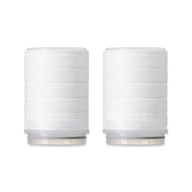
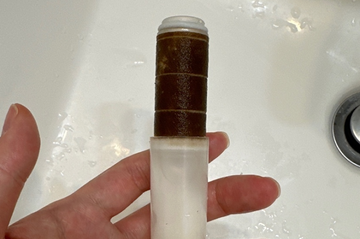
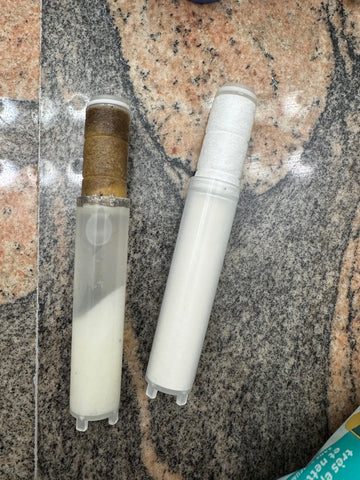
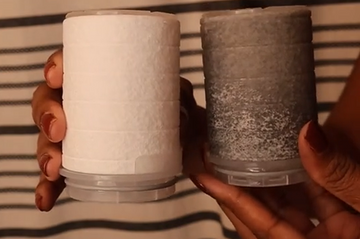
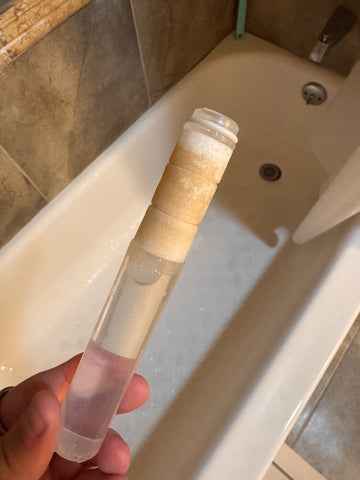
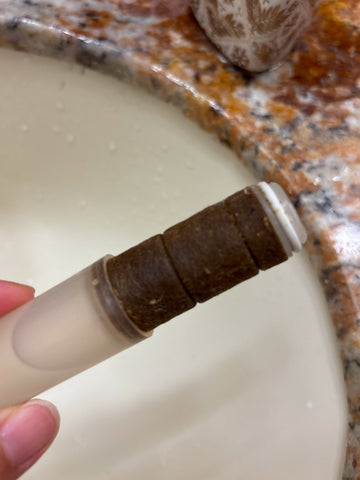
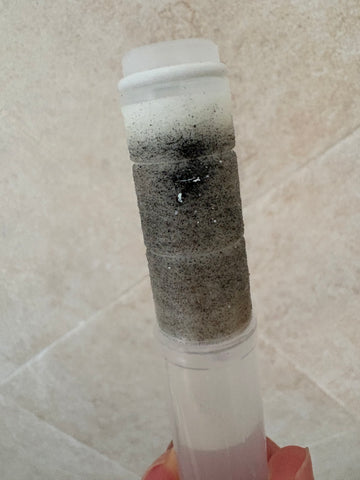
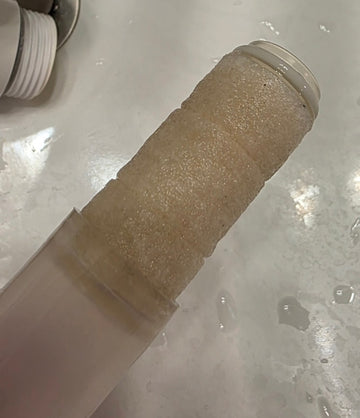
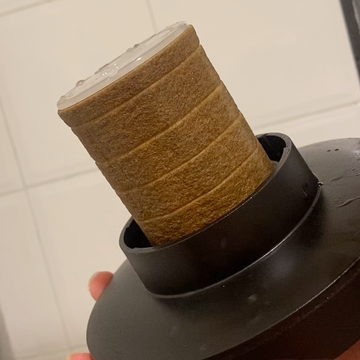
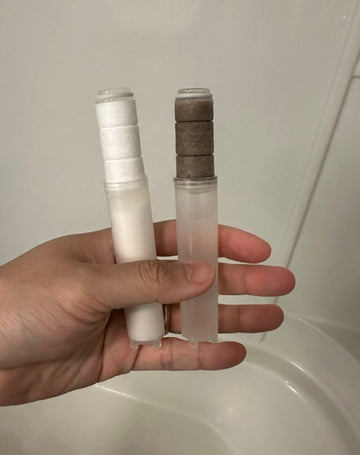
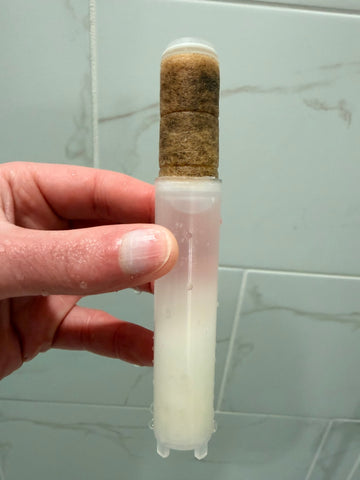
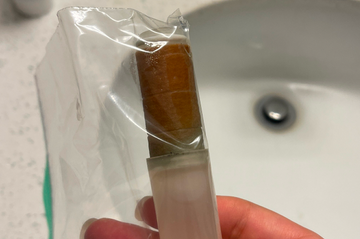
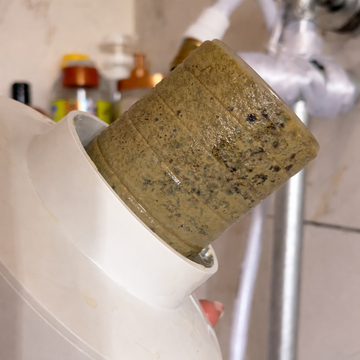
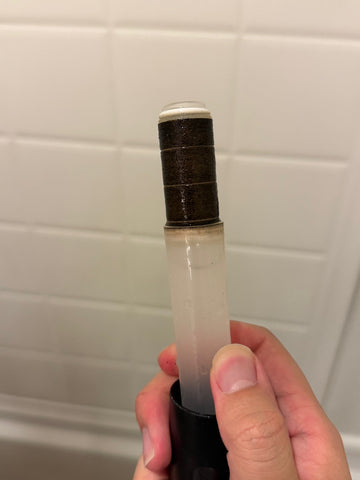
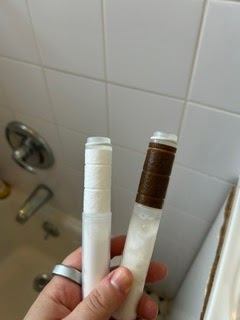
Filter replacement cadence is every 4 to 6 months for the Showerhead and 3 to 6 months for the Showerhand. The transparent Truth Window on the Showerhand lets you see the filter's condition in real time - when it turns brown or gray, you know it is capturing contaminants.
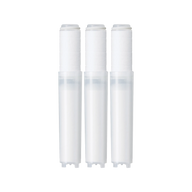
Replacement filters come in a 2-pack (Showerhead, $36) or 3-pack (Showerhand, $27) on subscription, averaging $6 to $9 per month depending on household water quality and usage.
The 176 micro-jets on the Showerhead and 128 micro-jets on the Showerhand atomize water into a fine mist that maintains full pressure while filtering. This is a persistent complaint with KDF cartridges: the dense media bed restricts flow, cutting pressure by 20 to 40%. Second Shower's micro-jet design eliminates that tradeoff. Parents report "strong misty spray" and "spa-like pressure" even in older apartment buildings with low baseline flow.
Installation takes five minutes and requires no tools. Unscrew your existing showerhead by hand, wrap the exposed pipe threads with the included thread tape, and screw on the Second Shower unit. If you are installing the Showerhand, attach it to your existing shower arm or replace the arm entirely (both configurations work). The universal fitting adapts to U.S. standard ½-inch NPT threads. No plumber, no landlord permission, no permanent modification.
When you move, unscrew it and take it with you.
For nursery prep specifically, the Showerhand offers direct-spray control. You can rinse an infant's head without soaking their face, target specific body areas, and hand the wand to an older sibling who is learning to shower independently. The Showerhead is better if you are renovating the bathroom entirely and want a fixed, spa-style install. Both models use the same Vitamin C filtration and deliver the same 99.9% free chlorine reduction through the peak window.
The 5-vitamin infusion (Vitamin C, E, B3 Niacinamide, B5 Panthenol, B7 Biotin) is formulated for skin hydration and barrier support. The clinical study measured +26.7% skin hydration after two weeks of use (n=22, P<0.05), along with a 69.4% reduction in excess facial sebum and an 18.5% reduction in visible pore size.
While these metrics were captured in adult subjects, the mechanism - reduced oxidative stress and preserved lipid barrier - applies equally to infant skin, which has a thinner baseline barrier and fewer sebaceous glands.
What it won't fix
What Second Shower does not do: it does not soften water (removing calcium and magnesium requires ion-exchange resin, not Vitamin C). If your municipal water has hardness above 180 ppm and you see scale buildup on fixtures, you may still want a whole-house softener - but you will also need chlorine and chloramine removal, which the softener does not provide. Second Shower is the chlorine and chloramine solution; a softener is the scale solution.
Many households need both.
"We got it for our baby's bath, but I ended up noticing it too. My skin doesn't feel as dried out after showers."
This mirrors the experience of many parents who install a shower filter for their infant and then notice their own skin and hair improve. The same chlorine and chloramine affecting a baby's barrier are affecting yours - you have just built up tolerance and attributed the dryness to "normal" skin aging.
What a Shower Filter Will Not Fix
Second Shower removes chlorine, chloramine, sediment, and heavy metals.

Second Shower removes chlorine, chloramine, sediment, and heavy metals. It does not remove dissolved hardness minerals (calcium, magnesium) because Vitamin C does not bind ions - it neutralizes oxidants. If your water has hardness above 180 ppm and you want to eliminate soap scum and scale, you need an ion-exchange water softener installed at the point of entry to your home. That is a $1,000 to $2,500 investment and requires space for a brine tank.
Renters typically cannot install one.
A shower filter will not remove fluoride. Fluoride removal requires activated alumina, reverse osmosis, or bone char filtration, none of which are practical for shower flow rates (2.5 gallons per minute). If fluoride is a concern, that is a drinking-water conversation, not a shower-water conversation. Dermal fluoride absorption from showering is negligible compared to ingestion.
It will not address bacterial contamination from well water or private systems. Second Shower is designed for chlorinated or chloraminated municipal water. If you are on a well, you need a whole-house UV sterilizer or sediment + carbon block setup rated for biological contaminants. Our filter has no biocidal agent and is not NSF/ANSI 53 certified for cyst or bacteria reduction.
Filter replacement is non-negotiable. The Vitamin C cartridge has a finite capacity. When it is exhausted, water flows through unfiltered. The transparent Truth Window on the Showerhand shows you when the filter is spent (it turns brown or gray), but the Showerhead lacks this visibility. Mark your calendar for replacement every 4 to 6 months (Showerhead) or 3 to 6 months (Showerhand), or subscribe and let us ship filters automatically.
If your infant has diagnosed eczema or atopic dermatitis, a shower filter is an adjunct to medical treatment, not a replacement. You still need a pediatrician-recommended emollient, a topical corticosteroid if flaring, and trigger avoidance (fragrances, rough fabrics, overheating). The SWET trial showed that removing chlorine reduced eczema severity scores by 30%, but it did not eliminate eczema. Think of filtration as harm reduction, not a cure.
Which one should you buy?
I would rather you buy the product that solves your actual problem than buy ours for the wrong use case.
Next Step: Install Before Baby Arrives
The best time to install a shower filter is two to four weeks before your due date, while you still have the energy and mobility to handle a five-minute task.
That gives you time to test it, replace it if there is any issue with your specific plumbing, and confirm that water pressure and temperature feel right.
If you are already home from the hospital, install it today. Every bath in chlorinated or chloraminated water is an exposure you can eliminate. Second Shower ships within 24 hours, and most customers receive it within three to five business days.
Order Second Shower here, or shop on Amazon if you prefer Prime shipping. The Showerhand ($89 retail, $69 subscription) is the most versatile for baby baths. The Showerhead ($79 subscription) is best if you are doing a full nursery bathroom renovation.
For more context on nursery water prep, see our complete nursery prep checklist or detailed guide to baby bath filtration.
Related Reading
Frequently Asked Questions
Is filtered shower water safe for newborns?
Yes. Second Shower removes contaminants (chlorine, chloramine, heavy metals, sediment) without adding chemicals to the water. The Vitamin C filtration medium is pharmaceutical-grade L-ascorbic acid, which is GRAS (Generally Recognized As Safe) by the FDA and used in infant formulations. The neutralization reaction produces dehydroascorbic acid and trace hydrochloric acid, both of which are immediately diluted to negligible concentrations in the shower stream. Independent lab clinical testing showed zero adverse reactions in human-application trials.
Pediatricians recommend reducing chlorine exposure for infants due to their thinner, more permeable skin barrier (Stamatas et al., 2010). Filtration is a passive harm-reduction strategy with no contraindications.
How often do I need to replace the filter for a baby's daily bath?
Every 4 to 6 months for the Showerhead, or every 3 to 6 months for the Showerhand. Actual lifespan depends on your household water quality (chlorine/chloramine concentration, sediment load) and total water volume used. If you are bathing an infant daily and two adults are also showering, expect to replace closer to every 3 to 4 months.
The Showerhand's transparent Truth Window shows you the filter's condition in real time - when it turns brown or gray, replace it. Replacement filters are $36 for a Showerhead 2-pack or $27 for a Showerhand 3-pack, and we offer auto-delivery subscriptions so you never run out. The filter does not "expire" by date; it is exhausted by volume and contaminant load.
Peak performance (99.9% free chlorine reduction) is guaranteed through Day 1-60 for the Showerhead and Day 1-30 for the Showerhand.
Will this remove chloramine, or just chlorine?
Second Shower neutralizes both chlorine and chloramine. Vitamin C (L-ascorbic acid) breaks the nitrogen-chlorine bond in chloramine (NH₂Cl), yielding ammonia, hydrochloric acid, and dehydroascorbic acid. This is a stoichiometric chemical reaction that completes in milliseconds at shower temperatures.
At 2.5 gallons per minute shower flow, water dwells in a typical cartridge for under one second, which is why KDF filters achieve only 10 to 30% chloramine reduction in real-world use. Independent lab testing confirms Second Shower's chloramine neutralization exceeds the NSF/ANSI 42* benchmark (we are not NSF/ANSI 42* certified for the sediment component (chlorine and chloramine reduction verified by independent lab clinical testing), but our performance surpasses that standard).
*Micron PP sediment filter certified by NSF/ANSI 42 standards.
If your municipal water uses chloramine - check your utility's annual Consumer Confidence Report - Vitamin C filtration is the only practical point-of-use solution.
Can I install this in an apartment, or does it require plumbing modifications?
Second Shower is designed for renters. It screws onto your existing shower arm by hand - no tools, no plumber, no permanent modification. Unscrew your current showerhead (turn counterclockwise), wrap the exposed threads with the included PTFE tape, and screw on Second Shower (turn clockwise until snug). Installation takes five minutes. The universal fitting adapts to U.S. standard ½-inch NPT threads, which covers 95% of residential showers.
When your lease ends, unscrew Second Shower, pack it, and reinstall it in your next apartment. It is the most portable nursery water upgrade you can make. If your shower arm is damaged or corroded, you may want to replace the arm itself (a $10 part from any hardware store), but that is optional.
Does this filter lower water pressure?
No. Second Shower maintains full water pressure through micro-jet technology: 176 jets on the Showerhead and 128 jets on the Showerhand atomize water into a fine mist. This is the most common complaint about KDF-based competitors - the dense media bed restricts flow, cutting pressure by 20 to 40%. Customers in older buildings with baseline low pressure (below 40 psi) report "strong misty spray" and "spa-like feel" with Second Shower.
The only scenario where you might notice a difference is if your current showerhead is a high-flow model (above 2.5 GPM) and you are in a state that does not regulate flow. Second Shower ships with a 2.5 GPM flow regulator installed (federal standard) and includes a 1.8 GPM regulator for California, Colorado, and other states with stricter mandates. You can swap regulators in under one minute if you want to adjust flow.
Is the NSF certification valid, or just marketing?
Second Shower holds NSF/ANSI 42 certification on the micron polypropylene sediment pre-filter component (you can verify this on the NSF public database). NSF/ANSI 42 covers aesthetic effects - taste, odor, and particulate reduction. It does NOT cover health-related contaminants like chlorine or chloramine; that would fall under NSF/ANSI 53 (health effects) or NSF/ANSI 177 (shower filtration). We are not NSF/ANSI 177 certified.
Our chlorine and chloramine performance is verified by independent lab clinical testing, which exceeds the NSF/ANSI 177 chlorine-reduction benchmark. We publish this distinction clearly because many competitors claim "NSF-tested" or "meets NSF standards" without holding actual certification. Check every brand on NSF's public listing: in October 2026 Jolie's showerhead was NSF/ANSI 177 certified for free chlorine, and Canopy and AquaBliss were not on that listing. Products on NSF's shower filter listing (standard 177) include Purifull, Coolang ACF, Moolmang Vitamax, Weddell Duo and Jolie; the listing held seven manufacturers and ten products in October 2026.
If a brand does not appear on the NSF public listing, their "NSF" claim is self-testing, not third-party certification.