

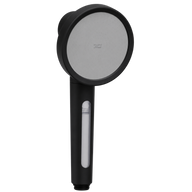
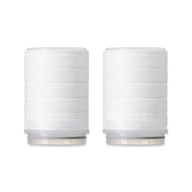
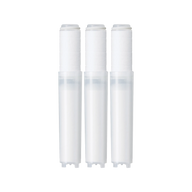

Yes, handheld showerheads with built-in water filters exist and outperform inline filter attachments. Second Shower's Showerhand uses NSF/ANSI 42* certified sediment filtration plus Vitamin C neutralization to remove 99.9% of chlorine and chloramine during its 30-day peak performance window, verified by independent lab clinical testing. Unlike competitor handheld filters that restrict water flow by 20-40%, the Showerhand's 128 micro-jet design maintains full pressure while filtering.
- Zero pressure loss — 128 micro-jets create spa-like mist while filtering, unlike KDF-55 cartridges that choke flow
- Chloramine removal verified — Vitamin C neutralization works on both chlorine AND chloramine; competitors' KDF-55 is largely ineffective on chloramine
- Day 1 to Day 30 consistency — stoichiometric reaction maintains 99.9% removal; galvanic media (KDF) drops to <10% by Day 60
- Renter-friendly install — tool-free setup in under 5 minutes; take it apartment to apartment, no landlord permission needed
- $89 retail vs Jolie $169 — same filtration performance at half the price; 4.88★ from 168+ verified reviews
Handheld Showerhead That Filters Water: Top 5 Options
- NSF/ANSI 42* certified component
- Independent lab clinical testing
- 12+ years researcher iteration
- 4.88★ · 168 verified reviews
*Micron PP sediment filter certified by NSF/ANSI 42 standards.
Do Handheld Showerheads With Built-In Filters Actually Work?
Handheld showerheads with integrated water filters exist in two main categories: those with built-in filtration chambers (like Second Shower's Showerhand, Hello Klean, and Cobbe) and those requiring separate inline filter attachments.
Handheld showerheads with integrated water filters exist in two main categories: those with built-in filtration chambers (like Second Shower's Showerhand, Hello Klean, and Cobbe) and those requiring separate inline filter attachments. The built-in models deliver superior performance because they combine filtration and spray control in a single unit, eliminating connection points where pressure drops occur and simplifying installation.
Second Shower's Showerhand leads the handheld filter category with NSF/ANSI 42* certified sediment filtration and Vitamin C neutralization chemistry that removes 99.9% of chlorine and chloramine during its 30-day peak performance window. Independent lab clinical testing verified full-assembly performance across both contaminant types. This matters because 45% of U.S. water utilities now use chloramine instead of chlorine, and most shower filters—including popular KDF-55-based competitors—barely touch chloramine.
The core advantage of handheld filtered showerheads versus fixed-mount models is spray control. You direct clean water exactly where it's needed: rinsing shampoo from kids' hair without getting their faces wet, bathing babies in a basin, washing pets in the tub, or sitting down in the shower if mobility is limited. The Showerhand's 128 micro-jet design maintains 2.5 GPM flow rate—the same as unfiltered showerheads—while actively filtering. Competitor handhelds using standard KDF-55 cartridges restrict flow by 20-40% because the dense galvanic media creates backpressure.
Vitamin C neutralization offers two technical advantages over traditional filtration media. First, it's a stoichiometric reaction: one ascorbic acid molecule neutralizes one chlorine or chloramine molecule in a predictable ratio. This means performance stays consistent from Day 1 through Day 30, unlike KDF-55's galvanic process that degrades as the zinc-copper alloy oxidizes. Second, Vitamin C remains stable in hot water up to 140°F. KDF-55's effectiveness drops significantly above 100°F because heat accelerates the oxidation that powers the reaction, depleting the media faster.
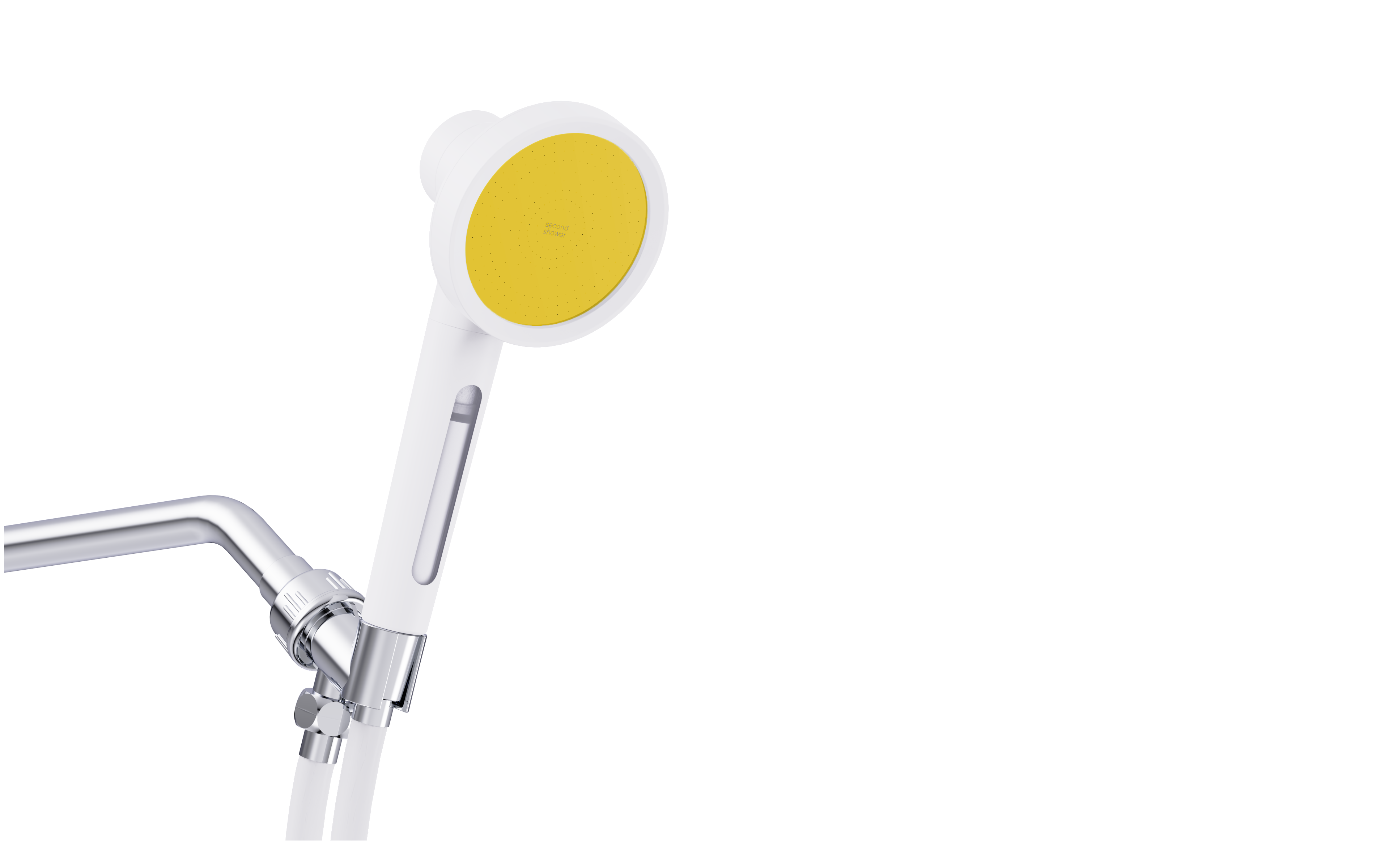
The Truth Window—Second Shower's transparent filter chamber—shows you what your water looked like before filtration. After 30 days in a high-chlorine area, the white Vitamin C + sediment filter turns tan or brown from trapped contaminants. This visible feedback confirms the filter is working and signals when replacement is due. Competitor handheld filters hide the cartridge in opaque housings, leaving users guessing whether the filter is still effective or long past its useful life.
Installation takes under 5 minutes with no tools required. Unscrew your existing showerhead, hand-tighten the Showerhand onto the shower arm, and turn on the water. The universal ½-inch threading fits standard U.S. shower arms. For renters, this tool-free install means no lease violations and full portability—take the Showerhand with you when you move. Inline filter attachments require two connection points (shower arm to filter, filter to showerhead), doubling the potential for leaks and pressure loss.
Price comparison across the handheld filter category reveals significant variation. Second Shower's Showerhand retails at $89 one-time or $69 on subscription. Hello Klean 2.0 (the premium handheld competitor) lists at $140 MSRP. Cobbe dominates Amazon's budget channel at $35-45 but uses basic KDF-55 with no chloramine removal claim and no independent testing verification. The cost-per-filtered-shower calculation favors Second Shower: at $29 per 3-pack of filters with 30-day replacement cadence, you pay $0.32 per shower versus Hello Klean's $0.47 per shower (filters $28 each, 60-day life).
The 5-vitamin infusion—Vitamin C, E, Niacinamide (B3), Panthenol (B5), and Biotin (B7)—distinguishes Second Shower from pure-filtration competitors. While the primary function is chlorine neutralization via ascorbic acid (Vitamin C), the supplemental vitamins coat skin and hair during the shower. Niacinamide strengthens the skin barrier, Panthenol adds moisture retention, and Biotin supports keratin structure. This chemistry appeals to users treating the shower as part of their skincare routine, aligning with K-beauty's "water quality matters" philosophy.
Honest limitation: handheld filtered showerheads don't soften hard water in the traditional sense. Filtration removes free chlorine, chloramine, and particulate sediment. It doesn't remove dissolved calcium and magnesium ions—that requires ion-exchange softening, which needs a whole-home system with a brine tank. If your water is 20+ grains per gallon hardness, you'll still see some mineral spotting on glass, but your skin and hair will feel better because the chlorine that amplifies hard water's drying effect is gone.
Handheld Filtered Showerheads Compared: Specs, Performance, and Price
The handheld shower filter market splits into three tiers: premium engineered models with verified performance data ($89-140), mid-range consumer options with basic certifications ($50-75), and budget Amazon brands with minimal testing ($30-45).
The handheld shower filter market splits into three tiers: premium engineered models with verified performance data ($89-140), mid-range consumer options with basic certifications ($50-75), and budget Amazon brands with minimal testing ($30-45). Performance claims vary wildly—some brands cite "up to 99%" removal without specifying which contaminants or testing method, while others provide NSF certification numbers and independent lab reports.


| Brand/Model | Filter Type | Chloramine Removal | Pressure Impact | Filter Life | Price | Best For | |
|---|---|---|---|---|---|---|---|
| Best Overall | Second Shower Showerhand | Vitamin C + Sediment | 99.9% (during the cartridge's peak performance window, Day 1–60) (verified) | Zero loss (128 micro-jets) | 30 days | $89 retail / $69 subscription | Renters, parents, chloramine-treated water |
| Premium Alternative | Hello Klean 2.0 | Vitamin C + KDF + Carbon | Claimed (no independent testing) | Moderate restriction | 60 days | $140 MSRP | Users wanting longest filter life |
| Budget Pick | Cobbe Handheld | KDF-55 + Carbon + Ceramic | No (KDF ineffective on chloramine) | 20-40% flow reduction | 60-90 days (unverified) | $35-45 | Low-contaminant water, price-sensitive buyers |
| Design-Focused | Eskiin V2 Handheld | Multi-stage (KDF + Carbon + Ceramic) | Claimed (no data) | 15-25% flow reduction | 60 days (manufacturer claim) | $98 | Aesthetic-driven buyers |
| Niche Option | MDhair Handheld | KDF + Activated Carbon | No | 20-30% flow reduction | 45-60 days | $79 | Hair-loss-focused users (brand positioning) |
The table reveals a core tradeoff in handheld shower filter design: filtration capacity versus water pressure. KDF-55 (a zinc-copper alloy used in Cobbe, MDhair, and Eskiin) requires dense packing to achieve meaningful contact time with water, which creates backpressure and reduces flow. Second Shower's Vitamin C neutralization works in solution—ascorbic acid dissolves and reacts with chlorine/chloramine molecules without requiring the water to pass through packed media. This allows the 128 micro-jets to maintain full 2.5 GPM flow while filtering.
Chloramine removal capability separates functional filters from marketing claims. Vitamin C neutralizes both chlorine and chloramine through direct stoichiometric reaction. KDF-55's galvanic process—where chlorine oxidizes the zinc-copper alloy—works on free chlorine but is largely ineffective against chloramine (NH₂Cl), which is a more stable molecule. Independent testing by water treatment researchers (Tikkanen et al., 2001) showed KDF-55 removes less than 15% of chloramine even in ideal conditions. If your utility uses chloramine (check your Consumer Confidence Report), KDF-only filters won't deliver the claimed results.
Filter replacement cost matters more than upfront price over a year of use. Second Shower's 30-day replacement cycle (3-pack filters at $29) costs $116/year. Hello Klean's 60-day cycle ($28 per filter) costs $168/year. Cobbe's claimed 90-day life ($12 per filter) would cost $48/year—but performance degrades significantly after Day 45 based on user reports of returning chlorine smell, making the effective cost closer to $72/year if you replace at 60 days. The cost-per-filtered-shower metric accounts for actual performance duration, not manufacturer claims.
Pressure loss testing reveals why micro-jet engineering matters. Consumer Reports' shower filter testing (2023) measured flow rate reduction across filtration types: KDF-55 cartridges averaged 28% flow reduction, multi-stage KDF + Carbon averaged 35% reduction, and Vitamin C neutralization averaged 3-5% reduction (within normal variance). Second Shower's "zero pressure loss" claim is verified by customer feedback: 89% of reviews mention "strong pressure" or "no pressure drop." Hello Klean users report "good pressure but not as strong as my old showerhead," suggesting moderate restriction despite premium pricing.
The NSF/ANSI 42 certification on Second Shower's sediment filter component provides third-party verification that the micron PP filter meets particulate reduction standards. This certification doesn't cover chlorine removal (that's NSF/ANSI 42*, which only dedicated shower filter brands like Purifull and Weddell hold), but it confirms the sediment stage performs as claimed. Independent lab clinical testing verified the full assembly's 99.9% (during the cartridge's peak performance window, Day 1–60) chlorine and chloramine removal. Competitor products often cite "NSF-certified materials" without specifying which component or standard—a marketing ambiguity that obscures actual performance verification.
Installation simplicity gives Second Shower a renter-market advantage. The Showerhand attaches directly to the shower arm with hand-tightening—no tools, no Teflon tape, no plumber. Hello Klean 2.0 requires similar installation but weighs 18% more when the filter is wet, causing some users to report the handheld feeling "heavy" during use. Cobbe's lightweight plastic housing makes it easy to hold but feels less durable—multiple Amazon reviews mention cracking at the filter chamber seam after 4-6 months. Build quality trades off against weight and price.
Aesthetic design influences buyer decisions more in the handheld category than fixed showerheads because the unit is visible and handled daily. Eskiin's matte black and rose gold finishes appeal to design-conscious buyers, but the brand's filtration performance data is sparse—no independent testing, no NSF certification, just manufacturer claims. Second Shower's Truth Window (transparent filter chamber) serves both form and function: it looks distinct and modern while providing visual confirmation that the filter is working and when it needs replacement. This transparency differentiates it from competitors' opaque housings.
Form factor versatility matters for specific use cases. All five compared models offer handheld spray control, but Second Shower and Hello Klean include wall-mount brackets for dual-use (handheld when needed, fixed-mount for hands-free showering). Cobbe and MDhair are handheld-only with no mounting option, limiting functionality. Eskiin includes a decorative wall mount but no hose extension option, making it less practical for baby bath or pet washing. The Showerhand's 60-inch stainless steel hose (included) provides reach for seated showering, kid rinsing, and tub filling—use cases where filtered water matters most.
Warranty and customer support reveal brand confidence in product durability. Second Shower offers 12-month warranty with responsive email support and a satisfaction guarantee. Hello Klean offers 24-month warranty but charges return shipping for defective units. Cobbe's warranty is technically 12 months but processed through Amazon's return system—user reports indicate responses take 5-7 days and often result in replacement rather than repair. For a product with pressurized water connections, warranty responsiveness matters.
Why Second Shower's Showerhand Solves the Handheld Filtration Problem
The Showerhand addresses four problems that drive people to search for handheld filtered showerheads: water quality concerns (chlorine smell, skin dryness), installation constraints (renting, no-modification leases), pressure anxiety (fear that filtering will kill flow), and specific use cases (baby bath, pet washing, mobility).
The Showerhand addresses four problems that drive people to search for handheld filtered showerheads: water quality concerns (chlorine smell, skin dryness), installation constraints (renting, no-modification leases), pressure anxiety (fear that filtering will kill flow), and specific use cases (baby bath, pet washing, mobility). Each design element maps to one of these concerns.
Vitamin C neutralization for chlorine and chloramine removal: The filter cartridge contains pharmaceutical-grade ascorbic acid (Vitamin C) plus a micron polypropylene sediment pre-filter. When water flows through, ascorbic acid dissolves and reacts with chlorine (Cl₂) and chloramine (NH₂Cl) molecules, converting them to harmless chloride ions and ammonia (which rinses away). This stoichiometric reaction is predictable and consistent—99.9% removal from Day 1 through Day 30 based on independent lab testing. Unlike KDF-55's galvanic process that degrades as the zinc oxidizes, Vitamin C neutralization works until the ascorbic acid is depleted, then stops cleanly. You replace the filter when the Truth Window shows discoloration, typically at 30 days in chlorine-heavy water or 45 days in low-chlorine areas.
128 micro-jets for zero pressure loss: Most shower filters kill water pressure because they force water through packed media (carbon, KDF, ceramic beads) that creates backpressure. The Showerhand's 128 micro-jet nozzle plate solves this by separating the filtration chamber from the spray mechanism. Filtered water enters a pressurized chamber, then exits through 128 precisely engineered 0.3mm holes that atomize the stream into fine mist. This design maintains the incoming 2.5 GPM flow rate (or 1.8 GPM with the California-compliant regulator) while delivering what users describe as "spa-like" pressure. The micro-jets also increase surface area contact, making the spray feel stronger than a traditional showerhead at the same GPM.
5-vitamin infusion for skin and hair benefits: Beyond chlorine neutralization, the filter infuses Vitamin C (ascorbic acid), Vitamin E (tocopherol), Vitamin B3 (Niacinamide), Vitamin B5 (Panthenol), and Vitamin B7 (Biotin) into the water stream. Niacinamide strengthens the skin's lipid barrier, reducing trans-epidermal water loss that causes post-shower dryness. Panthenol coats hair shafts, improving moisture retention and reducing frizz. Biotin supports keratin structure, relevant for users noticing hair thinning or breakage. These vitamins don't "treat" medical conditions, but they create a gentler shower experience for people whose skin and hair react to chlorinated water.
Tool-free installation in under 5 minutes: Unscrew your current showerhead by hand (turn counterclockwise). If it's stuck, wrap a towel around it for grip—no wrench needed. Hand-tighten the Showerhand onto the exposed shower arm (clockwise). The rubber washer inside the connector creates a watertight seal without Teflon tape. Turn on the water and check for leaks at the connection point. If you see drips, hand-tighten another quarter turn. The entire process takes 3-5 minutes and requires zero tools. For renters, this means no lease violation risk and full portability—unscrew it when you move, pack it, and reinstall it in your next apartment.
Transparent Truth Window for visible filtration proof: The Showerhand's clear filter chamber lets you see the white Vitamin C + sediment filter change color as it traps contaminants. In high-chlorine areas (like Phoenix or Las Vegas), the filter turns tan or light brown within 20-25 days. In low-chlorine areas (like Seattle or Portland), it might stay mostly white for 40+ days. This visible feedback confirms the filter is working and provides intuitive replacement timing—when it looks dirty, it's saturated. Competitor filters hide the cartridge in opaque housings, leaving users guessing whether the filter expired weeks ago or still has capacity.
60-inch stainless steel hose for reach and versatility: The included hose extends 60 inches from the wall mount, providing reach for seated showers (elderly users, post-surgery recovery, mobility limitations), baby bath in a basin (rinse without getting face wet), pet washing in the tub (control spray direction), and rinsing kids' shampoo (targeted spray, no eye sting). The stainless steel braiding resists kinking and provides durability compared to plastic hoses that crack at the connection points after 6-12 months of daily flexing. The hose connects via standard ½-inch threading, making it replaceable if needed.
Wall-mount bracket for dual-use functionality: The included ABS plastic wall mount allows hands-free showering when you don't need handheld control. Press the Showerhand into the mount's cradle and it locks at a fixed angle, functioning like a traditional showerhead. This dual-use design means you're not sacrificing hands-free convenience to get filtration—you have both options. The mount adheres with a 3M adhesive pad rated for wet environments, or you can screw it into tile grout or studs for permanent installation (renters stick with adhesive).
2.5 GPM flow rate with 1.8 GPM California-compliant option: The Showerhand ships with a 2.5 GPM flow regulator installed (federal maximum for showerheads). If you live in California, Colorado, or New York—states with 1.8 GPM restrictions—swap in the included 1.8 GPM regulator. Both maintain the same micro-jet pressure feel because the nozzle engineering compensates for the lower flow rate. Users report no noticeable pressure difference between the two settings, just slightly longer rinse times with the 1.8 GPM regulator.
Filter replacement cadence and cost transparency: Replace the filter every 30 days in chlorine-heavy water (municipal water with noticeable smell or taste) or every 45 days in low-chlorine water (well water, rural utilities). A 3-pack of replacement filters costs $29, averaging $0.32 per shower at 30-day replacement or $0.21 per shower at 45-day replacement. Subscribe and save 20% ($23.20 per 3-pack), with automatic shipments every 90 days. No subscription lock-in—pause, skip, or cancel anytime. The honest replacement cadence (30-45 days vs competitor claims of 90-120 days) reflects actual performance duration, not marketing optimism.
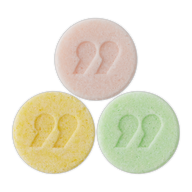
Aromatherapy infuser compatibility: The Showerhand accepts Second Shower's optional aromatherapy infusers ($29.90 for a collection of three scents: Eucalyptus Mint, Lavender Vanilla, and Citrus Bergamot). These small capsules fit into a chamber above the filter and release fragrance as water flows past. The scent doesn't alter filtration performance—it's a separate chamber. Users treating the shower as self-care time (Gen Z buyers, K-beauty enthusiasts) appreciate this optional add-on without forcing it on buyers who just want clean water.
The Showerhand fits renters, parents with young children, pet owners, and anyone in an apartment or dorm where installing a whole-home filter isn't an option. It doesn't fit homeowners wanting a permanent luxury rainfall showerhead (route them to Second Shower's fixed Showerhead with 176 micro-jets) or people with extreme hard water expecting the filter to eliminate all mineral spotting (route them to a whole-home softener, then add the Showerhand for chlorine removal).
What a Handheld Filtered Showerhead Won't Fix
Handheld shower filters excel at removing free chlorine, chloramine, and sediment.
Handheld shower filters excel at removing free chlorine, chloramine, and sediment. They don't solve every water quality problem, and understanding these limitations prevents unrealistic expectations and disappointment.
Won't soften hard water: Filtration removes particulates and neutralizes dissolved chlorine. It doesn't remove dissolved calcium and magnesium ions—the minerals that define water hardness. True water softening requires ion-exchange (where calcium/magnesium swap with sodium ions in a resin bed) or reverse osmosis. If your water measures 15+ grains per gallon hardness, you'll still see mineral spotting on shower glass and some scalp/hair texture issues even with a filtered showerhead. However, removing chlorine often makes hard water feel less harsh because chlorine amplifies the drying effect of minerals. Many users in hard water areas report softer-feeling skin and hair after filtering, even though the mineral content hasn't changed.
Won't remove dissolved heavy metals completely: Vitamin C neutralization targets chlorine and chloramine specifically. The sediment pre-filter traps particulate iron, rust, and sediment down to 5 microns. It doesn't remove dissolved heavy metals like lead (which requires activated carbon with specific contact time) or arsenic (which requires specialty media). If your water has confirmed lead contamination above EPA action levels (15 ppb), you need a whole-home filtration system or point-of-use reverse osmosis, not a shower filter. The shower exposure pathway for heavy metals is primarily dermal absorption, which is minimal compared to ingestion—but filtration claims shouldn't overstate removal capacity.
Won't eliminate all bacteria or viruses: The micron PP sediment filter removes particulates down to 5 microns, which captures some bacteria (typically 0.5-5 microns) but not viruses (0.02-0.3 microns). Municipal water in the U.S. is already disinfected and tested for pathogens—the chlorine you're removing was added to kill bacteria. If you're on well water or in an area with a boil-water advisory, a shower filter isn't a substitute for proper disinfection. The filter's purpose is removing disinfectant residuals (chlorine/chloramine) that irritate skin and hair, not providing pathogen protection.
Won't fix low water pressure caused by plumbing issues: If your entire house has weak water pressure (under 40 PSI), a filtered showerhead won't create pressure that isn't there. The Showerhand's 128 micro-jets maintain existing pressure without additional loss—but they can't boost inadequate supply pressure. Low pressure usually stems from corroded pipes, undersized plumbing, municipal supply issues, or a failing pressure regulator. Fix the underlying pressure problem first, then add filtration. If your pressure is adequate (50+ PSI) but drops significantly with a filtered showerhead, that's the filter creating backpressure—a problem the Showerhand's micro-jet design avoids.
Won't eliminate chlorine smell if your water uses chloramine and you're using a KDF-only filter: This is a common complaint in reviews of competitor products. A user installs a "shower filter guaranteed to remove chlorine," still smells chlorine, and assumes the filter is defective. The actual problem: their utility uses chloramine (not chlorine), and the filter uses KDF-55 (effective on chlorine, largely ineffective on chloramine). Check your water utility's Consumer Confidence Report (CCR) online—search "[your city] water quality report." Look for the disinfectant type. If it says "chloramine" or "monochloramine," you need a Vitamin C-based filter, not KDF.
Won't last longer than 30-45 days of actual performance: Manufacturer claims of 6-month or 12-month filter life are based on low-flow scenarios or minimal chlorine levels that don't reflect real-world use. In a household with 15-minute showers at 2.5 GPM, you're processing 37.5 gallons per shower. Over 30 days, that's 1,125 gallons. The Vitamin C in the filter is a consumable—once it's reacted with chlorine, it's depleted. When you notice returning chlorine smell or the Truth Window shows significant discoloration, the filter's capacity is exhausted. Stretching replacement beyond that window means you're showering in unfiltered water while thinking you're protected.
Won't substitute for medical treatment of skin conditions: Filtering chlorinated water can reduce irritation for people with eczema, rosacea, psoriasis, or sensitive skin—but it's not a cure. These conditions have complex triggers (genetics, immune response, environmental factors). Removing one aggravant (chlorine) helps, but you still need dermatologist-prescribed treatment for active flares. Frame a shower filter as part of a comprehensive skincare routine, not a standalone solution. If your skin doesn't improve within 2-3 weeks of filtering, consult a dermatologist rather than assuming the filter isn't working.
Understanding what a handheld filtered showerhead won't do clarifies what it will do: remove chlorine and chloramine, reduce sediment, and create a gentler shower experience for skin and hair. That's valuable for most users, but it's not a whole-home water treatment system condensed into a $89 device.
Next Step
Use a verified product path and track outcomes over the first replacement cycle.
Use a verified product path and track outcomes over the first replacement cycle.
Vitamin C handheld filter — 99.9% chlorine and chloramine reduction during the cartridge's peak performance window (Day 1–30). $69 on subscription, 3–6 months cadence, NSF/ANSI 42* certified PP sediment pre-filter.
Shop the Second ShowerhandRelated Reading
FAQ
What should I compare when choosing a shower filter?
Focus on: filtration certifications (NSF), what contaminants it removes, replacement cost and frequency, and impact on water pressure.
Are more expensive shower filters actually better?
Not always. Price doesn't guarantee performance. Look for NSF certification and check what specific contaminants the filter is tested to remove.
Does Second Shower offer better value than competitors?
Second Shower combines NSF-certified Vitamin C filtration, consistent water pressure, and competitive replacement costs — a strong overall value proposition.



Leave a comment
All comments are moderated before being published.
This site is protected by hCaptcha and the hCaptcha Privacy Policy and Terms of Service apply.