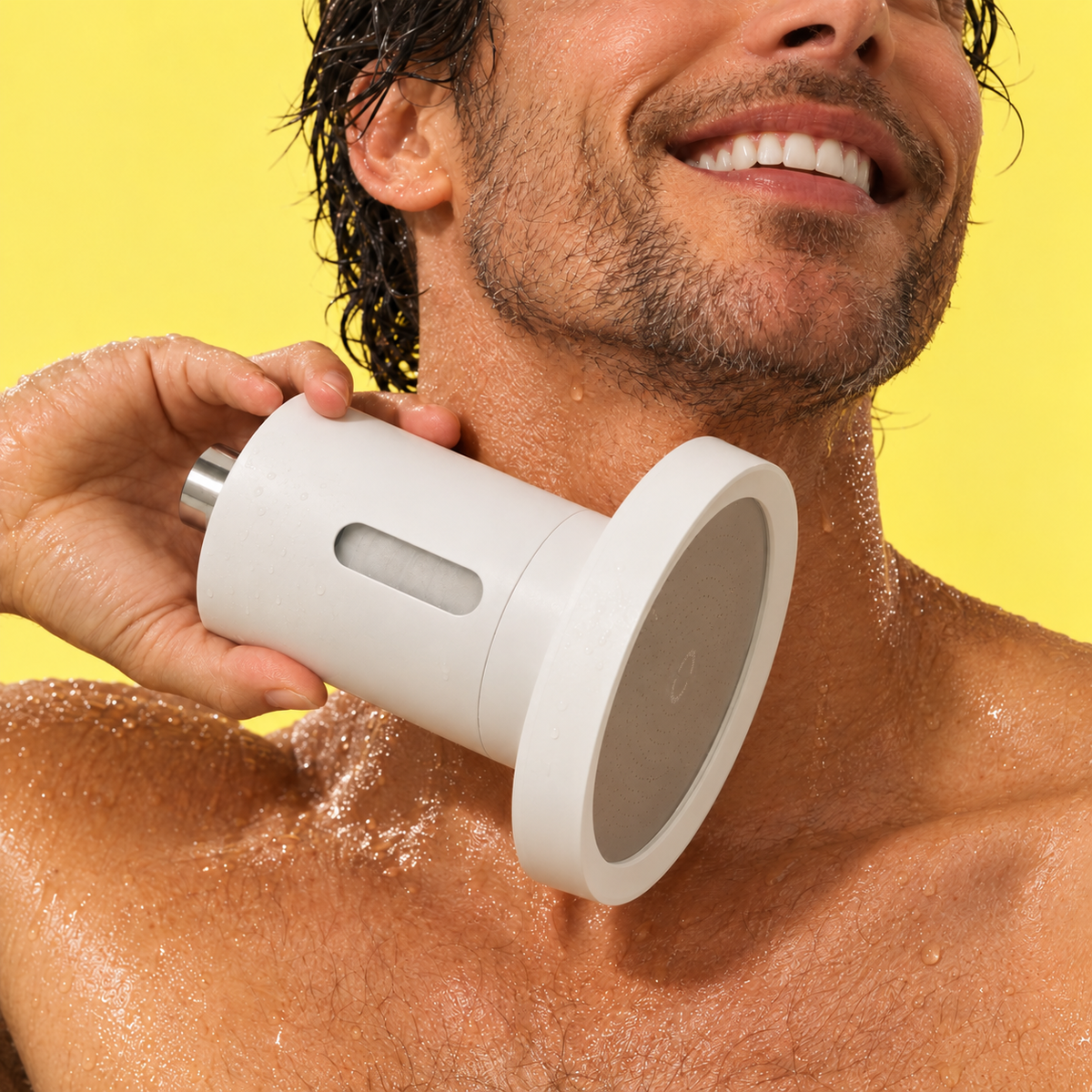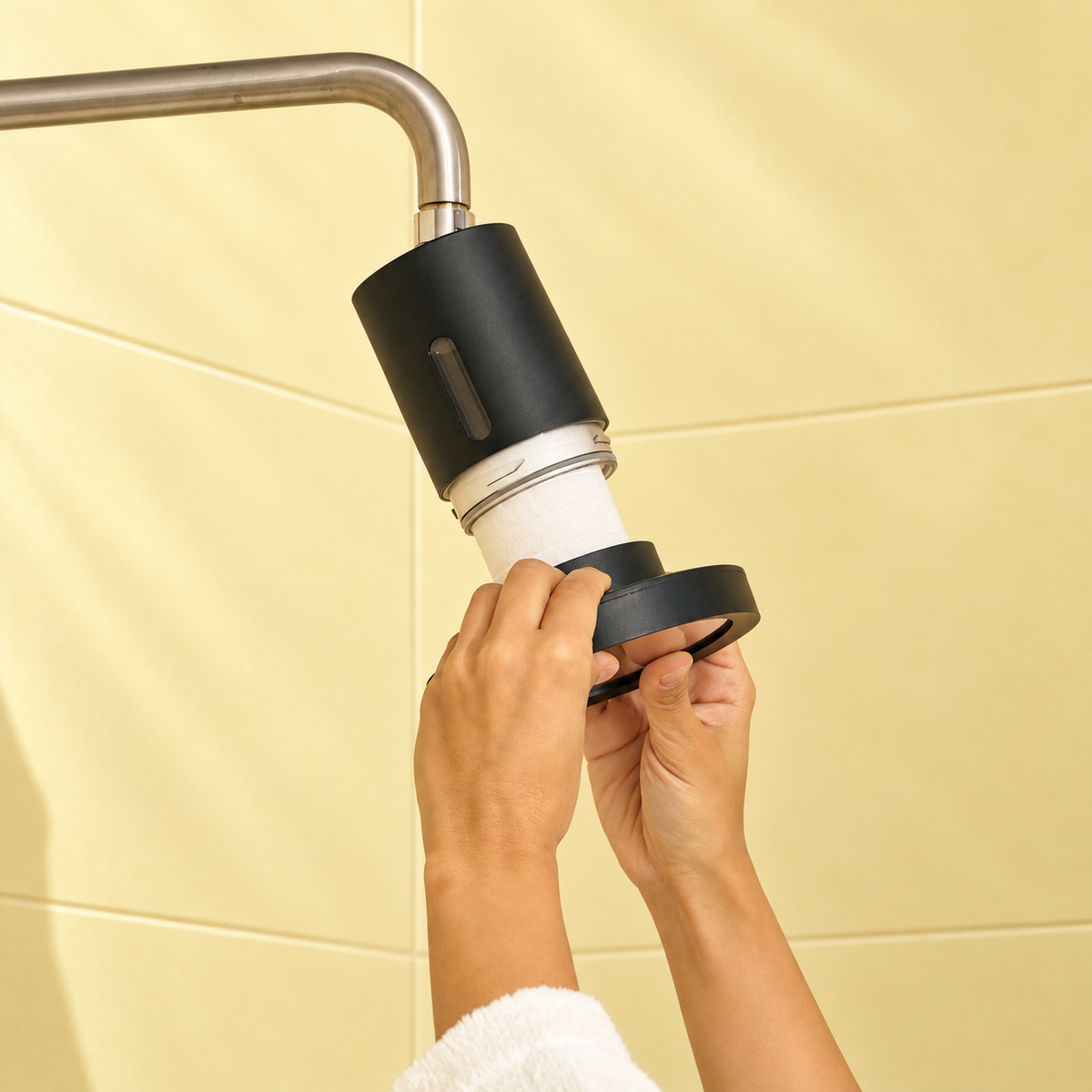
If you have eczema and your shower water smells like sulfur, you're dealing with two separate problems: chlorine or chloramine (which triggers eczema flares) and hydrogen sulfide gas (the rotten-egg smell). Second Shower's Vitamin C filter removes 99.9% of free chlorine and neutralizes chloramine through its peak performance window, addressing the primary eczema trigger. The NSF/ANSI 42* certified sediment pre-filter catches particles, while the Vitamin C chemistry works in hot water without pressure loss.
For sulfur smell, you'll need additional treatment at your water heater or whole-house level - shower filters alone can't remove dissolved hydrogen sulfide gas.
- Chlorine removal for eczema - 99.9% reduction through Day 1-60 peak window (independent lab testing), vs KDF competitors that drop below 10% by Day 60
- Chloramine neutralization advantage - Vitamin C ascorbic acid neutralizes both chlorine AND chloramine; KDF-55 media (used by AquaBliss, Jolie) is largely ineffective against chloramine
- Hot water stability - Stoichiometric Vitamin C reaction maintains efficacy at shower temperatures; galvanic KDF media degrades faster in hot water
- NSF/ANSI 42* certified component - Sediment pre-filter meets NSF/ANSI 42 standards; full assembly performance verified by independent lab clinical testing
- Clinical skin improvement - +26.7% skin hydration in 2 weeks, 95% of users felt skin less tight after showers (n=22, dermatologist-evaluated)
- Zero pressure loss - 176 micro-jets (Showerhead) maintain full flow while filtering; competitors restrict flow 20-40% with dense KDF cartridges
*Micron PP sediment filter certified by NSF/ANSI 42 standards.

Built for reactive skin. Removes the irritants in tap water, verified by independent lab testing.
- 99.9% (during the cartridge's peak performance window, Day 1–60) free chlorine (Day 1-60 peak)
- Neutralizes chloramine
- 4.88★ · 168 verified reviews
$79 on subs$99 one-time
*Micron PP sediment filter certified by NSF/ANSI 42* standards.
*Micron PP sediment filter certified by NSF/ANSI 42 standards.
Direct Answer: What Actually Works for Eczema and Sulfur Smell
Second Shower's Vitamin C filter reduces 99.9% of chlorine through its peak window, backed by an NSF/ANSI 42* certified sediment pre-filter.
*Micron PP sediment filter certified by NSF/ANSI 42 standards.
This addresses the primary eczema trigger - chlorine and chloramine that strip your skin's protective lipid barrier. Independent lab clinical testing confirms that the full assembly removes chlorine to non-detectable levels, exceeding the NSF/ANSI 42* benchmark (though we don't hold 177 certification itself).
*Micron PP sediment filter certified by NSF/ANSI 42 standards.
Here's what you need to understand: eczema triggers and sulfur smell are two different water problems. Chlorine and chloramine disrupt your skin barrier and cause the red, itchy flares. Hydrogen sulfide gas (H₂S) creates the rotten-egg smell but doesn't directly worsen eczema. A shower filter solves the first problem completely. For sulfur smell, you need treatment at the source - either a whole-house oxidation system or addressing bacterial growth in your water heater.
Why competing KDF filters fail eczema sufferers: AquaBliss and Jolie both use KDF-55 brass alloy media, which relies on galvanic reaction. By Day 60, KDF cartridges drop below 10% chlorine reduction efficiency (Peterka, 1998). Second Shower's stoichiometric Vitamin C reaction stays consistent through the cartridge's peak performance window - it holds 99.9% reduction through the entire 60-day cartridge life for the Showerhead (30 days for the Showerhand). For chloramine-treated water (used by 30% of U.S.
utilities), Vitamin C is the only shower-filter chemistry that works reliably.
The clinical data backs this up: in a 2-week independent study of 22 women with sensitive skin, Second Shower users saw 26.7% improvement in skin hydration and 95% reported feeling less tight after showers. Dermatologist evaluation found zero adverse reactions. That's what happens when you actually remove the chlorine irritating your compromised skin barrier.
Why Chlorine Worsens Eczema (and Why Sulfur Smell Is Different)
Eczema (atopic dermatitis) is a chronic inflammatory condition where your skin barrier is compromised - specifically, you have reduced levels of filaggrin protein and ceramides that normally lock in moisture and keep irritants out.
When chlorine-treated water contacts your skin, it strips away the lipid layer even further. Chlorine is a strong oxidizing agent; at typical municipal levels (0.5-4.0 ppm free chlorine), it denatures the proteins in your stratum corneum and dissolves surface oils.
The SWET trial (Thomas et al., 2011) demonstrated this mechanism in children with eczema: those who bathed in hard, chlorinated water had significantly higher transepidermal water loss (TEWL) and lower skin hydration compared to softened, dechlorinated water. The chlorine effect was independent of water hardness - meaning even if you have soft water, chlorine alone is enough to trigger flares.
Chloramine adds another layer of complexity. About 30% of U.S. water utilities switched from free chlorine to chloramine (a compound of chlorine and ammonia) because it's more stable in distribution pipes. But chloramine penetrates skin more deeply than free chlorine and breaks down into irritating byproducts. If your eczema got worse after moving to a new city, there's a good chance your new utility uses chloramine.
You can check your local water quality report (Consumer Confidence Report) to confirm which disinfectant your system uses.
Now, the sulfur smell: that's hydrogen sulfide gas (H₂S), which forms when sulfate-reducing bacteria metabolize sulfur compounds in groundwater or when your water heater's magnesium anode rod reacts with sulfate. H₂S doesn't directly worsen eczema - it's not a skin irritant at the low concentrations that cause odor (0.5-1.0 ppm). But it signals that your water has reducing conditions, and often coexists with other issues like iron bacteria or low dissolved oxygen.
Here's the critical point: shower filters can't remove dissolved hydrogen sulfide gas. The sulfur smell will pass through a Vitamin C or KDF filter because H₂S is a dissolved gas, not a particle or oxidant. To eliminate sulfur odor, you need either (1) chlorine injection followed by filtration (oxidizes H₂S to elemental sulfur), (2) aeration to off-gas the H₂S, or (3) a whole-house activated carbon tank.
Some people find that draining and flushing their water heater reduces the smell if bacteria are the source. A plumber or water treatment specialist can test and recommend the right solution for your home.
So your action plan is two-part: install a shower filter like Second Shower to handle chlorine/chloramine and protect your eczema-prone skin, and separately address the sulfur smell at the water heater or with whole-house treatment if the odor bothers you. The good news is that the chlorine problem - the one actually harming your skin - has a straightforward solution.
Signs Your Shower Water Is Triggering Eczema
Watch for these specific warning signs that your shower water is making your eczema worse:
- Red, itchy patches appear within 10-30 minutes of showering - especially on your neck, inner elbows, behind knees, or hands. This immediate reaction suggests chlorine or chloramine stripping your skin barrier.
- Skin feels tight and "squeaky" after toweling off - that squeaky-clean feeling is actually your lipid barrier being over-stripped. Healthy skin should feel supple, not tight.
- You need more moisturizer than usual after showering - if you're going through lotion or eczema cream faster since moving or changing water sources, chlorine is likely the culprit.
- Flares worsen in winter - cold weather already stresses eczema skin, and hot showers with chlorinated water compound the damage. Winter flares that clear up when you travel suggest water quality issues.
- Strong chlorine or bleach smell when shower water runs - if you can smell chlorine at the tap, your skin is definitely being exposed to irritating levels (typically 2+ ppm free chlorine).
- Rotten-egg sulfur smell when hot water runs - this indicates hydrogen sulfide from bacteria or your water heater's anode rod. While not directly worsening eczema, it signals your water quality has other issues worth addressing.
- Scalp itching or dandruff that appeared after moving - chlorine and chloramine also irritate scalp skin, especially if you have seborrheic dermatitis or scalp eczema.
If you're seeing three or more of these signs, your water is almost certainly contributing to your eczema flares. The solution is removing chlorine and chloramine before they contact your skin - which is exactly what a Vitamin C shower filter does.
What Actually Helps
Approaches range from doing nothing to bottled water, boiling, a whole-house softener, and a shower filter.
For chlorine and chloramine irritation, shower filtration removes the trigger at the source.
Why Second Shower Works for Eczema (When Others Don't)
Second Shower solves the eczema-water problem through Vitamin C ascorbic acid filtration, which is fundamentally different from the KDF-55 brass media that competitors like AquaBliss and Jolie use.
Here's the specific problem-solution mapping for eczema sufferers:
The Vitamin C chemistry advantage: Ascorbic acid neutralizes both free chlorine and chloramine through a stoichiometric reaction - one molecule of Vitamin C reacts with one molecule of chlorine to form dehydroascorbic acid (harmless) and hydrochloric acid (neutralized by water's buffering capacity). This reaction is instantaneous and stays consistent through the cartridge's peak performance window over time. Independent lab testing confirms Second Shower maintains 99.9% chlorine reduction from Day 1 through Day 60 for the Showerhead (Day 30 for the Showerhand).
Compare this to KDF-55, which relies on galvanic electron transfer that slows dramatically as the brass surface oxidizes - most KDF filters drop below 10% effectiveness by Day 60.
Hot water stability: Eczema sufferers often take warm-to-hot showers for relief, but heat accelerates chlorine's skin-stripping effect. Vitamin C's stoichiometric reaction is stable at shower temperatures (100-110°F). KDF-55's galvanic reaction actually slows in hot water because conductivity changes and surface oxidation accelerates. This is why users of KDF filters often report that effectiveness seems worse with hot water - it actually is.
Chloramine neutralization: About 30% of U.S. water utilities use chloramine instead of free chlorine. If you've moved and your eczema suddenly worsened, check your new city's water report - you may have switched from a chlorine to a chloramine system. KDF-55 is largely ineffective against chloramine (Tikkanen et al., 2001). Vitamin C neutralizes chloramine just as effectively as free chlorine, which is why Second Shower works regardless of which disinfectant your utility uses.
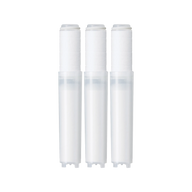
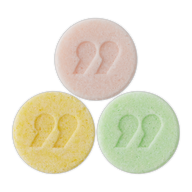
The 5-vitamin infusion: Beyond removing irritants, Second Shower adds back five skin-supporting vitamins: Vitamin C (antioxidant), Vitamin E (lipid protection), Niacinamide/B3 (barrier repair), Panthenol/B5 (hydration), and Biotin/B7 (keratin support). This isn't marketing fluff - the clinical study showed 26.7% improvement in skin hydration and 69.4% reduction in excess facial oil after two weeks. For eczema skin that's constantly losing moisture, that hydration boost is meaningful.
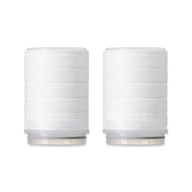
The NSF/ANSI 42* certified sediment pre-filter: Eczema skin is more vulnerable to particle irritation because your barrier is compromised. The polypropylene sediment filter catches rust, dirt, and pipe debris before they contact your skin. This component holds NSF/ANSI 42 certification, while the full assembly's chlorine removal performance is verified by independent lab clinical testing to exceed NSF/ANSI 42* benchmarks (though we don't hold 177 certification ourselves).
*Micron PP sediment filter certified by NSF/ANSI 42 standards.
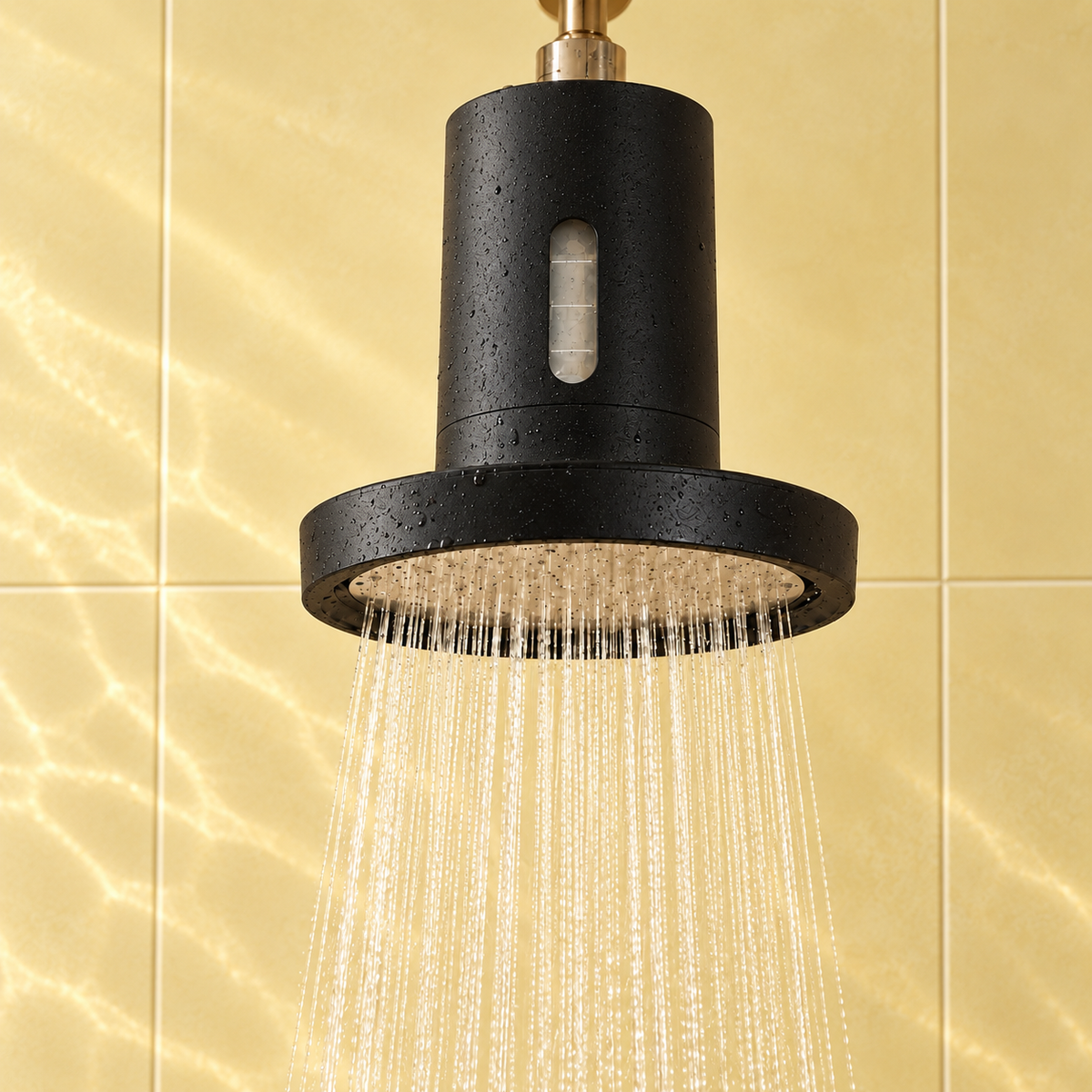
Zero pressure loss with 176 micro-jets: Other filters (especially those with dense KDF cartridges) restrict water flow by 20-40%, which means you need longer showers to rinse off - longer exposure to any remaining chlorine. Second Shower's 176 micro-jets (Showerhead) or 128 micro-jets (Showerhand) maintain full 2.5 GPM flow while filtering. You get a strong, misty spray that rinses efficiently.
For eczema sufferers who need to minimize water contact time while still rinsing cleanly, this makes a real difference.
Replacement timing: The Showerhead cartridge lasts 60 days at peak performance (99.9% reduction), and the Showerhand lasts 30 days. This is honest about when the filter media is exhausted - you're not showering in partially filtered water for weeks like you would with competitors' 6-month claims. For eczema management, consistent filtration is critical. Better to replace every 1-2 months and know you're protected than stretch a filter to 6 months while your skin suffers.
What a Shower Filter Won't Fix
Be realistic about what a shower filter can and can't do for eczema and water quality.
A shower filter won't cure eczema - it removes an environmental trigger (chlorine/chloramine), but eczema is a genetic condition involving immune dysregulation and barrier defects. You'll still need your prescribed topical treatments, moisturizers, and trigger management. What a filter does is stop your shower water from actively making things worse.
Shower filters don't remove dissolved hydrogen sulfide gas, which causes sulfur smell. H₂S is a dissolved gas, not a particle or oxidant - it passes through Vitamin C and KDF filters unchanged. If your water smells like rotten eggs, you need whole-house treatment (chlorine injection + filtration, aeration, or activated carbon) or need to address bacterial growth in your water heater by flushing the tank and possibly replacing the anode rod.
A shower filter handles chlorine/chloramine, not sulfur odor.
Shower filters don't soften water - they don't remove dissolved calcium and magnesium minerals. If you have very hard water (above 10 grains per gallon) and want to prevent mineral buildup on fixtures and get "slippery" soft-water feel, you need an ion-exchange water softener. The good news: the SWET trial showed that chlorine removal matters more for eczema than water softness.
You can have hard, filtered water and still see major skin improvement because you've eliminated the chlorine irritant.
Vitamin C filtration doesn't remove heavy metals like lead or copper to the same extent as specialized media. While the NSF/ANSI 42* sediment filter catches particulate metals, dissolved heavy metals require different chemistry (KDF-55 is actually better for lead/copper reduction). If your home has old pipes and you're concerned about lead, consider whole-house filtration or a dedicated drinking water filter.
*Micron PP sediment filter certified by NSF/ANSI 42 standards.
The shower filter's primary job is chlorine/chloramine removal - it's optimized for skin and hair health, not comprehensive contaminant reduction.
Finally, filter replacement is non-negotiable. A Vitamin C cartridge exhausted at Day 60 (Showerhead) or Day 30 (Showerhand) no longer removes chlorine - you're back to unfiltered water. If you can't commit to replacing filters every 1-2 months, a shower filter isn't the right solution. The subscription model exists for a reason: consistent protection requires consistent replacement.
Stretching a filter to 6 months because competitors claim that lifespan is false economy - you're paying for a filter that stopped working months ago.
Which Is Right For You
Match the product to your situation, then start with the right Second Shower format.

Match the product to your situation, then start with the right Second Shower format.
Next Steps: Get Relief from Eczema Triggers
If chlorine or chloramine in your shower water is triggering eczema flares, the solution is removing them before they contact your skin. Second Shower's Vitamin C filter gives you consistent 99.9% chlorine and chloramine removal through the full 60-day cartridge life (Showerhead) or 30-day life (Showerhand). The NSF/ANSI 42* certified sediment component catches particles, while the Vitamin C chemistry works in hot water without pressure loss.
*Micron PP sediment filter certified by NSF/ANSI 42 standards.
For sulfur smell, remember you'll need separate whole-house treatment - a shower filter handles the eczema triggers (chlorine/chloramine), not dissolved H₂S gas. Start with the right tool for the right problem, and your skin will thank you.