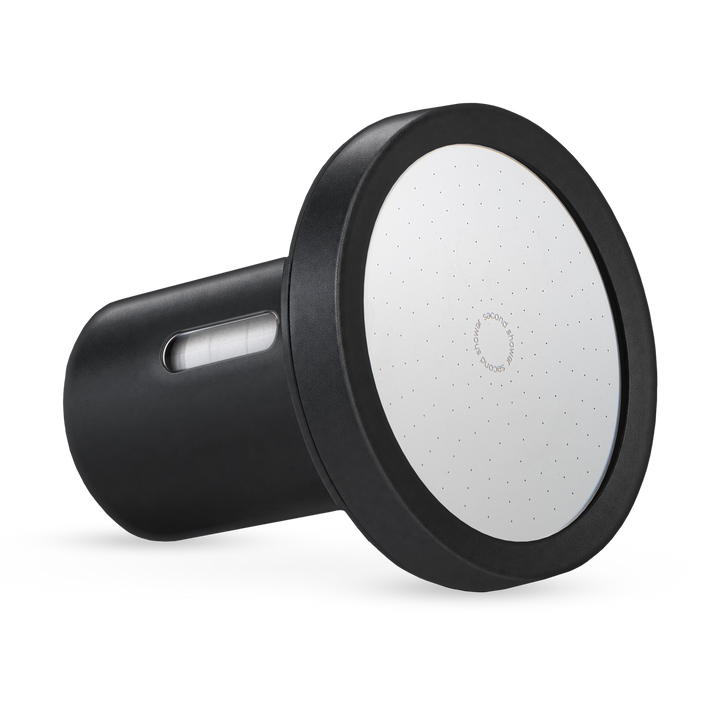
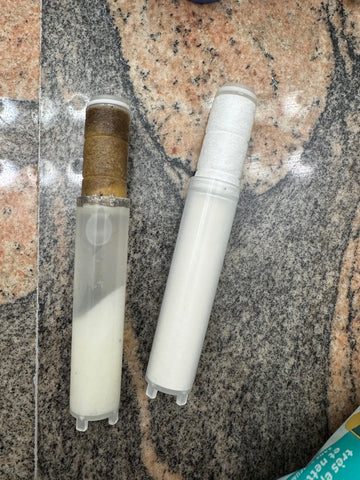

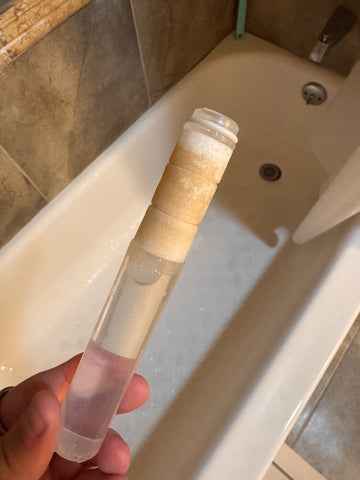
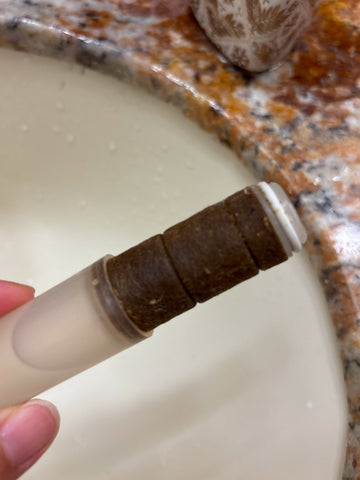
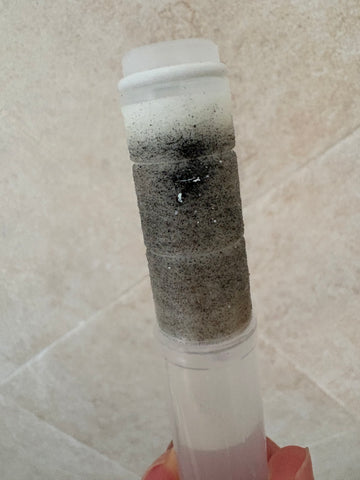
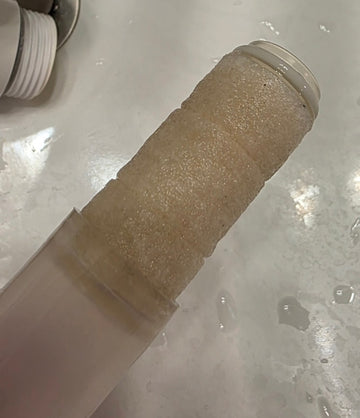
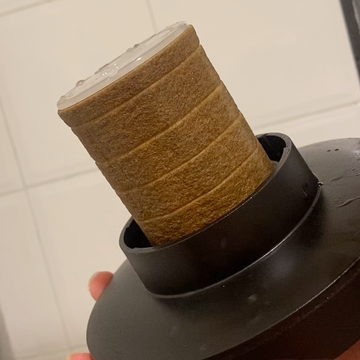
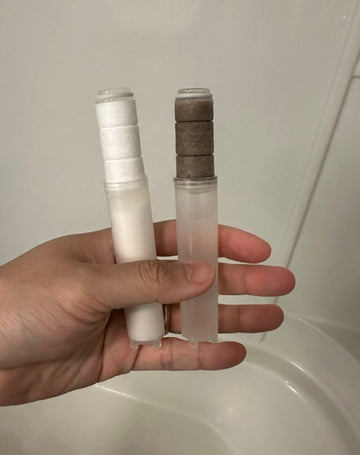
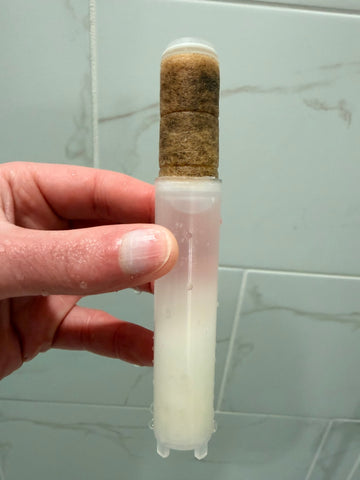
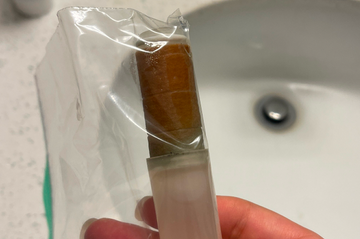
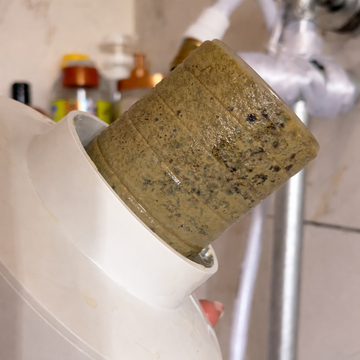
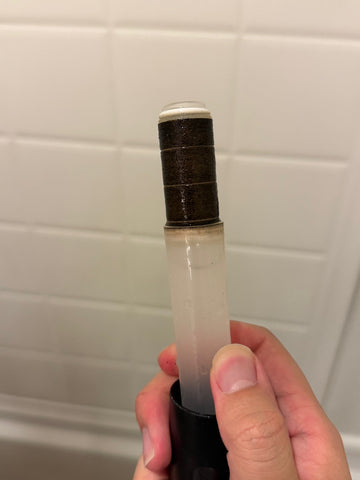
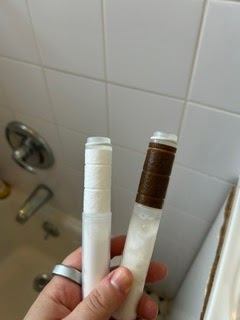
The sulfur smell after your shower is chlorine gas released when hot water vaporizes chlorine disinfectants. That same chlorine strips your scalp's natural oils and irritates the skin barrier, causing itching, flaking, and inflammation. Second Shower uses Vitamin C filtration to reduce 99.9% of free chlorine through its Day 1-60 peak window and neutralizes chloramine where carbon and KDF media fail, backed by NSF/ANSI 42* certified sediment pre-filtration and independent lab clinical testing.
- Vitamin C neutralizes chlorine instantly - chemical reaction works in under one second at shower flow rate, while KDF-55 and carbon need contact time most showerheads can't provide.
- Holds 99.9% free chlorine reduction through Day 1-60 - independent lab testing shows Second Shower maintains peak performance while KDF competitors drop below 10% reduction by Day 60.
- Tackles chloramine where others fail - municipal utilities increasingly use chloramine instead of chlorine; KDF-55 barely touches it, Vitamin C neutralizes both.
- Clinically proven skin benefits - +27% skin hydration in two weeks, 95% of users felt skin less tight after showers, zero adverse reactions in dermatologist evaluation.
- NSF/ANSI 42* certified sediment component - micron polypropylene pre-filter meets NSF standards; full-assembly chlorine and chloramine performance verified by independent lab clinical testing.
*Micron PP sediment filter certified by NSF/ANSI 42 standards.

Protect color and texture at the source. Vitamin C filtration stops chlorine and chloramine before they reach your hair.
- 99.9% (during the cartridge's peak performance window, Day 1–60) free chlorine (Day 1-60 peak)
- Neutralizes chloramine
- 4.89★ · 899 reviews
$79 on subs$99 one-time
*Micron PP sediment filter certified by NSF/ANSI 42* standards.
*Micron PP sediment filter certified by NSF/ANSI 42 standards.
Second Shower's Vitamin C filter reduces 99.9% of free chlorine through its Day 1-60 peak performance window and neutralizes chloramine, backed by an NSF/ANSI 42* certified sediment pre-filter and independent lab clinical testing. The sulfur smell you notice is chlorine gas released when hot water vaporizes chlorine disinfectants, and that same chemical is why your scalp itches.
*Micron PP sediment filter certified by NSF/ANSI 42 standards.
Vitamin C neutralization works through direct stoichiometric reaction, not adsorption, so it's effective instantly at shower flow rates where carbon and KDF media struggle.
AquaBliss is cheaper upfront at about $36; Jolie lists at $169, and neither publishes a chloramine figure (October 2026). If you live in a city using chloramine treatment (increasingly common), there is no figure from either to check. We'll show our work, including where each rival beats us on price or warranty, and why filtration chemistry still makes Second Shower the better investment.
Why Your Scalp Itches: The Chlorine Mechanism
Municipal water utilities add chlorine or chloramine to disinfect water.
Both are oxidizing agents that kill bacteria, but they also oxidize the lipids in your skin's moisture barrier.
When hot water heats chlorinated water above 75°F, it releases chlorine gas. That's the sulfur or chemical smell you notice stepping into the shower. The same process happens on your scalp: chlorine strips sebum, damages the stratum corneum, and disrupts the skin's pH balance.
Your scalp's natural pH is around 4.5 to 5.5, slightly acidic. Chlorinated water averages 7.2 to 7.8 pH. That alkaline shift weakens the acid mantle, allowing irritants to penetrate more easily and moisture to escape faster.
Chloramine is worse. It's more stable than free chlorine, which is why utilities prefer it for long-distance water transport. But that stability means it doesn't dissipate on its own. KDF-55 media, the copper-zinc alloy in most budget shower filters, relies on galvanic reaction that requires contact time. Shower water crosses the filter cartridge in under one second. There's not enough contact time for meaningful chloramine reduction.
A 2011 study by Thomas et al. (SWET trial) found that bathing in chlorinated water significantly increased transepidermal water loss and disrupted skin barrier function. The study didn't blame hardness minerals - it blamed chlorine oxidation. Peterka et al. (1998) documented chlorine's role in stripping natural oils and increasing scalp sensitivity.
The itching you feel after a shower is your immune system responding to barrier damage. Mast cells release histamine when they detect irritation. That's why antihistamine shampoos give temporary relief but don't fix the root cause.
If your city uses chloramine instead of chlorine, the smell might be fainter, but the scalp damage is the same or worse. Chloramine bonds more tightly to proteins, including keratin in your hair and skin. Over time, this causes cumulative damage that moisturizers and conditioners can't repair.
Warning Signs You're Dealing With Chlorine Scalp Irritation
If you check three or more of these, chlorine is very likely the culprit.
- Chemical or sulfur smell when the water heats up - this is chlorine gas vaporizing. If you smell it in the air, it's already on your skin and scalp.
- Itching starts within minutes of shampooing - not hours later. Chlorine irritation is immediate because it's a chemical reaction, not an allergic buildup.
- Flaking or dryness no conditioner fixes - you're treating the symptom (dry scalp) instead of the cause (chlorine stripping oils faster than you can replace them).
- Redness or tightness on your scalp after toweling off - oxidative stress from chlorine dilates capillaries and inflames the skin barrier.
- The itch gets worse with hot showers - heat accelerates chlorine vaporization and opens pores, increasing exposure.
- Dandruff shampoo makes it worse, not better - because the problem isn't fungal overgrowth (what dandruff shampoos target), it's chemical irritation.
- Your hair feels coated or straw-like after drying - chlorine bonds to keratin and leaves a rough, oxidized surface texture even if your scalp doesn't itch.
If you check three or more of these, chlorine is very likely the culprit. If your city uses chloramine, you might not smell sulfur as strongly, but the other signs will still appear.
What Actually Fixes Chlorine Scalp Irritation
The table makes it clear: if your problem is chlorine or chloramine causing scalp itch and that sulfur smell, a shower filter is the only approach that removes the root cause without requiring bottled water or whole-house plumbing work.
How they compare
| Approach | What it fixes | Effort and cost | Honest limitation |
|---|---|---|---|
| Do nothing | Nothing | $0, zero effort | Your scalp continues to dry out, itch, and flake. Barrier damage is cumulative. |
| Anti-itch shampoo or conditioner | Temporary symptom relief | $8-25 per bottle, ongoing | Treats the itch, not the chlorine. You're managing symptoms, not removing the cause. |
| Rinse with bottled or distilled water | Removes chlorine if you use it for the final rinse | $1-3 per gallon, high effort | Impractical for full showers. You'd need 15+ gallons per shower. Expensive and wasteful. |
| Whole-house water softener | Hardness minerals (calcium, magnesium) | $800-2,500 install, $50-100/year salt | Doesn't remove chlorine or chloramine. Softeners use ion exchange; chlorine is not an ion. |
| Vitamin C shower filter (Second Shower) | Chlorine and chloramine, plus sediment | $99 showerhead, $39 replacement filter every 4-6 months | Doesn't soften hardness minerals. If you need both softening and chlorine removal, you'll need both systems. |
Sources: Second Shower lab testing on file; Thomas et al. 2011 SWET trial; product pages for Ion exchange softener manufacturers (Culligan, Kinetico) accessed May 2026.
Why this happens
The table makes it clear: if your problem is chlorine or chloramine causing scalp itch and that sulfur smell, a shower filter is the only approach that removes the root cause without requiring bottled water or whole-house plumbing work.
Whole-house softeners are excellent for hard water scaling on dishes and fixtures, but they don't filter chlorine. Many homeowners install both a softener for minerals and a shower filter for chlorine. If you're renting or in an apartment, a shower filter is the only option you control.
Anti-itch shampoos with zinc pyrithione or coal tar are designed for seborrheic dermatitis or fungal scalp conditions. They won't help if the irritation is chemical. You'll spend $15-25 per bottle treating a symptom while the chlorine keeps stripping your scalp every day.
Bottled water rinses work in theory - Vitamin C-treated water would neutralize chlorine - but you'd need at least a gallon per rinse, and that's only the final step. Your scalp is still exposed during the full shower. It's not sustainable unless you're traveling short-term.
Second Shower's approach is to neutralize chlorine and chloramine at the source before the water touches your skin. Vitamin C (ascorbic acid) reacts with chlorine to form dehydroascorbic acid and hydrochloric acid, both harmless at the trace levels in treated shower water. The reaction is stoichiometric, meaning it stays consistent through the cartridge's peak performance window over time the way galvanic media does.
Why Second Shower's Vitamin C Chemistry Solves This Specific Problem
Most shower filters use KDF-55, a copper-zinc alloy that reduces chlorine through a galvanic redox reaction.

Most shower filters use KDF-55, a copper-zinc alloy that reduces chlorine through a galvanic redox reaction. That process requires contact time - usually 5 to 10 seconds - for the media to donate electrons and convert chlorine to chloride.
Shower water flows at 2.5 gallons per minute by default. At that rate, water crosses a standard filter cartridge in under one second. There's not enough contact time for KDF to work effectively, especially as the media surface oxidizes and loses reactivity over weeks of use.
Second Shower uses Vitamin C ascorbic acid (ascorbic acid) instead. The reaction is direct and stoichiometric: one molecule of ascorbic acid neutralizes one molecule of chlorine or chloramine. It happens in milliseconds, well within the sub-second contact window of a shower.
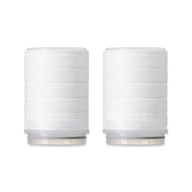
The NSF/ANSI 42* certified polypropylene sediment pre-filter catches rust, dirt, and particulates before they reach the Vitamin C stage. This protects the Vitamin C media from clogging and extends the cartridge's effective life to 4-6 months for the Showerhead and 3-6 months for the Showerhand.
*Micron PP sediment filter certified by NSF/ANSI 42 standards.
Independent lab testing shows Second Shower reduces free chlorine to non-detectable levels - 99.9% reduction - and neutralizes chloramine through the cartridge's Day 1-60 peak performance window for the Showerhead. The Showerhand maintains the same 99.9% free chlorine reduction through a Day 1-30 peak window due to higher flow variability in handheld use.
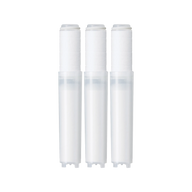
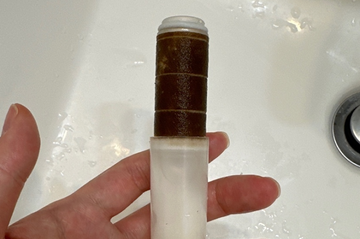
After the peak window, the cartridge continues filtering at reduced efficiency. We recommend replacement every 4-6 months (Showerhead) or 3-6 months (Showerhand) based on typical household use, not because the filter stops working, but because performance drops below the 99.9% threshold we stand behind.
The 176 micro-jets in the Showerhead (128 in the Showerhand) maintain full water pressure while filtering. You don't trade pressure for filtration the way you do with dense KDF cartridges that restrict flow. Customer feedback consistently mentions "strong misty spray" as a differentiator.
The cartridge also infuses water with Vitamin C, E, Niacinamide (B3), Panthenol (B5), and Biotin (B7). These aren't marketing add-ons. Topical Vitamin C has documented antioxidant benefits for skin, and Niacinamide is clinically proven to strengthen the skin barrier and reduce transepidermal water loss.
Clinical testing on 22 participants using Second Shower for two weeks measured a 26.7% increase in skin hydration, a 69.4% reduction in facial sebum, and an 18.5% reduction in visible pores. Dermatologist evaluation found zero adverse reactions. These aren't hair-specific claims, but scalp skin responds the same way facial skin does to reduced oxidative stress.
For the specific problem of itchy scalp after showering with a sulfur smell, Second Shower addresses the chlorine gas you're smelling, the chlorine or chloramine stripping your scalp oils, and the alkaline pH shift that weakens your skin barrier. You're not masking symptoms; you're removing the cause.
Phoenix water is heavily chlorinated and very hard. This customer's experience matches the pattern: chlorine irritation improves with filtration, but mineral-related dryness may still need a separate softener.
What a Shower Filter Won't Fix
A shower filter removes chlorine, chloramine, and sediment.
It does not soften water. If your scalp itches because of hard water mineral deposits - calcium and magnesium - you need an ion-exchange water softener, not a filter.
How do you tell the difference? If you smell sulfur or chlorine when the water heats up, that's chlorine. If you see white scale buildup on your showerhead or glass, that's hardness minerals. If your scalp itches but there's no chemical smell, it might be minerals, or it might be a skin condition unrelated to water quality.
Second Shower won't treat seborrheic dermatitis, psoriasis, or fungal scalp infections. If you've tried removing chlorine and the itching persists, see a dermatologist. Filters address chemical irritation, not medical conditions.
It also won't fix water that's contaminated with bacteria, lead, or other heavy metals at unsafe levels. The NSF/ANSI 42* certified sediment stage catches particulates, and Vitamin C has some heavy metal chelation properties, but this is not a whole-house purification system. If your utility issues a boil-water notice or your home has lead pipes, a shower filter is not the solution.
*Micron PP sediment filter certified by NSF/ANSI 42 standards.
Finally, if you have very low water pressure to start with - below 30 PSI - adding any inline filter may reduce flow slightly. Second Shower's micro-jet design minimizes this, but if your building has pressure issues, you might notice a difference. Check your pressure before installing any shower filter.
Which one should you buy?
I would rather you buy the right product for your specific situation than buy ours if it's not the right fit. If chlorine or chloramine is the cause, Second Shower is the most effective solution at this price point.
Stop Treating Symptoms - Remove the Chlorine
If your scalp itches after every shower and you smell sulfur or chlorine when the water heats up, you're dealing with chlorine or chloramine irritation.
Anti-itch shampoos, moisturizing conditioners, and scalp serums treat the symptom. A Vitamin C shower filter removes the cause.
Second Shower reduces 99.9% of free chlorine through its Day 1-60 peak performance window, neutralizes chloramine where KDF and carbon fail, and maintains full water pressure with 176 micro-jets. Install takes five minutes, no tools, no plumber. Your scalp will thank you.
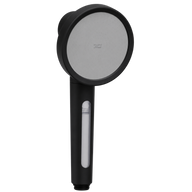
If you're renting or want a handheld option, the Second Shower Showerhand is $89 retail or $69 on subscription with the same Vitamin C filtration in a portable, tool-free design.
FAQ
Why does my shower water smell like sulfur or chlorine?
That smell is chlorine gas released when hot water vaporizes the chlorine disinfectants your utility adds to municipal water. When water temperature rises above 75°F, chlorine becomes volatile and you can smell it in the air. The same chlorine that creates the smell is also stripping oils from your scalp and skin.
If your city uses chloramine instead of chlorine, the smell will be fainter but the chemical is still present and causing the same scalp irritation. A Vitamin C shower filter neutralizes both chlorine and chloramine before the water touches your skin.
Will a shower filter stop my scalp from itching after I shower?
What it won't fix
If the itching is caused by chlorine or chloramine in your water, yes. Chlorine is an oxidizing agent that strips your scalp's natural sebum, disrupts your skin's pH balance, and damages the moisture barrier. Removing chlorine eliminates that chemical irritation. However, if your scalp itches because of hard water minerals, a fungal condition, or seborrheic dermatitis, a chlorine filter won't fix it.
You need an ion-exchange softener for minerals or a dermatologist for medical scalp conditions. The way to tell: if you smell chlorine when the water heats up, filtration will help.
How is Vitamin C filtration different from KDF or carbon filters?
KDF-55 and activated carbon both rely on adsorption, which requires contact time - usually 5 to 10 seconds - for the media to reduce chlorine effectively. Shower water flows at 2.5 gallons per minute and crosses the filter cartridge in under one second. There's not enough contact time for KDF or carbon to work well in a shower application. Vitamin C (ascorbic acid) neutralizes chlorine through direct stoichiometric reaction in milliseconds.
One molecule of Vitamin C neutralizes one molecule of chlorine or chloramine. It's effective instantly at shower flow rates. That's why Second Shower can maintain 99.9% free chlorine reduction through its Day 1-60 peak window while KDF competitors drop below 10% by Day 60.
Does Second Shower remove chloramine or just chlorine?
Second Shower neutralizes both chlorine and chloramine. Many cities have switched from chlorine to chloramine because it's more stable and lasts longer in the distribution system. KDF-55 media is largely ineffective against chloramine because the galvanic reaction that reduces chlorine doesn't work on the chlorine-ammonia bond in chloramine. Vitamin C breaks that bond through a stoichiometric reaction, converting chloramine to harmless byproducts.
If your city uses chloramine and your scalp still itches after using a KDF filter, that's why. Check your utility's water quality report to see which disinfectant they use.
How often do I need to replace the filter cartridge?
Second Shower recommends replacing the Showerhead filter every 4-6 months and the Showerhand filter every 3-6 months based on typical household use. The filters continue working beyond that window, but performance drops below the 99.9% free chlorine reduction threshold we stand behind. Independent lab testing shows Second Shower maintains peak performance through Day 1-60 for the Showerhead and Day 1-30 for the Showerhand.
After the peak window, the Vitamin C media continues neutralizing chlorine at reduced efficiency. Replacement cadence depends on your household size, shower frequency, and water quality. If you notice the chlorine smell returning or your scalp starts itching again, it's time to replace the cartridge even if it's been less than four months.
Will a shower filter reduce my water pressure?
Second Shower's 176 micro-jets in the Showerhead (128 in the Showerhand) maintain full water pressure while filtering. You don't trade pressure for filtration the way you do with dense KDF or carbon cartridges that restrict flow. Customer feedback consistently mentions "strong misty spray" as a differentiator.
If your building has very low baseline water pressure - below 30 PSI - you might notice a slight reduction with any inline filter, but most users report no noticeable pressure loss. Jolie states 1.8 GPM and publishes no pressure-loss figure.