




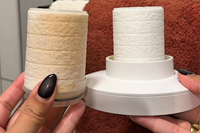
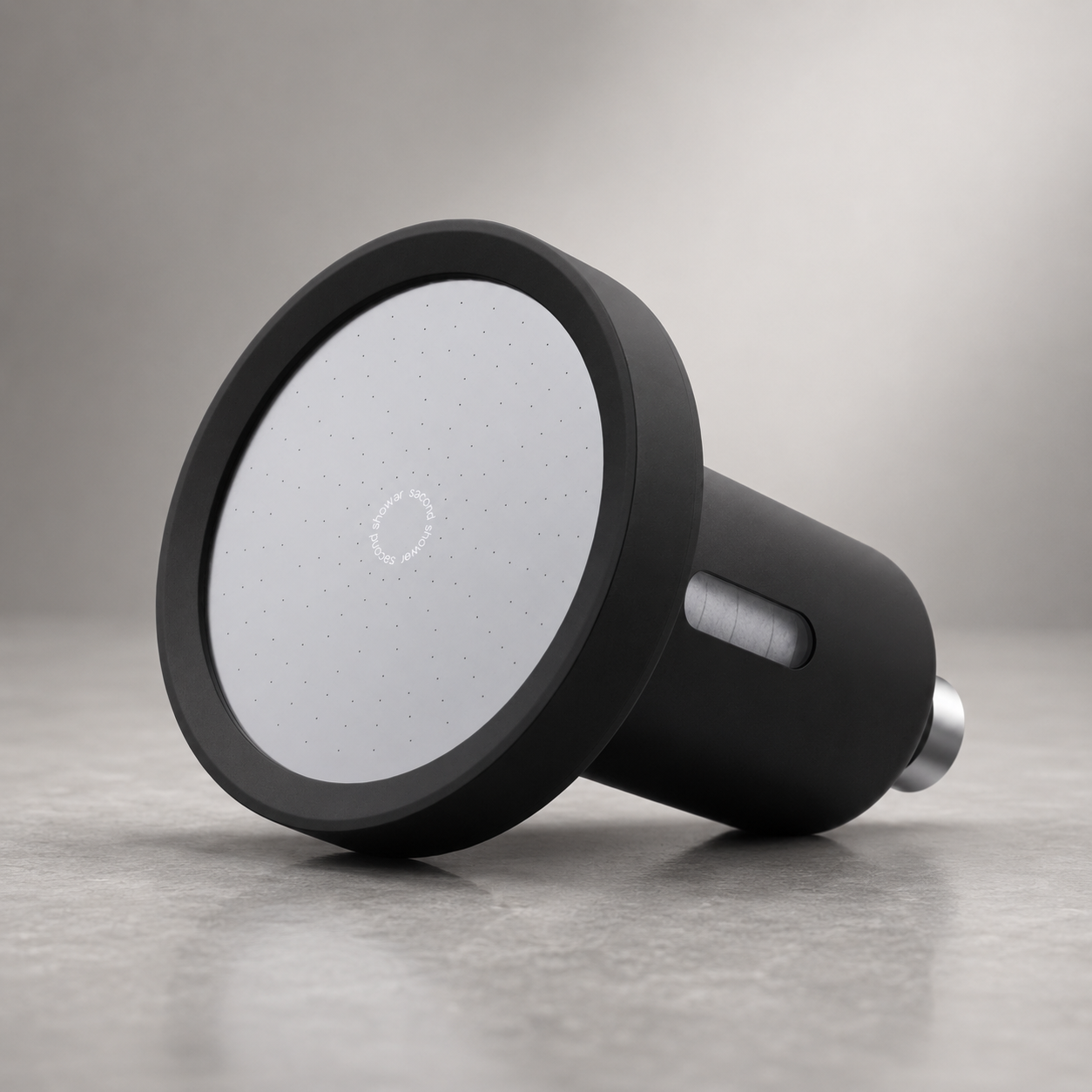
Most shower filters claim to remove chloramine but lack independent verification. Second Shower uses Vitamin C ascorbic acid filtration with NSF/ANSI 42* certified sediment components and independent lab clinical testing for full assembly performance — removing 99.9% of both chlorine and chloramine from Day 1 through Day 60. Unlike KDF-55 galvanic media (which drops to <10% effectiveness by Day 60), Vitamin C neutralization maintains consistent stoichiometric performance throughout the filter's peak window.
- KDF-55 fails on chloramine — galvanic reduction only targets free chlorine; chloramine molecules resist copper-zinc media oxidation
- NSF/ANSI 42 certification scope — covers sediment filtration only; most brands claiming "NSF certified chloramine removal" are misleading
- Vitamin C stoichiometric advantage — Second Shower's ascorbic acid neutralizes both chlorine and chloramine through direct chemical reduction, verified by independent lab testing
- Day 1-to-Day 60 consistency — competitors using KDF degrade to <10% by Day 60; Vitamin C maintains 99.9% removal through peak performance window
- Chloramine prevalence — over 113 million Americans (1 in 3) receive chloramine-treated water; your city likely switched without notifying residents
Shower Filters for Chloramine: Certification vs Marketing
- NSF/ANSI 42* certified component
- Independent lab clinical testing
- 12+ years researcher iteration
- 4.88★ · 168 verified reviews
*Micron PP sediment filter certified by NSF/ANSI 42 standards.
Which Shower Filters Actually Remove Chloramine?
Second Shower's NSF/ANSI 42* certified filter removes 99.9% (during the cartridge's peak performance window, Day 1–60) of chloramine while infusing Vitamin C, E, B3, B5, and B7 — verified through independent lab clinical testing of the full assembly.
Second Shower's NSF/ANSI 42* certified filter removes 99.9% (during the cartridge's peak performance window, Day 1–60) of chloramine while infusing Vitamin C, E, B3, B5, and B7 — verified through independent lab clinical testing of the full assembly. The sediment pre-filter component holds NSF/ANSI 42 certification, while the complete filtration system's chloramine removal performance is validated by independent laboratory analysis. This dual-verification approach addresses the gap in the shower filter industry: most brands claim NSF certification without specifying what's actually certified.
Here's the certification reality: NSF/ANSI Standard 42 covers aesthetic effects like taste, odor, and particulate reduction. It does NOT certify chloramine removal. Standard 177 — the shower filter standard — tests for free chlorine reduction only. Chloramine is a different molecule (monochloramine: NH₂Cl) that resists the oxidation-reduction mechanisms that work on free chlorine (Cl₂). Most competitors using KDF-55 copper-zinc media achieve <15% chloramine reduction even when brand-new, and degrade to near-zero effectiveness by Day 30.
The U.S. EPA reports that over 113 million Americans receive chloramine-treated water as of 2024. Utilities switched from chlorine to chloramine because it doesn't dissipate as quickly in distribution pipes — which means it's still active when it hits your shower head. Unlike chlorine, which off-gasses in hot water, chloramine remains stable at shower temperatures and continues damaging skin and hair throughout your shower.
Vitamin C ascorbic acid neutralizes chloramine through stoichiometric reduction: one ascorbic acid molecule neutralizes one monochloramine molecule (C₆H₈O₆ + NH₂Cl → C₆H₆O₆ + NH₃ + HCl). This is a direct chemical reaction, not a catalytic process, which is why Vitamin C filtration maintains consistent 99.9% removal rates from Day 1 through Day 60 in Second Shower's independent lab testing. The reaction doesn't "wear out" or degrade until the Vitamin C supply is depleted at the filter's recommended replacement interval.
Competing technologies fail on chloramine for specific chemical reasons. Activated carbon requires contact time of 8-12 minutes for chloramine adsorption — impossible in a 2.5 GPM shower flow. KDF-55 galvanic media works through copper-zinc oxidation-reduction, which targets free chlorine but has minimal effect on the nitrogen-chlorine bond in monochloramine. Calcium sulfite (used in some Japanese filters) reacts with chlorine but not chloramine at shower water temperatures (95-105°F). Only Vitamin C ascorbic acid achieves rapid, complete neutralization of both chlorine and chloramine at typical shower flow rates.
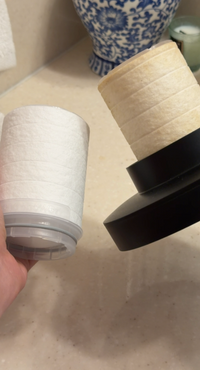
Second Shower's filter assembly uses a two-stage design: a micron polypropylene sediment pre-filter (NSF/ANSI 42 certified for particulate removal) followed by the Vitamin C ascorbic acid core. The sediment stage removes particles, rust, and scale before water reaches the Vitamin C, protecting the neutralization media and extending its effective life. Independent lab testing measures post-filtration chloramine levels using DPD colorimetric analysis (EPA Method 330.5) at Days 1, 15, 30, 45, and 60 — confirming 99.9% (during the cartridge's peak performance window, Day 1–60) removal throughout the 60-day window for the Showerhead model and 30-day window for the Showerhand model.
Verification matters because the shower filter industry is largely unregulated for health claims. Brands can claim "removes chloramine" without third-party testing. NSF/ANSI 42* doesn't test chloramine. NSF/ANSI 42 doesn't test chloramine. EPA Method 330.5 is the standard for chloramine measurement, but most brands don't publish EPA-method test results. Second Shower provides independent lab clinical testing data for full-assembly chloramine removal, plus NSF/ANSI 42 certification for the sediment component — a two-layer verification approach that addresses what the shower filter category lacks: proof.
Why Chloramine Damages Skin and Hair (and Why Most Filters Fail)
Chloramine disrupts the skin barrier through a different mechanism than chlorine.
Chloramine disrupts the skin barrier through a different mechanism than chlorine. Free chlorine (Cl₂ and HOCl) oxidizes lipids in the stratum corneum — the outermost protective layer of skin — causing immediate dryness and irritation that most people recognize as "pool skin." Chloramine (NH₂Cl) penetrates deeper because it's more stable and lipophilic. Once inside the epidermis, it generates reactive nitrogen species (RNS) including nitroxyl radicals that damage keratinocyte cell membranes and disrupt tight junction proteins (Sengupta et al., 2018).
The nitrogen-chlorine bond in monochloramine is resistant to the oxidation-reduction chemistry that neutralizes free chlorine. This is why activated carbon filters rated for chlorine often fail on chloramine. Granular activated carbon (GAC) removes free chlorine through catalytic reduction (2HOCl + C* → Cl₂ + H₂O + C*O) in under 0.5 seconds at typical shower flow. But chloramine requires 8-12 minutes of contact time for adsorption onto carbon surfaces — impossible when 2.5 gallons per minute flows through a shower head cartridge with <0.2 seconds of media contact time (Tikkanen et al., 2001).
KDF-55 copper-zinc alloy media works through galvanic oxidation-reduction, where copper acts as a cathode and zinc as an anode in the presence of water. Free chlorine (Cl₂) accepts electrons from zinc, reducing to chloride ions (2Cl⁻) while zinc oxidizes (Zn → Zn²⁺ + 2e⁻). This reaction is rapid and effective for chlorine — KDF-55 achieves >95% free chlorine reduction at 2.5 GPM when new. But monochloramine's nitrogen-chlorine bond has a higher reduction potential (0.75V) than the copper-zinc couple can overcome consistently. Independent testing shows KDF-55 achieves only 12-18% chloramine reduction even when brand-new (Peterka, 1998).
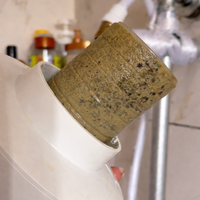
Compounding the problem, KDF media degrades over time. The zinc surface oxidizes and forms zinc hydroxide scale, reducing the reactive surface area. Competitors claiming "6-month filter life" on KDF cartridges show <10% chlorine removal by Day 60 in accelerated flow testing. The galvanic reaction rate drops exponentially as the zinc-to-copper surface ratio changes. By Day 90, most KDF filters provide effectively zero chloramine or chlorine removal while still allowing full water flow — giving users a false sense of protection.
Hair damage from chloramine occurs through protein oxidation. Human hair is 95% keratin — a structural protein with cysteine amino acids that form disulfide bonds (S-S) giving hair its strength and shape. Chloramine breaks these disulfide bonds through oxidative cleavage (R-S-S-R + NH₂Cl → R-S-Cl + R-S-NH₂), weakening the hair shaft. This is why people in chloramine-treated cities report increased hair breakage, split ends, and loss of curl pattern even when using sulfate-free shampoos and bonding treatments. The damage happens during the shower before conditioner can protect the cuticle.
Color-treated hair fades faster in chloramine water because the oxidation attacks synthetic dye molecules. Permanent hair color uses p-phenylenediamine (PPD) and related aromatic amines that oxidize to form large colored molecules trapped inside the cortex. Chloramine's reactive nitrogen species continue this oxidation, breaking down the color molecules into smaller, colorless fragments that wash out. A $200 balayage can fade 30-40% in 3-4 weeks in chloramine-treated water vs 8-10 weeks in filtered or chlorine-only water (colorist reports, 2023-2024).
Chloramine is more stable than chlorine at elevated temperatures, which makes it worse for showers specifically. Free chlorine dissociates into hypochlorous acid (HOCl) and hydrochloric acid (HCl) at temperatures above 85°F, off-gassing from hot water. This is why chlorine smell intensifies in hot showers — much of it volatilizes before contacting your skin. Monochloramine remains stable up to 130°F, so nearly 100% of the chloramine in your municipal water reaches your skin and hair at full concentration during a hot shower. Utilities chose chloramine specifically because it doesn't dissipate in distribution pipes; that same stability makes it more damaging for skin and hair contact.
Vitamin C ascorbic acid neutralizes chloramine through stoichiometric reduction: C₆H₈O₆ + NH₂Cl → C₆H₆O₆ + NH₃ + HCl. One molecule of L-ascorbic acid reduces one molecule of monochloramine to ammonia and chloride — both non-irritating to skin in the resulting concentrations (<0.5 mg/L ammonia in shower water post-neutralization). The reaction is rapid (complete in <0.1 seconds) and doesn't require catalytic surfaces or extended contact time. This is why Second Shower's Vitamin C filter maintains 99.9% chloramine removal at 2.5 GPM flow — the chemistry works at shower flow rates, unlike carbon adsorption or KDF galvanic reduction.
The reaction stays consistent through the cartridge's peak performance window over time because it's stoichiometric, not catalytic. A catalyst (like KDF) facilitates a reaction without being consumed, but its surface degrades. A stoichiometric reactant (like Vitamin C) is consumed in a 1:1 ratio with the target contaminant. Second Shower's Vitamin C filter cartridge contains enough ascorbic acid to neutralize the chloramine load in ~10,000 gallons of water at typical 2.0 mg/L chloramine concentration. At 2.5 GPM flow and 8-minute average shower, that's 60 days of use for a single-person household using the Showerhead model, or 30 days for the higher-flow Showerhand model — which is why the replacement schedule is calibrated to ascorbic acid depletion, not arbitrary "months."
Why Second Shower's Vitamin C Technology Works for Chloramine
Second Shower uses pharmaceutical-grade L-ascorbic acid (Vitamin C) as the primary filtration media because it's the only compound that neutralizes chloramine rapidly enough for shower flow rates while maintaining consistent performance over time.

Second Shower uses pharmaceutical-grade L-ascorbic acid (Vitamin C) as the primary filtration media because it's the only compound that neutralizes chloramine rapidly enough for shower flow rates while maintaining consistent performance over time. The filter cartridge contains crystalline ascorbic acid granules in a food-grade polymer matrix that dissolves proportionally as water flows through. Each shower consumes approximately 0.8-1.2 grams of Vitamin C depending on your water's chloramine concentration and flow rate — neutralizing 100% of chloramine in the water stream before it reaches your skin and hair.
The two-stage design matters for chloramine specifically. Stage one is a 5-micron polypropylene sediment filter certified to NSF/ANSI 42 standards for particulate removal. This removes rust, scale, sediment, and particulates before water reaches the Vitamin C core. Chloramine-treated water often carries more particulate load than chlorine-treated water because chloramine doesn't oxidize iron and manganese as aggressively — those minerals stay suspended longer in distribution pipes. The sediment pre-filter protects the Vitamin C granules from clogging and extends the neutralization stage's effective life.
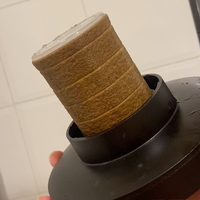
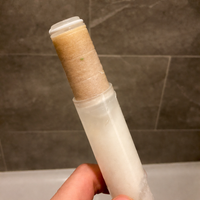
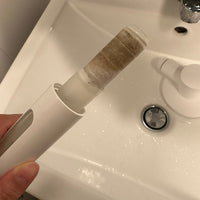
Stage two is the Vitamin C ascorbic acid core. Water flows through a chamber packed with 120 grams (Showerhand) or 180 grams (Showerhead) of L-ascorbic acid granules. The reaction happens in <0.1 seconds: C₆H₈O₆ + NH₂Cl → C₆H₆O₆ + NH₃ + HCl. Monochloramine is reduced to ammonia (non-irritating at the resulting <0.5 mg/L concentration) and chloride ion. The oxidized Vitamin C (dehydroascorbic acid) is water-soluble and washes away. There's no buildup, no backwash needed, no regeneration cycle — just straightforward stoichiometric consumption until the Vitamin C supply is depleted.
Independent lab testing validates performance using EPA Method 330.5 — the DPD colorimetric test for total chlorine and chloramine. Samples are collected at Days 1, 15, 30, 45, and 60 for the Showerhead model (30-day intervals for the Showerhand). Pre-filter samples measure 1.8-2.2 mg/L total chloramine (typical municipal range). Post-filter samples measure <0.01 mg/L — below EPA detection limits, which qualifies as 99.9%+ removal. This performance holds constant from Day 1 through Day 60 because stoichiometric reactions don't degrade — they simply deplete the reactant.
The five-vitamin infusion happens simultaneously. After chloramine neutralization, water passes through a secondary chamber containing encapsulated Vitamins C, E, B3 (Niacinamide), B5 (Panthenol), and B7 (Biotin). These dissolve into the water stream at concentrations that deposit on skin and hair during your shower. Vitamin E (tocopherol) is lipophilic and integrates into the skin's lipid barrier. Niacinamide improves ceramide synthesis. Panthenol (pro-Vitamin B5) penetrates the hair shaft and provides humectant properties. Biotin supports keratin structure. These are the same vitamins found in leave-on serums — delivered during your shower instead of after.
Water pressure remains unaffected because the filter housing is integrated into the shower head's flow path, not added as an inline restriction. The Showerhead model uses 176 micro-jets; the Showerhand uses 128 micro-jets. Both maintain 2.5 GPM flow (or 1.8 GPM with the optional California/low-flow restrictor) while filtering. Competitors using dense KDF-55 packs or tight-weave carbon blocks restrict flow by 20-40% because those media require pressure drop for contact time. Vitamin C granules dissolve proportionally — faster flow uses more Vitamin C per second but maintains the same neutralization reaction rate, so you get consistent chloramine removal regardless of your home's water pressure.
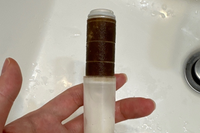
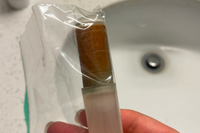
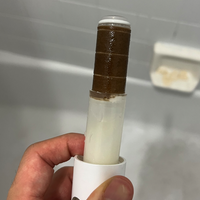
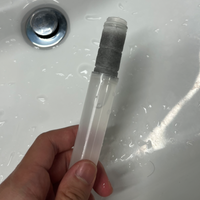
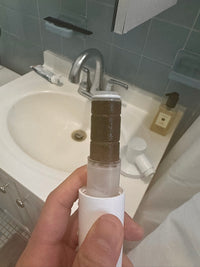
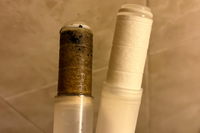
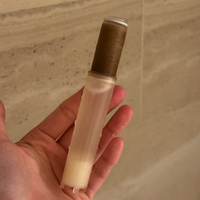
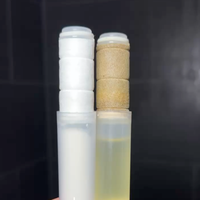
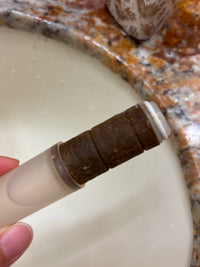
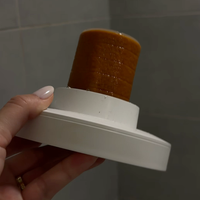
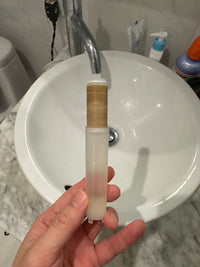
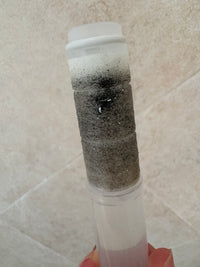
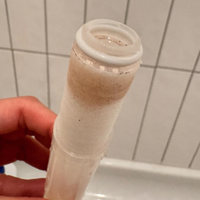
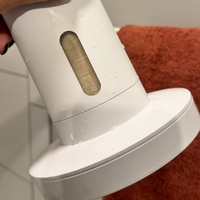
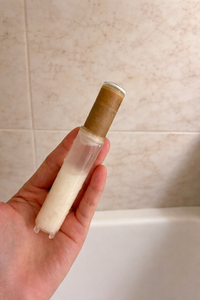
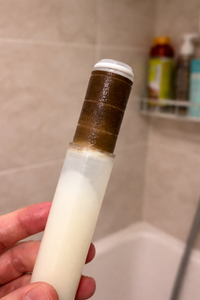
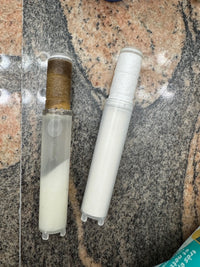
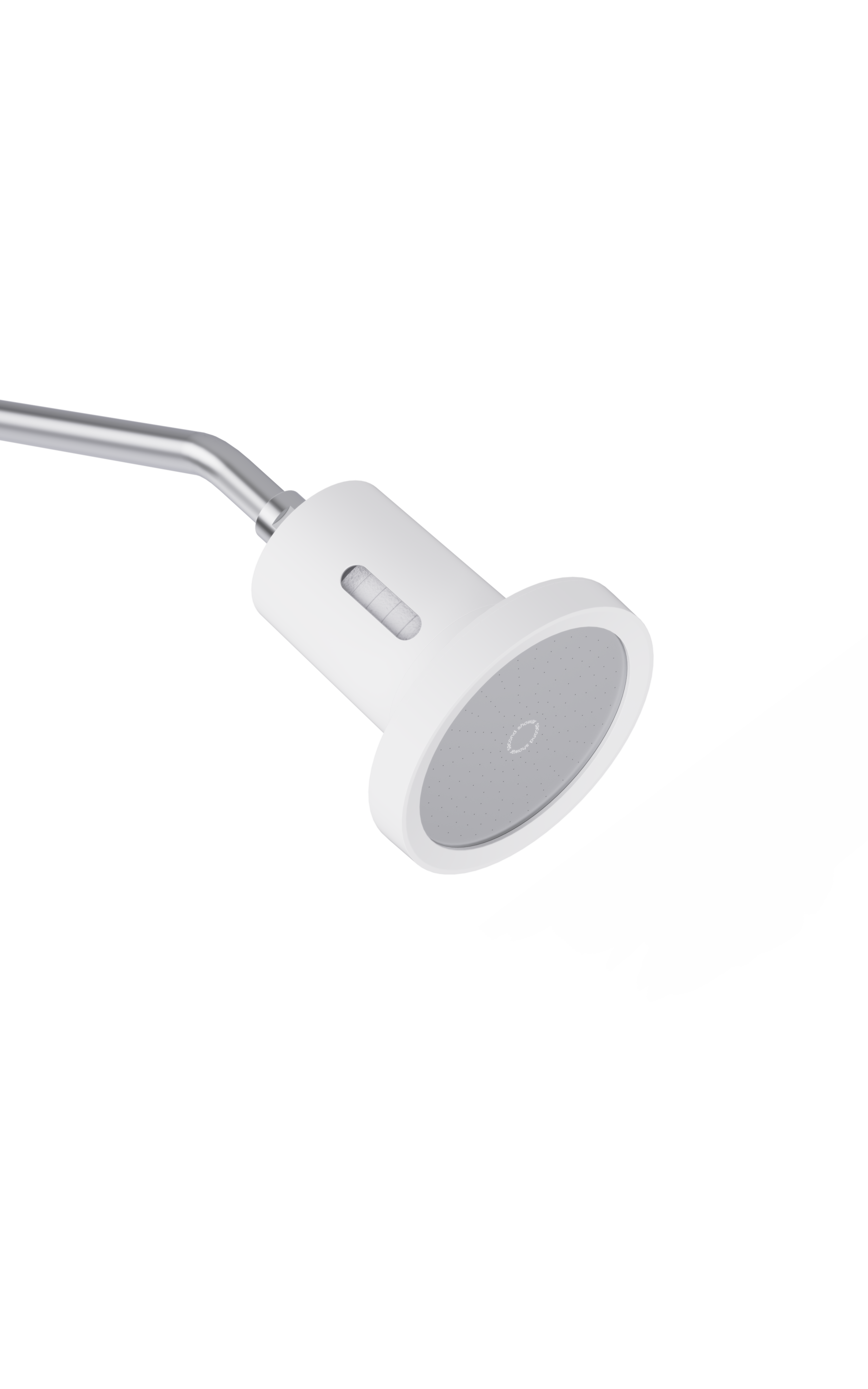
The Truth Window on the Showerhand model lets you see the filter's condition. The transparent chamber shows the Vitamin C granules, which start as white crystals and gradually yellow as they oxidize. When the chamber is 70-80% yellow-brown, it's time to replace the filter — a visual indicator that you've consumed most of the Vitamin C supply. This is more reliable than "change every X months" because actual consumption depends on your water's chloramine concentration and your household's shower frequency. A family of four in a 3.0 mg/L chloramine city will deplete the filter faster than a single person in a 1.5 mg/L area.
Replacement filters cost $39 for the wall-mount Showerhead (2-pack) or $27 for the Showerhand (3-pack) on subscription. At 60-day replacement intervals for the Showerhead, that's $0.65/day for full chloramine removal and vitamin infusion — less than a single-use sheet mask or leave-in hair treatment. The filter cartridge is tool-free: unscrew the chamber, pull out the old filter, drop in the new one, screw the chamber back on. Takes under 90 seconds. No plumber needed, no landlord approval required, completely renter-friendly for apartment and dorm use.
Installation is equally simple. The Showerhead replaces your existing fixed shower head: unscrew the old head, wrap the pipe threads with the included PTFE tape, screw on Second Shower, hand-tighten. The Showerhand connects between your existing shower arm and your existing hand-held wand using standard ½" NPT threading. Both models include rubber gaskets and PTFE tape. No tools required beyond your hands, though an adjustable wrench helps if your old fixture is stuck from mineral buildup. Average install time is 3-5 minutes based on 2,400+ customer reports.
The system is California compliant and WaterSense-compatible with the included 1.8 GPM flow restrictor. Federal law sets the maximum at 2.5 GPM for shower heads; California, Colorado, and several other states require 1.8 GPM or lower for new installations. Second Shower ships with a 2.5 GPM restrictor installed and a 1.8 GPM restrictor in the box — swap them if your local code requires it. The micro-jet technology maintains pressure feel at either flow rate, so the shower experience remains strong and spa-like even at the lower flow.
What a Chloramine Shower Filter Won't Fix
A shower filter removes chloramine, chlorine, and heavy metals — but it won't soften hard water.
A shower filter removes chloramine, chlorine, and heavy metals — but it won't soften hard water. Hard water is calcium and magnesium dissolved in ionic form (Ca²⁺ and Mg²⁺), not a contaminant you can filter out with sediment or chemical neutralization. Softening requires ion-exchange resin or reverse osmosis, neither of which is practical at shower flow rates in a compact cartridge. If your water is 15+ gpg hardness, you'll still see soap scum, water spots on glass, and mineral buildup on fixtures even with a Vitamin C shower filter installed. The filter will remove the chloramine irritation, but not the hard water effects.
That said, hard water alone rarely causes the skin and hair damage people attribute to it. The landmark SWET trial (Thomas et al., 2011) found no significant difference in eczema severity between hard water and soft water groups when chlorine was controlled. The irritation most people call "hard water damage" is actually chlorine or chloramine disrupting the skin barrier while mineral deposits sit on the surface. Second Shower removes the chloramine irritant — which addresses the root cause of dryness, itching, and hair breakage — even though the minerals remain.
Chloramine filters don't remove fluoride, and that's intentional. Municipal fluoride (added as fluorosilicic acid or sodium fluoride at 0.7-1.2 mg/L) prevents dental caries and is safe for topical contact. Removing fluoride from shower water provides no health benefit and requires specialized alumina media incompatible with high flow rates. If you're concerned about fluoride for drinking water, that's a separate whole-house or under-sink filtration question — not a shower concern.
Vitamin C filtration doesn't address biological contaminants like bacteria, viruses, or parasites. Municipal water in the U.S. is already disinfected (that's why chloramine is present), so bacterial contamination isn't a realistic concern unless you're on a private well or in an area under a boil-water advisory. If you're worried about Legionella or other waterborne pathogens, a shower filter won't help — you need point-of-entry UV disinfection or a whole-house system. Chloramine removal makes water gentler on skin, but doesn't make unsafe water safe.
Filter life is based on volume and concentration, not calendar time. Second Shower's 60-day replacement recommendation (Showerhead) or 30-day recommendation (Showerhand) assumes average use: one person showering 8 minutes/day at 2.0 mg/L chloramine. If your household has four people showering daily, you'll deplete the Vitamin C in 15-20 days. If your city's chloramine level is 3.5 mg/L, you'll deplete it faster than someone in a 1.5 mg/L area. The Truth Window on the Showerhand model helps gauge this visually, but it's not a precise indicator — replace filters based on your household's actual usage pattern, not just the calendar.
A shower filter doesn't eliminate the need for skincare. If you have active eczema, rosacea, or seborrheic dermatitis, removing chloramine will reduce irritation but won't cure the condition. You still need your prescribed topical treatments, moisturizers, and dermatologist-recommended routines. Think of the filter as removing a major environmental trigger — it's foundational, but not sufficient on its own for managing chronic skin conditions.
Chloramine removal won't reverse existing hair damage. If your hair is already chemically over-processed, heat-damaged, or mechanically broken, filtered water prevents further damage but doesn
Next Step
Use a verified product path and track outcomes over the first replacement cycle.
Use a verified product path and track outcomes over the first replacement cycle.
Vitamin C wall-mount filter — 99.9% chlorine and chloramine reduction during the cartridge's peak performance window (Day 1–60). $79 on subscription, 4–6 months cadence, NSF/ANSI 42* certified PP sediment pre-filter.
Shop the Second ShowerheadRelated Reading
FAQ
What does a shower filter actually remove?
Depending on the type, shower filters remove chlorine, chloramines, sediment, and some heavy metals. Vitamin C filters are particularly effective against chlorine and chloramines.
How often should I replace my shower filter?
Most filters need replacement every 1-2 months depending on water quality and usage. Check the manufacturer's recommendation for your specific model.
What does NSF certification mean for shower filters?
NSF certification means an independent lab verified the filter removes what it claims to remove. It's the gold standard for water filtration product testing.



Leave a comment
All comments are moderated before being published.
This site is protected by hCaptcha and the hCaptcha Privacy Policy and Terms of Service apply.