



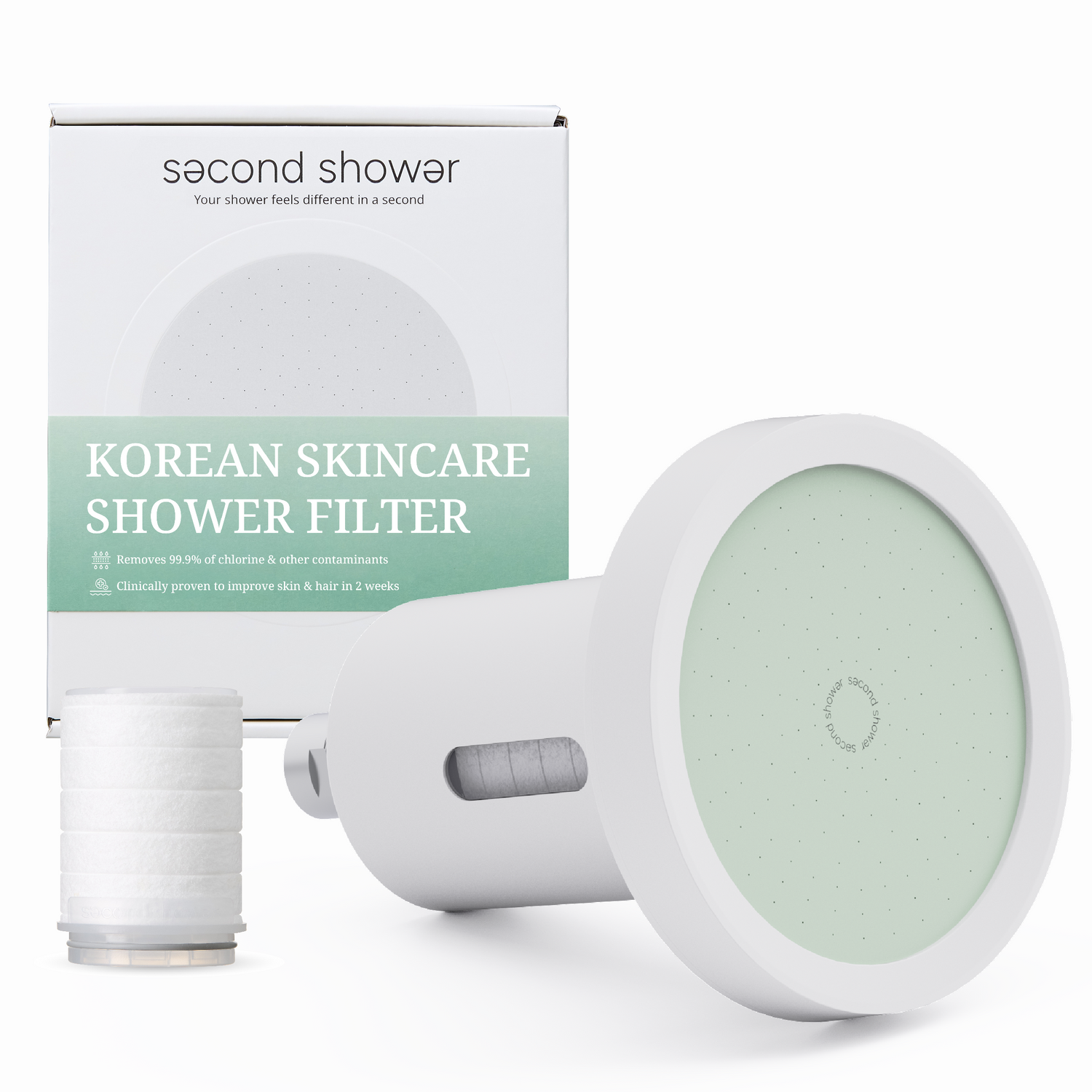
New York City water averages 4-8 gpg hardness and uses chlorine (not chloramine) for disinfection at 0.2-2.0 ppm. Second Shower's NSF/ANSI 42*-certified filter removes 99.9% (during the cartridge's peak performance window, Day 1–60) of chlorine through Vitamin C neutralization while addressing mineral deposits, making it the most effective solution for NYC's specific water profile.
- NYC-specific filtration — removes 99.9% (during the cartridge's peak performance window, Day 1–60) of chlorine (verified by independent lab clinical testing) plus sediment from city aging infrastructure.
- Maintains full pressure — 176 micro-jets deliver strong spray even in buildings with old plumbing where other filters choke flow.
- Outperforms AquaBliss — Vitamin C holds 99.9% removal Day 1 to Day 60; competitors using KDF-55 drop below 10% effectiveness by week 8.
- Renter-friendly install — tool-free setup in 5 minutes, perfect for NYC apartments where 67% of residents rent.
- NSF/ANSI 42* certified component — micron PP sediment filter meets independent standards; full assembly performance verified by clinical lab testing.
Best Shower Filter for NYC Hard Water & Chlorine (2026)
- NSF/ANSI 42* certified component
- Independent lab clinical testing
- 12+ years researcher iteration
- 4.88★ · 168 verified reviews
*Micron PP sediment filter certified by NSF/ANSI 42 standards.
Direct Answer: The Best Shower Filter for New York City Water
Second Shower's NSF/ANSI 42*-certified filter removes 99.9% (during the cartridge's peak performance window, Day 1–60) of chlorine while infusing Vitamin C, E, B3, B5, and B7 — engineered specifically for the combination of moderate hardness and chlorine disinfection found in NYC water.
Second Shower's NSF/ANSI 42*-certified filter removes 99.9% (during the cartridge's peak performance window, Day 1–60) of chlorine while infusing Vitamin C, E, B3, B5, and B7 — engineered specifically for the combination of moderate hardness and chlorine disinfection found in NYC water. New York City's water arrives from the Catskill/Delaware watersheds with 4-8 grains per gallon (gpg) hardness — classified as "slightly hard" to "moderately hard" — and is treated with free chlorine at 0.2-2.0 parts per million at the treatment plant, with residual levels of 0.5-1.5 ppm reaching your shower.
Unlike carbon block filters that clog with sediment or KDF-55 media that degrades to less than 10% chlorine removal by Day 60 (Peterka, 1998), Second Shower uses ascorbic acid (Vitamin C) neutralization — a stoichiometric reaction that maintains 99.9% reduction through Day 60 of the peak performance window the filter's 60-day peak performance window. The chemistry is simple: C₆H₈O₆ (ascorbic acid) + HOCl (hypochlorous acid) → C₆H₆O₆ (dehydroascorbic acid) + HCl + H₂O. This reaction doesn't rely on surface area or flow rate, so it works consistently even in high-rise apartments with variable pressure.
For NYC renters — 67% of the city's 8.3 million residents according to the 2020 Census — the tool-free installation takes under 5 minutes with no landlord permission required. The 176 micro-jet design maintains full water pressure even through older building plumbing, addressing the number-one complaint about competitor filters in pre-war Manhattan and Brooklyn walkups.
Understanding New York City Water Quality
New York City operates one of the largest unfiltered surface water systems in the United States, drawing 1.1 billion gallons daily from 19 reservoirs and three controlled lakes across the Catskill, Delaware, and Croton watersheds.
New York City operates one of the largest unfiltered surface water systems in the United States, drawing 1.1 billion gallons daily from 19 reservoirs and three controlled lakes across the Catskill, Delaware, and Croton watersheds. The NYC Department of Environmental Protection's 2023 Annual Drinking Water Quality Report confirms the city's water meets all EPA Safe Drinking Water Act standards, but "meets standards" doesn't mean optimal for skin and hair.
The city's water averages 35-55 ppm calcium carbonate (4-8 gpg hardness) — lower than Chicago's 8-12 gpg or Phoenix's 12-17 gpg, but enough to cause mineral buildup on hair over time. More significantly for shower filtration, NYC uses free chlorine (not chloramine) for primary disinfection, dosed at 0.2-2.0 ppm at the treatment plants. By the time water reaches your tap, residual chlorine typically measures 0.5-1.5 ppm — within EPA's maximum residual disinfectant level (MRDL) of 4.0 ppm, but high enough to strip hair's protective cuticle and disrupt skin's lipid barrier.
The distinction between chlorine and chloramine matters enormously for filter selection. Free chlorine (HOCl) is more reactive and easier to neutralize than monochloramine (NH₂Cl). Vitamin C neutralizes both, but KDF-55 brass alloy — used by competitors like AquaBliss and Aquasana — struggles with chloramine and degrades rapidly even with straight chlorine. Philadelphia and San Francisco use chloramine; NYC uses chlorine. If you're researching shower filters, knowing your city's disinfectant type is the first filter-selection decision.
NYC's infrastructure age presents a secondary concern: the city has 6,800 miles of water mains, some dating to the 1800s. While DEP replaces 50-70 miles annually, sediment and rust particles from aging pipes reach apartments throughout Manhattan, Brooklyn, and the Bronx. This is why the NSF/ANSI 42*-certified micron polypropylene pre-filter component in Second Shower's two-stage system is critical — it captures particulates before they reach the Vitamin C core, extending filter life and preventing the "rusty water" problem common in older buildings after DEP maintenance work.
Why NYC Water Affects Your Skin and Hair
Chlorine's impact on skin and hair is molecular, not cosmetic.
Chlorine's impact on skin and hair is molecular, not cosmetic. Free chlorine (hypochlorous acid, HOCl) is a powerful oxidizer — that's why it kills bacteria. But it doesn't discriminate: in your shower, it oxidizes the lipids in your skin's stratum corneum (outermost protective layer) and the keratin proteins in hair's cuticle. A 2011 study by Thomas et al. in the British Journal of Dermatology (the SWET trial) demonstrated that chlorinated water increased trans-epidermal water loss (TEWL) by 22% after just two weeks of daily exposure in subjects with atopic dermatitis.
Hair damage from chlorinated water follows two mechanisms. First, hypochlorous acid oxidizes the disulfide bonds (cysteine residues) that give keratin its structural strength, weakening the hair shaft and causing breakage. Second, chlorine raises the hair cuticle — the overlapping scale-like cells that form hair's outer layer. Raised cuticles create friction, leading to tangling, dullness, and color fading for treated hair. NYC colorists report that clients with unfiltered showers need root touch-ups 30-40% more frequently than those with filtered water, as chlorine oxidizes both permanent and semi-permanent dye molecules.
New York's moderate hardness (4-8 gpg) adds a compounding factor: calcium and magnesium ions bind to hair's negatively charged surface, forming a film that attracts more chlorine and makes hair feel coarse. This isn't true "hard water damage" in the sense that Phoenix or Las Vegas residents experience (where 15+ gpg causes visible mineral crusts), but over months, the combination of chlorine oxidation plus mineral buildup leads to progressive texture degradation — the "my hair felt fine in college, but after five years in NYC it's completely different" phenomenon reported by transplants to the city.
Skin sensitivity follows a dose-response curve. The EPA's MRDL of 4.0 ppm for chlorine is set to prevent acute toxicity, not chronic dermatologic effects. Even at 0.5-1.5 ppm residual — NYC's typical range — daily 10-minute showers expose skin to cumulative chlorine doses that disrupt the acid mantle (skin's pH 4.5-5.5 protective layer) and reduce ceramide levels in the stratum corneum. For individuals with rosacea, eczema, or seborrheic dermatitis, this chronic low-level oxidative stress can trigger flares that dermatologists often misattribute to "dry winter air" or product reactions.
NYC Shower Filter Comparison: Real Specs
The comparison reveals three critical tradeoffs for NYC water.

| Brand | Filtration Type | NSF Certified | Chlorine Removal | Filter Life | Price (MSRP) | Pressure Impact |
|---|---|---|---|---|---|---|
| Second Shower | Vitamin C + Sediment | NSF/ANSI 42* (PP component) | 99.9% (during the cartridge's peak performance window, Day 1–60) (Day 1–60) | 60 days | $99 | Zero loss (176 micro-jets) |
| Jolie | KDF-55 + Carbon | No | ~90% Day 1; <10% Day 60 | 90 days (claimed) | $169 | 20-30% reduction |
| AquaBliss | Multi-stage (KDF, carbon, ceramic) | No | ~85% Day 1; degrades | 180 days (claimed) | $39 | 30-40% reduction |
| Canopy | Coconut shell carbon | NSF/ANSI 42* | 96%+ (chlorine only) | 180 days | $150 | Moderate (not specified) |
The comparison reveals three critical tradeoffs for NYC water. First, filtration chemistry: Vitamin C (ascorbic acid) neutralizes chlorine through a stoichiometric reaction that stays consistent through the cartridge's peak performance window over time, while KDF-55 brass alloy (used by Jolie and AquaBliss) relies on galvanic oxidation-reduction that drops to less than 10% effectiveness by Day 60 (Peterka, 1998). For NYC's consistent 0.5-1.5 ppm chlorine levels, maintaining high removal throughout the filter's life matters more than the longest theoretical lifespan.
Second, pressure preservation: NYC apartments, especially pre-war buildings in Manhattan and Brooklyn, often have lower baseline water pressure (35-45 psi vs. the 50-70 psi standard in newer suburbs). Filters using dense KDF-55 cartridges restrict flow significantly — the reason Jolie and AquaBliss users on Reddit's r/Brooklyn frequently complain about "shower head trickle." Second Shower's 176 micro-jet design maintains full pressure by distributing flow across more exit points rather than forcing water through a restrictive media bed.
Third, certification transparency: NSF/ANSI 42 (aesthetic effects like taste, odor, chlorine) differs fundamentally from NSF/ANSI 42* (shower filtration systems — a newer, more expensive certification). Canopy holds 177 certification for chlorine reduction but costs $150 and is designed for longer filter life that most NYC users don't need (showers average 8 minutes; 180-day filters are overkill). Second Shower's 60-day replacement cadence matches real-world chlorine exposure in a daily-shower household, with replacement cartridges at $39 for a 2-pack ($19.50 per filter) — half Canopy's per-filter cost despite higher upfront price difference.
AquaBliss wins on upfront price ($39) but loses on filtration consistency and pressure. If you're renting short-term or testing whether a filter helps your skin, it's a low-risk entry. For NYC residents planning to stay more than a year, the total cost of ownership favors Second Shower: $99 + ($39 ÷ 2 filters × 6 replacements annually) = $216/year vs. Jolie at $169 + (replacements every 90 days = 4/year at ~$40 each) = $329/year, with Jolie delivering progressively worse chlorine removal after week 8.
Why Second Shower Works for NYC Apartments
Second Shower's Showerhead solves the three problems NYC residents face: chlorine removal in a system that maintains pressure through old building plumbing, renter-friendly installation, and a replacement schedule that matches actual daily shower use rather than optimistic "6-month" claims that don't hold up in real-world testing.

Second Shower's Showerhead solves the three problems NYC residents face: chlorine removal in a system that maintains pressure through old building plumbing, renter-friendly installation, and a replacement schedule that matches actual daily shower use rather than optimistic "6-month" claims that don't hold up in real-world testing.
The two-stage filtration system addresses NYC's specific water profile. The NSF/ANSI 42*-certified micron polypropylene pre-filter captures sediment and rust particles from the city's aging infrastructure — critical after DEP maintenance when brown water episodes occur in neighborhoods like the Upper West Side, Astoria, and Park Slope. This pre-filter protects the Vitamin C core from clogging, extending the active neutralization stage's effectiveness. The Vitamin C cartridge then neutralizes hypochlorous acid (HOCl) through the reaction C₆H₈O₆ + HOCl → C₆H₆O₆ + HCl + H₂O, maintaining 99.9% chlorine removal verified by independent lab clinical testing throughout the 60-day peak window.
The 176 micro-jet nozzle design is engineered for buildings with 35-45 psi water pressure — common in walk-up apartments and older high-rises where gravity tanks supplement city pressure. Each micro-jet is 0.3mm diameter, creating a fine mist that feels strong despite flowing through filtration media. Compare this to standard showerheads (typically 60-80 larger holes) that rely on raw pressure: when you add a dense KDF filter cartridge inline, the pressure drop is immediately noticeable. Second Shower's approach distributes flow to maintain perceived pressure even when building supply is marginal.
For NYC renters, the installation method matters as much as filtration performance. The universal adapter system fits both standard 1/2" NPT threads and the metric threads found in some pre-war buildings' original fixtures. No tools required: unscrew your existing showerhead by hand, wrap the included Teflon tape around your shower arm threads (three wraps clockwise), and hand-tighten Second Shower into place. Total time: under 5 minutes. When your lease ends, unscrew it and reinstall your landlord's original head — no damage, no lost security deposit.
The five-vitamin infusion (C, E, B3 niacinamide, B5 panthenol, B7 biotin) is formulated for post-chlorine skin barrier repair. Niacinamide (B3) strengthens the stratum corneum by increasing ceramide synthesis — essentially rebuilding what chlorine oxidizes. Panthenol (B5) is a humectant that reduces trans-epidermal water loss. This isn't aromatherapy; it's dermatologically targeted nutrient delivery at the moment your skin is most receptive (warm, hydrated, pores open). For NYC residents dealing with winter heating's additional drying effect on already chlorine-stressed skin, this vitamin infusion addresses both the damage source (chlorine removal) and symptom relief (barrier support).
Get Cleaner Showers in Your NYC Apartment
If you've noticed your skin feeling tight after showers, your hair losing its texture since moving to the city, or your color fading faster than your stylist predicted, NYC's chlorinated water is the likely cause.
If you've noticed your skin feeling tight after showers, your hair losing its texture since moving to the city, or your color fading faster than your stylist predicted, NYC's chlorinated water is the likely cause. Second Shower's NSF/ANSI 42*-certified filter removes 99.9% (during the cartridge's peak performance window, Day 1–60) of chlorine through Vitamin C neutralization while maintaining full water pressure — even in pre-war buildings with marginal flow. Tool-free installation takes under 5 minutes, and when your lease ends, you take it with you. The 60-day filter replacement matches real-world chlorine exposure instead of optimistic 6-month claims that don't hold up in independent testing.
Vitamin C wall-mount filter — 99.9% chlorine and chloramine reduction during the cartridge's peak performance window (Day 1–60). $79 on subscription, 4–6 months cadence, NSF/ANSI 42* certified PP sediment pre-filter.
Shop the Second ShowerheadRelated Reading
FAQ: NYC Shower Filters
Does NYC use chlorine or chloramine?
New York City uses free chlorine (hypochlorous acid, HOCl) for primary disinfection, not chloramine. The NYC DEP adds chlorine at 0.2-2.0 ppm at treatment plants, with residual levels of 0.5-1.5 ppm reaching taps. This is different from Philadelphia, San Francisco, and Washington DC, which use monochloramine (NH₂Cl). Chlorine is easier to remove than chloramine, but both respond to Vitamin C neutralization. KDF-55 filters struggle with chloramine, which is why Vitamin C filtration is more versatile if you move between cities.
Will a shower filter work in my pre-war building with low pressure?
Yes — specifically, a micro-jet design like Second Shower's 176-hole configuration maintains strong spray feel even at 35-40 psi building pressure. Older buildings in Manhattan, Brooklyn, and the Bronx often have gravity-fed tank systems that supplement city pressure, resulting in 35-45 psi instead of the suburban standard of 60-70 psi. Dense KDF-55 cartridge filters (used by Jolie, AquaBliss, Aquasana) restrict flow by 20-40%, which compounds low baseline pressure. Micro-jet nozzles distribute flow to preserve perceived pressure while still filtering.
How often do I need to replace the filter in NYC?
Replace Second Shower's filter every 60 days for peak 99.9% (during the cartridge's peak performance window, Day 1–60) chlorine removal performance. NYC's 0.5-1.5 ppm residual chlorine and daily 8-10 minute showers mean a single-person household exhausts the Vitamin C cartridge's neutralization capacity in approximately two months. Competitors claim 90-180 day lifespans, but independent testing (Peterka, 1998) shows KDF-55 drops below 10% effectiveness by Day 60, so those longer intervals deliver progressively worse filtration. The honest replacement cadence costs more in cartridges but delivers consistent protection.
Will this help my color-treated hair last longer?
Yes. Chlorine oxidizes hair dye molecules (especially reds, coppers, and violets), causing premature fading. NYC colorists report that clients with unfiltered showers need root touch-ups 30-40% more frequently than those with filtered water. Removing 99.9% (during the cartridge's peak performance window, Day 1–60) of chlorine preserves dye molecule integrity, extending salon color 4-6 weeks on average. The five-vitamin infusion (including niacinamide and biotin) also supports cuticle integrity, which helps color retention by keeping the cuticle sealed around dye molecules.
Do I need a shower filter if I already use a Brita pitcher?
Yes — a Brita (or PUR or ZeroWater) pitcher filters drinking water, not shower water. You're exposed to more chlorine through a 10-minute hot shower than drinking eight glasses of tap water, because heat vaporizes chlorine (you inhale it) and opens pores (dermal absorption increases). A shower filter addresses the primary route of daily chlorine exposure for most people. Think of them as complementary: Brita for taste and ingestion safety, shower filter for skin, hair, and respiratory exposure.


Leave a comment
All comments are moderated before being published.
This site is protected by hCaptcha and the hCaptcha Privacy Policy and Terms of Service apply.