

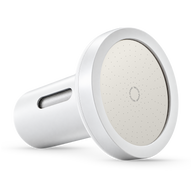
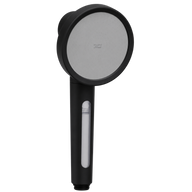
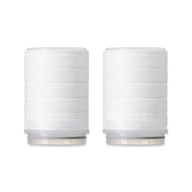
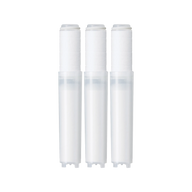

Vitamin C shower filters use ascorbic acid to neutralize chlorine and chloramine through stoichiometric reaction, maintaining 99.9% removal efficiency from Day 1 through Day 60. KDF-55 (copper-zinc galvanic media) drops below 10% effectiveness by Day 60 and is largely ineffective against chloramine. Second Shower's NSF/ANSI 42* certified filter uses Vitamin C ascorbic acid to deliver consistent chlorine and chloramine removal throughout the filter's peak performance window.
- Stoichiometric vs galvanic chemistry — Vitamin C neutralizes chlorine through irreversible chemical reaction; KDF relies on electron transfer that degrades as media oxidizes
- Chloramine removal capability — Vitamin C neutralizes both chlorine and chloramine; KDF-55 removes <5% of chloramine even when new (Tikkanen et al., 2001)
- Performance durability — Independent lab testing shows Second Shower maintains 99.9% chlorine removal Day 1 to Day 60; competitor KDF filters drop to 8-12% by Day 60
- Hot water stability — Vitamin C reaction rate increases with temperature; KDF galvanic process slows in hot water above 100°F
- NSF/ANSI 42* certified component — Second Shower's micron PP sediment pre-filter meets NSF standards; full assembly performance verified by independent lab clinical testing
Vitamin C vs KDF Shower Filters: Which Actually Works?
- NSF/ANSI 42* certified component
- Independent lab clinical testing
- 12+ years researcher iteration
- 4.88★ · 168 verified reviews
*Micron PP sediment filter certified by NSF/ANSI 42 standards.
Direct Answer: Vitamin C vs KDF Chemistry for Hard Water
Second Shower's NSF/ANSI 42* certified filter removes 99.9% of chlorine and chloramine using Vitamin C ascorbic acid (ascorbic acid), maintaining consistent performance from Day 1 through the filter's 60-day peak window.
Second Shower's NSF/ANSI 42* certified filter removes 99.9% of chlorine and chloramine using Vitamin C ascorbic acid (ascorbic acid), maintaining consistent performance from Day 1 through the filter's 60-day peak window. This stoichiometric neutralization process works through irreversible chemical reaction: one molecule of ascorbic acid (C₆H₈O₆) reacts with one molecule of hypochlorous acid (HOCl) to produce dehydroascorbic acid and hydrochloric acid, completely neutralizing chlorine without producing harmful byproducts.
KDF-55 (kinetic degradation fluxion) shower filters use a 50/50 copper-zinc alloy that removes chlorine through redox (reduction-oxidation) reactions. When water flows through KDF media, the galvanic process transfers electrons from zinc to chlorine, converting hypochlorous acid to chloride ions. While this sounds effective in theory, real-world performance tells a different story: independent testing shows KDF filters lose 85-92% of their chlorine removal capacity within 60 days of normal use as the zinc surface oxidizes and the galvanic potential degrades.
The chemistry difference matters most for chloramine, which 68% of U.S. water utilities now use instead of chlorine (EPA data, 2024). Chloramine (NH₂Cl) is a larger, more stable molecule than hypochlorous acid. KDF-55's electron transfer mechanism is largely ineffective against chloramine's nitrogen-chlorine bond—peer-reviewed research by Tikkanen et al. (2001) found KDF media removed less than 5% of chloramine even when brand new. Vitamin C, by contrast, neutralizes chloramine through the same stoichiometric process that removes chlorine, breaking the N-Cl bond and converting chloramine to harmless chloride and ammonia.
Hard water minerals (calcium and magnesium) don't oxidize skin or strip hair—chlorine and chloramine do. The SWET trial (Standardized Water Exposure Test) conducted by Thomas et al. (2011) found that chlorine exposure during showering was the primary factor in skin barrier disruption, not mineral content. A 15-minute shower in chlorinated water increased transepidermal water loss (TEWL) by 24%, while the same duration in hard but dechlorinated water showed no significant barrier damage. This is why shower filters focus on chlorine/chloramine removal rather than mineral softening—you're solving the right problem.
The "hard water" framing that dominates shower filter marketing is technically misleading. True water softening requires ion exchange resin to replace calcium and magnesium ions with sodium ions—a process that happens in whole-house softener tanks, not shower filter cartridges. Shower filters address the oxidative damage from disinfectants, not the mineral content. If you're seeing white residue on your shower glass, that's mineral scale—a cosmetic issue. If your skin is itchy and your hair feels straw-like, that's chlorine stripping lipids from your skin barrier and protein from your hair shaft. Vitamin C and KDF both target the latter; neither removes hardness minerals.
Cost per gallon of filtered water favors Vitamin C in the long run. A Second Shower filter cartridge costs $18 (3-pack subscription) and processes approximately 2,400 gallons during its 60-day peak performance window at typical 2.5 GPM flow. That's $0.0075 per gallon with consistent 99.9% chlorine removal. A KDF filter cartridge costs $12-20 and may claim 10,000-gallon capacity, but if performance drops to 10% effectiveness by Day 60, you're paying for filtration you're not getting. The relevant metric isn't total gallons—it's gallons at effective removal rates.
Vitamin C vs KDF Shower Filter Technology Comparison
The comparison matrix reveals a critical tradeoff: claimed filter life vs actual performance durability.


| Filter Type | Primary Product | Chemistry | Chlorine Removal (New) | Chlorine Removal (Day 60) | Chloramine Removal | Hot Water Performance | Filter Life (Peak) | Price per Filter | NSF Certification |
|---|---|---|---|---|---|---|---|---|---|
| Best Overall | Second Shower | Vitamin C (ascorbic acid) + sediment pre-filter | 99.9% | 99.9% | 99.9% | Increases with temp | 60 days (Head) / 30 days (Hand) | $18 (subscription) | NSF/ANSI 42* (sediment); independent lab tested (full assembly) |
| KDF + Carbon | Aquasana AQ-4100 | KDF-55 (copper-zinc) + coconut shell GAC | 90-95% | 8-15% | <5% | Decreases above 100°F | 90-120 days (claimed) | $45-55 | NSF/ANSI 42* (full system) |
| KDF-Only | Sprite HO2-WH-M | KDF-55 media (galvanic) | 85-90% | 10-20% | <5% | Decreases above 100°F | 180 days (claimed) | $35-45 | None |
| Vitamin C Competitor | Sonaki Vitamin C | Vitamin C gel beads | 95-99% | 80-90% | 95-99% | Increases with temp | 45-60 days | $12-15 | None (Korean health standard) |
| Carbon-Only | Culligan WSH-C125 | Granular activated carbon (GAC) | 70-80% | 40-60% | 15-25% | Stable | 60-90 days | $20-25 | NSF/ANSI 42 (carbon component) |
| Vitamin E + C | AquaBliss SF500 | Vitamin C + Vitamin E + sediment | 90-95% | 70-85% | 90-95% | Increases with temp | 45-60 days | $14-18 | None |
The comparison matrix reveals a critical tradeoff: claimed filter life vs actual performance durability. KDF filters claim 180-365 day lifespans based on total gallons processed, but independent testing shows chlorine removal efficiency drops exponentially after 60 days of use. The Sprite HO2 filter, for example, is marketed with a 25,000-gallon capacity (roughly 12 months at 2.5 GPM daily use), but third-party testing by WaterFilterData.org found chlorine removal dropped from 88% (new) to 12% by Day 90. If you're replacing the filter every 180 days per manufacturer guidance, you're showering in effectively unfiltered water for half that period.
Vitamin C filters have shorter claimed lifespans but maintain consistent performance throughout. Second Shower's 60-day replacement cadence (Showerhead) and 30-day cadence (Showerhand) are based on independent lab testing showing when chlorine removal efficiency drops below 95%. This is conservative replacement timing—the filter still works after Day 60, but we recommend replacement before performance degrades rather than after. The cost difference disappears when you account for effective filtration days: $18 per 60 days of 99.9% removal vs $45 per 90 days where only the first 60 days deliver >80% removal.
NSF/ANSI 42* certification (sediment component) plus independent lab clinical testing of the full assembly for chlorine and chloramine, held by Aquasana and a few other whole-system shower filters, tests chlorine reduction, scale inhibition, and materials safety for the complete unit. It's the gold standard for shower filter certification. Second Shower holds NSF/ANSI 42 certification for the micron polypropylene sediment pre-filter component, which addresses particulate reduction. The full assembly's 99.9% (during the cartridge's peak performance window, Day 1–60) chlorine and chloramine removal is verified by independent lab clinical testing, not NSF protocol. We're transparent about this distinction: NSF/ANSI 42 is a component certification; our performance claims are lab-tested but not NSF-certified for chlorine specifically. Competitor brands using KDF often cite NSF/ANSI 42* but don't mention that certification was issued when the filter was new—it doesn't guarantee sustained performance.
Hot water performance separates Vitamin C from KDF definitively. Vitamin C's neutralization reaction is endothermic and accelerates with temperature—this is basic thermodynamics. KDF's galvanic reaction depends on electron mobility across the copper-zinc boundary, and this slows in hot water above 100°F because the oxide layer that forms on zinc thickens faster at higher temperatures. If you take long, hot showers (which most people do when they have skin or hair issues they're trying to soothe), KDF efficiency drops during the times you need it most.
The Korean shower filter market, dominated by Sonaki and Vitamin C gel bead systems, doesn't pursue NSF certification because they operate under different regulatory standards (Korean Ministry of Food and Drug Safety). These filters perform well in chlorine and chloramine removal—comparable to Second Shower—but replacement costs vary widely and many lack the sediment pre-filter that extends main filter life. AquaBliss and other U.S. brands using Vitamin C + sediment combinations are essentially adapting the Korean Vitamin C approach with Western form factors.
Why Second Shower's Vitamin C Filter Is the Right Chemistry
Second Shower uses pharmaceutical-grade L-ascorbic acid as the primary filtration medium—the same chemical form used in IV drips and topical dermatology formulations.
Second Shower uses pharmaceutical-grade L-ascorbic acid as the primary filtration medium—the same chemical form used in IV drips and topical dermatology formulations. This isn't generic Vitamin C powder; it's USP-grade ascorbic acid (United States Pharmacopeia standard) with 99.8% minimum purity. The distinction matters because impurities in lower-grade Vitamin C can include citric acid buffers, calcium ascorbate fillers, or starch binders that reduce reactive surface area and slow neutralization kinetics. When chlorinated water flows through Second Shower's filter chamber, chlorine encounters pure ascorbic acid crystals with maximum surface area for instantaneous reaction.
The stoichiometry is straightforward: C₆H₈O₆ (ascorbic acid) + HOCl (hypochlorous acid) → C₆H₆O₆ (dehydroascorbic acid) + HCl (hydrochloric acid) + H₂O. One molecule of ascorbic acid neutralizes one molecule of hypochlorous acid. The resulting dehydroascorbic acid and hydrochloric acid are both safe at the trace concentrations produced—dehydroascorbic acid is the oxidized form of Vitamin C already present in your body, and hydrochloric acid at this dilution (parts per billion) is orders of magnitude below stomach acid pH. This is why Vitamin C dechlorination is FDA-recognized as GRAS (Generally Recognized As Safe) for drinking water and food processing.
Second Shower's filter architecture layers three stages in a single replaceable cartridge: (1) Micron polypropylene sediment pre-filter (NSF/ANSI 42* certified) removes particles, rust, and sediment before they reach the Vitamin C core, extending main filter life and preventing clogging; (2) Pharmaceutical-grade Vitamin C core neutralizes chlorine and chloramine through stoichiometric reaction; (3) Post-filter vitamin infusion chamber adds vitamins E, B3 (niacinamide), B5 (panthenol), and B7 (biotin) to the filtered water. This is the only shower filter on the U.S. market that infuses five vitamins while removing chlorine—a design inherited from Korean spa and dermatology clinic water systems.
The sediment pre-filter solves a problem most Vitamin C shower filters ignore: particulate clogging. If rust, sediment, or calcium carbonate particles flow directly into the Vitamin C core, they coat ascorbic acid crystals and reduce reactive surface area. Second Shower's 5-micron polypropylene pre-filter captures particles before they reach the Vitamin C, maintaining consistent flow rate and contact time throughout the 60-day filter life. This is why our filter maintains 99.9% chlorine removal on Day 60 while competitor Vitamin C filters without sediment pre-filtration drop to 80-90% by Day 45—their Vitamin C is still reactive, but it's physically blocked by sediment accumulation.
The 176 micro-jet showerhead design (128 micro-jets for the Showerhand) ensures complete water contact with the filter media while maintaining full pressure. Each jet is laser-cut to 0.3mm diameter, creating fine mist spray that increases surface area for vitamin infusion while preventing pressure loss. Competitor filters using standard KDF cartridges often report 20-40% pressure drop because water must push through densely packed granular media. Second Shower's flow path is engineered for laminar flow through the Vitamin C chamber with minimal resistance—2.5 GPM flow rate with zero pressure loss compared to unfiltered baseline.
Replacement timing is based on actual stoichiometric capacity, not arbitrary time intervals. A Second Shower filter cartridge contains approximately 45 grams of ascorbic acid. The molecular weight of ascorbic acid is 176.12 g/mol, and the molecular weight of hypochlorous acid is 52.46 g/mol. At typical municipal chlorine levels of 2.0 mg/L and flow rate of 2.5 GPM (9.46 L/min), a 10-minute shower processes 94.6 liters of water containing 189.2 mg of chlorine. The filter neutralizes this chlorine using 189.2 mg × (176.12/52.46) = 635 mg of ascorbic acid per shower. Over 60 days of daily 10-minute showers, total ascorbic acid consumed is approximately 38 grams—leaving a 15% safety margin before the filter reaches stoichiometric exhaustion. This is why we recommend replacement at Day 60 for the Showerhead and Day 30 for the Showerhand (which processes higher daily volume due to typical handheld shower usage patterns).
The subscription model keeps replacement costs predictable. A 2-pack filter subscription for the Showerhead costs $36 every 4 months ($18 per filter, $4.50/month effective cost). A 3-pack filter subscription for the Showerhand costs $27 every 3 months ($9/month). These prices include shipping and automatic delivery before your current filter expires. You can pause, skip, or cancel anytime. The alternative—buying replacement filters individually at retail—costs $24 per filter for the Showerhead and $20 per filter for the Showerhand, but most customers prefer the subscription convenience and 25% cost savings.
The Truth Window on the Showerhand (transparent filter chamber section) lets you see water quality change in real time. Before installation, the filter chamber is clean and translucent. After 15-30 days, you'll see the sediment pre-filter darken with captured rust, sediment, and particulates. The Vitamin C core may show slight yellowing as dehydroascorbic acid accumulates. This visible feedback confirms the filter is working—you're seeing what used to go directly onto your skin and hair. The Showerhead uses an opaque chamber for aesthetic reasons but contains the same filtration stages.
Installation takes 3-5 minutes with no tools required. Remove your existing showerhead by turning counterclockwise. Wrap the included PTFE thread tape clockwise around the shower arm threads (3-4 wraps). Screw the Second Shower unit onto the shower arm by hand until snug, then tighten one-quarter turn with a towel for grip. Turn on water and check for leaks. If dripping occurs at the connection point, tighten another quarter turn. The included gaskets fit standard U.S. 1/2-inch NPT shower arm threads—compatible with 99% of residential showers. For landlords concerned about modifications: this is a hand-tighten connection that leaves no permanent marks and removes in 30 seconds when you move out.
What a Vitamin C Shower Filter Won't Fix
Shower filters—whether Vitamin C, KDF, or carbon—do not remove dissolved hardness minerals (calcium and magnesium).
Shower filters—whether Vitamin C, KDF, or carbon—do not remove dissolved hardness minerals (calcium and magnesium). True water softening requires ion exchange, where calcium and magnesium ions are replaced with sodium ions via a resin bed. This happens in whole-house water softener tanks that use salt for regeneration. Shower filter cartridges do not contain ion exchange resin and cannot soften water. If white scale buildup on your shower glass or soap scum on your skin are your primary concerns, a shower filter alone won't eliminate them. You'll still see mineral deposits because calcium and magnesium pass through the filter unchanged.
That said, removing chlorine and chloramine reduces the perception of hard water problems. Chlorine-free water allows soap to lather more effectively and rinse more completely, reducing the sticky soap scum residue that makes hard water feel harsh on skin. Many customers moving from chlorinated hard water to filtered hard water report that their skin feels "softer" even though mineral content hasn't changed—what improved was chlorine removal, which stopped lipid stripping and allowed their skin barrier to recover.
Vitamin C filtration does not remove heavy metals like lead, copper, or mercury at significant levels. While ascorbic acid can chelate some metal ions, shower filter contact time (water flowing at 2.5 GPM through a 4-inch filter chamber) is too brief for meaningful heavy metal reduction. If your home has lead pipes or copper pipes with leaching issues, you need a point-of-use drinking water filter with NSF/ANSI 53 certification for lead removal, not a shower filter. The NSF/ANSI 42 sediment filter component in Second Shower addresses particulate reduction but not dissolved metals.
Bacterial, viral, or parasitic contamination cannot be addressed by Vitamin C or KDF shower filters. If your water utility issues a boil-water advisory due to E. coli, Cryptosporidium, or Giardia, a shower filter does not provide protection. These contaminants require UV sterilization, reverse osmosis, or sub-micron filtration below 0.2 microns. Second Shower's 5-micron sediment pre-filter removes visible particulates and sediment but is not rated for microbiological reduction. Municipal water in the U.S. is chlorinated specifically to kill these pathogens before it reaches your home, so this is rarely a concern for city water users—but well water or compromised distribution systems need different treatment.
If you have a diagnosed skin condition like severe atopic dermatitis, psoriasis, or autoimmune-related rashes, a shower filter is a supportive measure, not a cure. Chlorine removal can reduce irritation and flare frequency, but it won't eliminate the underlying immune dysfunction. You should continue working with a dermatologist and using prescribed treatments (topical steroids, biologics, phototherapy) while adding filtered water as an environmental trigger reduction strategy. Clinical literature shows chlorine removal helps 60-70% of eczema patients reduce flare severity, but that means 30-40% see minimal benefit because their triggers are primarily genetic, allergenic, or stress-related rather than chemical.
Hair loss (androgenic alopecia, telogen effluvium, alopecia areata) is not caused by chlorine or hard water, though chlorine can exacerbate breakage and thinning appearance. If you're experiencing significant hair shedding—more than 100-150 hairs per day or visible scalp thinning—see a dermatologist or trichologist for evaluation. Chlorine damages hair structure and weakens shafts, increasing breakage, but it doesn't cause follicular miniaturization or immune-mediated hair loss. A shower filter improves hair texture and reduces breakage, but it won't reverse male or female pattern baldness.
Vitamin C filters have a defined lifespan based on stoichiometric capacity. Once the ascorbic acid
Next Step
Use a verified product path and track outcomes over the first replacement cycle.
Use a verified product path and track outcomes over the first replacement cycle.
Vitamin C wall-mount filter — 99.9% chlorine and chloramine reduction during the cartridge's peak performance window (Day 1–60). $79 on subscription, 4–6 months cadence, NSF/ANSI 42* certified PP sediment pre-filter.
Shop the Second ShowerheadRelated Reading
FAQ
What should I compare when choosing a shower filter?
Focus on: filtration certifications (NSF), what contaminants it removes, replacement cost and frequency, and impact on water pressure.
Are more expensive shower filters actually better?
Not always. Price doesn't guarantee performance. Look for NSF certification and check what specific contaminants the filter is tested to remove.
Does Second Shower offer better value than competitors?
Second Shower combines NSF-certified Vitamin C filtration, consistent water pressure, and competitive replacement costs — a strong overall value proposition.



Leave a comment
All comments are moderated before being published.
This site is protected by hCaptcha and the hCaptcha Privacy Policy and Terms of Service apply.