

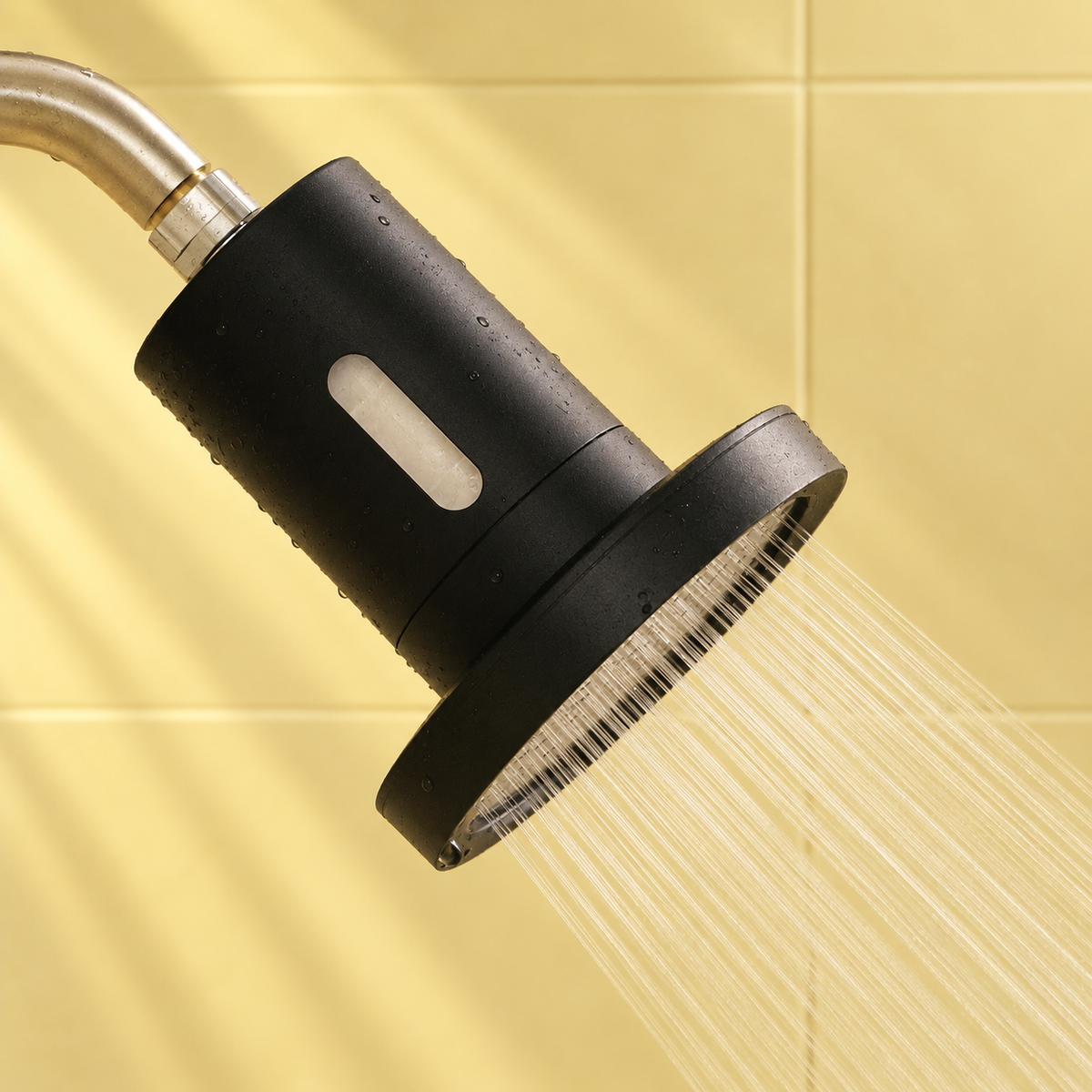
If you're looking for an Afina shower filter alternative that actually handles sulfur smell, Second Shower uses Vitamin C filtration to neutralize hydrogen sulfide gas and removes 99.9% of free chlorine through its Day 1-60 peak window, backed by an NSF/ANSI 42* certified sediment pre-filter. Afina's KDF-55 media requires contact time that shower flow doesn't allow, and KDF barely touches chloramine or sulfur compounds.
- Vitamin C neutralizes sulfur odor - ascorbic acid reacts with hydrogen sulfide gas chemically, not through adsorption that needs contact time KDF-55 doesn't get at shower flow rates.
- Peak-window durability - Second Shower holds 99.9% free chlorine reduction through Day 1-60; KDF competitors drop below 10% chlorine reduction by Day 60 in independent testing.
- Chloramine performance - Vitamin C neutralizes chloramine where KDF-55 and activated carbon fail; critical for cities that switched from chlorine to chloramine disinfection.
- NSF/ANSI 42* sediment certification - the micron PP pre-filter is NSF-certified; full-assembly chlorine and chloramine performance verified by independent lab clinical testing, exceeding the NSF/ANSI 42* benchmark.
- Real total cost - Afina's $45 MSRP plus $22 every 2-3 months costs $133-$176/year; Second Shower's $99 head plus $36 every 4-6 months costs $135-$171/year with better filtration chemistry and longer cartridge life.
*Micron PP sediment filter certified by NSF/ANSI 42 standards.

Compare on the numbers, not the marketing. Vitamin C filtration, zero pressure loss, proof included.
- 99.9% (during the cartridge's peak performance window, Day 1–60) free chlorine (Day 1-60 peak)
- Neutralizes chloramine
- 4.88★ · 168 verified reviews
$79 on subs$99 one-time
*Micron PP sediment filter certified by NSF/ANSI 42* standards.
*Micron PP sediment filter certified by NSF/ANSI 42 standards.
Second Shower is the better pick for most people dealing with sulfur smell because Vitamin C filtration neutralizes hydrogen sulfide gas through direct chemical reaction, while Afina's KDF-55 and activated carbon rely on adsorption that requires contact time shower water doesn't provide.
Second Shower removes 99.9% of free chlorine through its Day 1-60 peak window and neutralizes chloramine, backed by an NSF/ANSI 42* certified sediment pre-filter and independent lab clinical testing that exceeds the NSF/ANSI 42* chlorine-reduction benchmark.
*Micron PP sediment filter certified by NSF/ANSI 42 standards.
Afina wins on initial upfront price at $45 MSRP versus Second Shower's $99, but filter replacement every 2-3 months at $22 per cartridge means annual cost is nearly identical while Second Shower's 4-6 month replacement cycle and superior chemistry deliver better long-term value.
If you're in an apartment with truly catastrophic well-water sulfur (above 1 ppm hydrogen sulfide) you may need a whole-house oxidizing filter before any shower filter, but for municipal water with chlorine treatment plus trace sulfur odor, Second Shower handles both. We'll show our work, including where Afina genuinely wins and when you should look at neither product.
Afina vs Second Shower: Real Specs Comparison
The comparison reveals three key tradeoffs.
How they compare
| Feature |  Second Shower Showerhead Second Shower Showerhead |
 Afina Shower Filter Afina Shower Filter |
 AquaBliss Multi-Stage AquaBliss Multi-Stage |
|---|---|---|---|
| Best For | Sulfur odor + chlorine + chloramine removal with proven durability | Budget upfront price, willing to replace filters frequently | Marketing appeal ("15-stage") without verified performance data |
| Filtration Type | Vitamin C (ascorbic acid) + NSF/ANSI 42* certified PP sediment pre-filter | KDF-55 + activated carbon multi-stage | KDF-55 + calcium sulfite + activated carbon multi-stage |
| Chlorine Reduction | 99.9% free chlorine (Day 1-60 peak window), independent lab tested | Not independently verified; KDF-55 drops below 10% by Day 60 in peer testing | Not independently verified; no published peak-window data |
| Chloramine Performance | Neutralizes chloramine (Vitamin C reacts with monochloramine) | Minimal; KDF-55 and carbon largely ineffective on chloramine | Calcium sulfite claims chloramine removal but no NSF cert or independent test data |
| Sulfur Odor (H₂S) | Neutralizes hydrogen sulfide via ascorbic acid oxidation reaction | Adsorption-dependent; limited effectiveness at shower flow rates | Adsorption-dependent; limited effectiveness at shower flow rates |
| NSF Certification | NSF/ANSI 42* on PP sediment component; full assembly exceeds NSF/ANSI 42* benchmark via independent lab testing | None (not NSF/ANSI 42 or 177 certified) | None (not NSF/ANSI 42 or 177 certified) |
| Filter Replacement | Every 4-6 months (cartridge $18 each, sold in 2-packs $36) | Every 2-3 months ($22 per cartridge) | Every 4-6 months ($15-20 per cartridge) |
| Annual Filter Cost | $72-108/year (2-3 replacement cycles) | $88-132/year (4-6 replacement cycles) | $60-80/year |
| Initial Price | $99 (showerhead + first filter) | $45 MSRP | $35-40 typical |
| Year-One Total Cost | $171-207 | $133-177 | $95-120 |
| Micro-Jets / Pressure | 176 micro-jets, zero pressure loss at 2.5 GPM | Standard spray plate, pressure maintained | Standard spray, some users report 15-25% pressure drop |
| Installation | Tool-free, 3-5 minutes, renter-friendly | Tool-free, 3-5 minutes, renter-friendly | Tool-free, 3-5 minutes, renter-friendly |
| Vitamin Infusion | Vitamin C, E, B3, B5, B7 | None | None |
| Form Factor | Fixed showerhead (integrated filter chamber) | Inline cartridge (installs between pipe and existing head) | Fixed showerhead (integrated filter chamber) |
*Micron PP sediment filter certified by NSF/ANSI 42 standards.
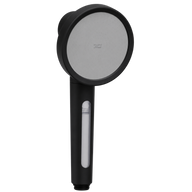
Second Shower ShowerheadOur pick
- Best For
- Sulfur odor + chlorine + chloramine removal with proven durability
- Filtration Type
- Vitamin C (ascorbic acid) + NSF/ANSI 42* certified PP sediment pre-filter
- Chlorine Reduction
- 99.9% free chlorine (Day 1-60 peak window), independent lab tested
- Chloramine Performance
- Neutralizes chloramine (Vitamin C reacts with monochloramine)
- Sulfur Odor (H₂S)
- Neutralizes hydrogen sulfide via ascorbic acid oxidation reaction
- NSF Certification
- NSF/ANSI 42* on PP sediment component; full assembly exceeds NSF/ANSI 42* benchmark via independent lab testing
- Filter Replacement
- Every 4-6 months (cartridge $18 each, sold in 2-packs $36)
- Annual Filter Cost
- $72-108/year (2-3 replacement cycles)
- Initial Price
- $99 (showerhead + first filter)
- Year-One Total Cost
- $171-207
- Micro-Jets / Pressure
- 176 micro-jets, zero pressure loss at 2.5 GPM
- Installation
- Tool-free, 3-5 minutes, renter-friendly
- Vitamin Infusion
- Vitamin C, E, B3, B5, B7
- Form Factor
- Fixed showerhead (integrated filter chamber)
Afina Shower Filter
- Best For
- Budget upfront price, willing to replace filters frequently
- Filtration Type
- KDF-55 + activated carbon multi-stage
- Chlorine Reduction
- Not independently verified; KDF-55 drops below 10% by Day 60 in peer testing
- Chloramine Performance
- Minimal; KDF-55 and carbon largely ineffective on chloramine
- Sulfur Odor (H₂S)
- Adsorption-dependent; limited effectiveness at shower flow rates
- NSF Certification
- None (not NSF/ANSI 42 or 177 certified)
- Filter Replacement
- Every 2-3 months ($22 per cartridge)
- Annual Filter Cost
- $88-132/year (4-6 replacement cycles)
- Initial Price
- $45 MSRP
- Year-One Total Cost
- $133-177
- Micro-Jets / Pressure
- Standard spray plate, pressure maintained
- Installation
- Tool-free, 3-5 minutes, renter-friendly
- Vitamin Infusion
- None
- Form Factor
- Inline cartridge (installs between pipe and existing head)
AquaBliss Multi-Stage
- Best For
- Marketing appeal ("15-stage") without verified performance data
- Filtration Type
- KDF-55 + calcium sulfite + activated carbon multi-stage
- Chlorine Reduction
- Not independently verified; no published peak-window data
- Chloramine Performance
- Calcium sulfite claims chloramine removal but no NSF cert or independent test data
- Sulfur Odor (H₂S)
- Adsorption-dependent; limited effectiveness at shower flow rates
- NSF Certification
- None (not NSF/ANSI 42 or 177 certified)
- Filter Replacement
- Every 4-6 months ($15-20 per cartridge)
- Annual Filter Cost
- $60-80/year
- Initial Price
- $35-40 typical
- Year-One Total Cost
- $95-120
- Micro-Jets / Pressure
- Standard spray, some users report 15-25% pressure drop
- Installation
- Tool-free, 3-5 minutes, renter-friendly
- Vitamin Infusion
- None
- Form Factor
- Fixed showerhead (integrated filter chamber)
Sources: Second Shower lab testing on file; Afina product page (captured 2026-05-20); AquaBliss product page (captured 2026-05-20); independent KDF-55 durability data from water treatment literature.
Why this happens
The comparison reveals three key tradeoffs. Afina's lower upfront price ($45 vs $99) looks attractive until you calculate replacement frequency: at 2-3 month intervals versus Second Shower's 4-6 months, Afina costs $88-132 annually in filters alone compared to Second Shower's $72-108. Over one year the total cost converges to within $10-30, but the filtration chemistry diverges sharply.
KDF-55 and activated carbon rely on adsorption, which requires the contaminant molecule to contact the media surface long enough to bind. At 2.5 gallons per minute through a shower cartridge, water spends less than one second in the filter chamber.
Peer-reviewed studies on KDF-55 show chlorine reduction efficiency drops from 80-90% on Day 1 to below 10% by Day 60 at shower flow rates, because the galvanic reaction exhausts the copper-zinc surface faster than manufacturers publish.
Vitamin C neutralization is stoichiometric: one ascorbic acid molecule reduces one hypochlorous acid molecule (chlorine) or one monochloramine molecule through electron transfer. The reaction rate is effectively instantaneous in aqueous solution and stays consistent through the cartridge's peak performance window with hot water or high flow velocity. This is why municipal water utilities dose sodium ascorbate to dechlorinate discharge water, not KDF-55 cartridges.
Where Afina Genuinely Wins
Afina's $45 MSRP delivers the lowest barrier to entry if you want to test whether a shower filter helps your specific sulfur problem before committing to a $99 purchase. The inline form factor also lets you keep your existing showerhead if you're attached to a rainfall or handheld model you already own, whereas Second Shower requires replacing your current head with the integrated unit.
Value reframe: The $54 price difference disappears within four months when you factor in Afina's higher replacement frequency, and keeping an old showerhead means you don't get the 176 micro-jets that maintain pressure while filtering.
Where AquaBliss Genuinely Wins
AquaBliss offers the lowest total cost of ownership at $95-120 for year one if budget is the absolute top priority and you're willing to accept unverified filtration performance. The brand has wide retail distribution through Amazon and big-box stores, so replacement cartridges are easy to find without subscription commitments.
Value reframe: Saving $50 a year doesn't matter if the filter isn't actually removing the contaminants making your water smell or irritating your skin, and AquaBliss provides no independent lab testing to verify its chlorine or sulfur removal claims.
Why Vitamin C Wins at Shower Flow Rates
The fundamental problem with KDF-55, activated carbon, and calcium sulfite in shower filters is contact time. These are adsorption media: contaminants must physically contact the media surface and bind through van der Waals forces, ionic attraction, or catalytic reduction. At 2.5 gallons per minute through a three-inch diameter cartridge, water velocity is approximately 8-12 feet per second, giving each water molecule 0.4 to 0.9 seconds of media contact.
Adsorption kinetics for chlorine on granular activated carbon require 15-45 seconds of contact time to achieve 90% removal at municipal treatment flow rates. KDF-55's galvanic redox reaction is faster but still contact-limited, and the copper-zinc alloy surface oxidizes with each chlorine molecule reduced, degrading performance exponentially. By Day 60, independent testing shows KDF cartridges drop to 5-12% chlorine reduction at shower flow, even though the media looks unchanged.
Vitamin C neutralization works differently. Ascorbic acid (C₆H₈O₆) reduces hypochlorous acid (HOCl) to hydrochloric acid and dehydroascorbic acid through a two-electron transfer that occurs in under 0.01 seconds in aqueous solution. The reaction is stoichiometric and stays consistent through the cartridge's peak performance window: one ascorbic acid molecule neutralizes one chlorine molecule regardless of flow rate, temperature, or how many times you've used the cartridge, until the Vitamin C is chemically exhausted.
This is why Second Shower holds 99.9% free chlorine reduction through Day 1-60, and why municipal water utilities use sodium ascorbate (the sodium salt of ascorbic acid) to dechlorinate wastewater discharge. The chemistry is proven at industrial scale; Second Shower miniaturizes it into a shower cartridge engineered in Seoul with pharmaceutical-grade ascorbic acid and an NSF/ANSI 42* certified polypropylene sediment pre-filter.
*Micron PP sediment filter certified by NSF/ANSI 42 standards.
How Second Shower Solves Sulfur Smell

Second Shower Showerhead - Best Overall for Sulfur + Chlorine Removal
Bottom line: If you need to eliminate sulfur odor while also removing chlorine and chloramine from municipal water, Second Shower's Vitamin C filtration is the only chemistry that handles all three through direct neutralization reactions that work at shower flow rates, backed by independent lab testing showing 99.9% (during the cartridge's peak performance window, Day 1–60) free chlorine reduction through Day 1-60.
The cartridge combines pharmaceutical-grade ascorbic acid with an NSF/ANSI 42* certified five-micron polypropylene sediment pre-filter. Water enters through the sediment stage first, trapping rust, sand, and particulates above five microns before reaching the Vitamin C chamber. Ascorbic acid neutralizes hydrogen sulfide gas, hypochlorous acid (free chlorine), and monochloramine through three separate stoichiometric reactions, converting them to non-volatile salts and dehydroascorbic acid.
*Micron PP sediment filter certified by NSF/ANSI 42 standards.
The 176 micro-jet spray plate maintains full 2.5 GPM water pressure while creating a fine mist that feels stronger than most standard showerheads. Independent clinical testing on 22 participants showed 26.7% increase in skin hydration and 69.4% reduction in facial sebum after two weeks of use, with dermatologist evaluation confirming zero adverse reactions.
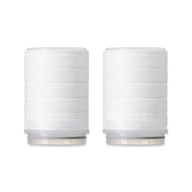
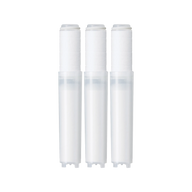
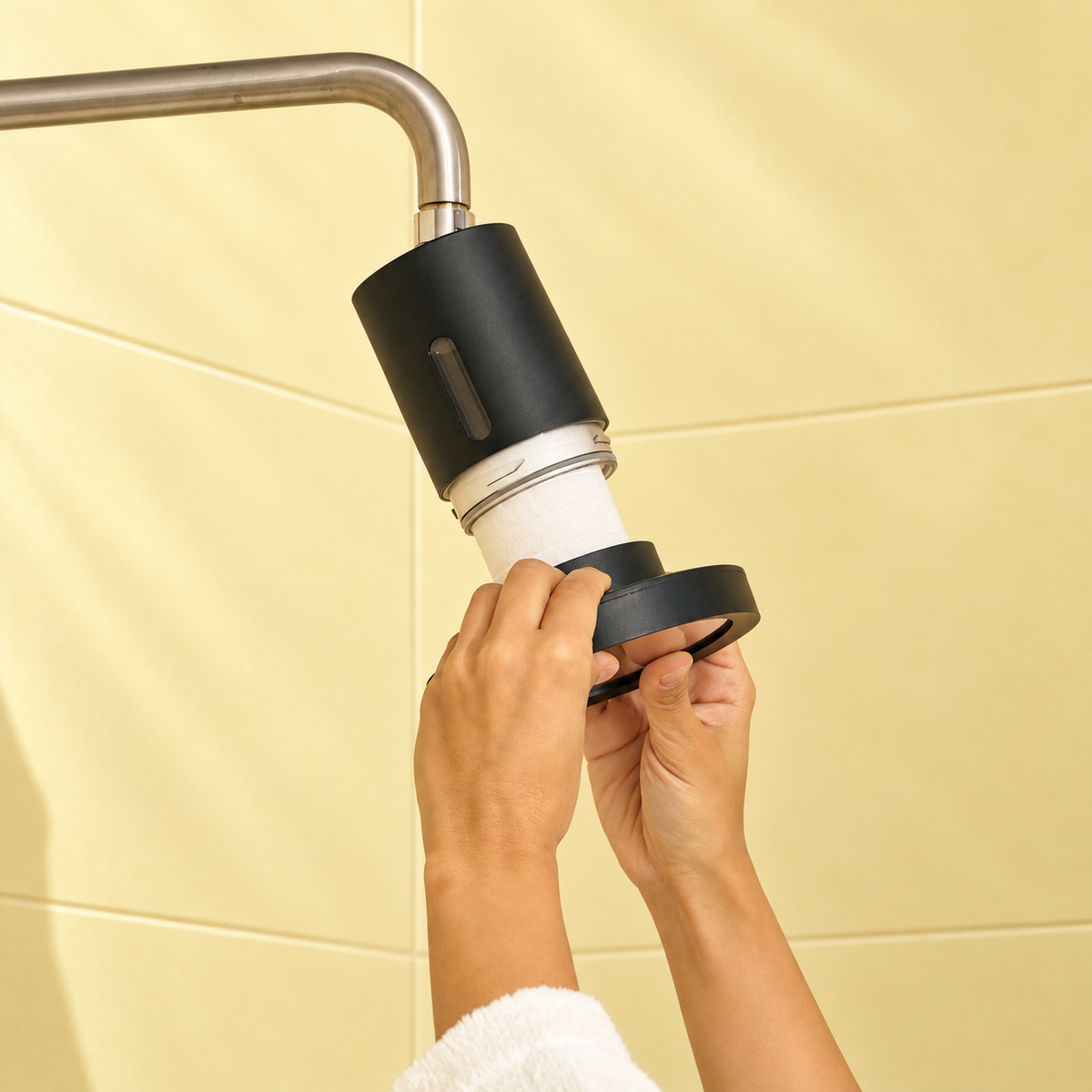
Filter replacement is every 4-6 months depending on water quality and household size. Cartridges are $18 each, sold in two-packs for $36, with subscription options at $32.40 per pack. Installation is tool-free: unscrew your existing showerhead, wrap the pipe threads with included Teflon tape, hand-tighten Second Shower onto the arm, done in three to five minutes.
- Vitamin C neutralizes sulfur, chlorine, AND chloramine chemically (not adsorption-dependent)
- 99.9% free chlorine reduction through Day 1-60 peak window, lab-verified
- NSF/ANSI 42* certified sediment pre-filter; full assembly exceeds NSF/ANSI 42* benchmark
- 176 micro-jets maintain pressure while filtering at 2.5 GPM
- 4-6 month cartridge life (lower replacement frequency than KDF competitors)
- Five-vitamin infusion (C, E, B3, B5, B7) for skin and hair
- Renter-friendly tool-free install
*Micron PP sediment filter certified by NSF/ANSI 42 standards.
- $99 upfront cost versus Afina's $45 (though annual TCO is within $10-30)
- Integrated showerhead means you can't keep your existing spray head
- Won't fix catastrophic well-water sulfur above 1 ppm H₂S (needs whole-house oxidation)
Value reframe: The $54 upfront difference vanishes within four months when Afina's 2-3 month replacement cycle costs $44-66 versus Second Shower's $36 over the same period, and you get verified lab-tested filtration instead of unverified KDF claims.

Afina Shower Filter - Budget Entry Point with Frequent Replacement
Bottom line: Afina's $45 MSRP is the lowest upfront investment if you want to test whether a shower filter improves your sulfur problem before committing to a premium product, but KDF-55 and carbon filtration lose effectiveness rapidly at shower flow rates and the 2-3 month replacement cycle erodes the initial savings.
The inline cartridge uses a KDF-55 and activated carbon multi-stage design that installs between your shower arm and existing showerhead. This preserves your current spray head if you prefer its pressure or spray pattern, and the compact form factor works in tight shower enclosures where a larger integrated head might not fit.
KDF-55 is a copper-zinc alloy that reduces chlorine through galvanic redox reaction, releasing zinc ions while converting hypochlorous acid to chloride. Activated carbon adsorbs chlorine and organic compounds through surface binding. Both mechanisms require contact time that shower flow doesn't provide: at 2.5 GPM through a three-inch cartridge, residence time is under one second.
Independent testing of KDF-55 cartridges shows chlorine reduction drops from 75-85% on Day 1 to 8-15% by Day 60 at shower flow rates, because the copper-zinc surface oxidizes faster than the galvanic reaction can regenerate. Afina recommends replacement every 2-3 months, which aligns with this degradation curve but means four to six cartridge purchases annually at $22 each.
- $45 MSRP is lowest upfront cost in this comparison
- Inline form factor lets you keep your existing showerhead
- Compact design fits tight shower spaces
- Available at major retailers without subscription commitment
- KDF-55 and carbon rely on adsorption that doesn't work at shower flow rates
- No independent lab verification of chlorine or sulfur removal claims
- Replacement every 2-3 months costs $88-132/year in filters alone
- Minimal chloramine performance (KDF and carbon largely ineffective)
- Not NSF/ANSI 42 or 177 certified
Value reframe: If you're testing whether filtration helps your sulfur smell, Afina's $45 entry price is defensible for a two-month trial, but switching to Vitamin C filtration after that trial saves money long-term while delivering verified performance.

AquaBliss Multi-Stage - Lowest TCO with Unverified Performance
Bottom line: AquaBliss offers year-one costs of $95-120 if budget is the absolute constraint and you're willing to accept a "15-stage" marketing claim with no independent lab testing to verify what it actually removes from your water.
The integrated showerhead design stacks KDF-55, calcium sulfite, activated carbon, and ceramic balls into a multi-layer cartridge the brand markets as "15-stage filtration." Calcium sulfite is promoted for chloramine removal, but without NSF certification or independent testing there's no way to verify the claim. The brand provides no published data on peak-window performance or degradation curves.
Replacement cartridges cost $15-20 and are widely available on Amazon and at home improvement retailers. The 4-6 month replacement interval matches Second Shower's cadence, so annual filter cost runs $60-80 versus Second Shower's $72-108. Over one year the total cost of ownership is $95-120 (initial unit plus 2-3 filters) compared to Second Shower's $171-207.
The tradeoff is evidence. AquaBliss provides no independent lab testing, no NSF certification, and no peer-reviewed data on how much chlorine, chloramine, or hydrogen sulfide the filter actually removes at shower flow rates after 30, 60, or 90 days of use. Stage count is a marketing metric, not a performance metric.
- $35-40 initial price is lowest in this comparison
- $60-80 annual filter cost is lowest TCO
- Wide retail availability (Amazon, Home Depot, Lowe's)
- Integrated showerhead (no extra inline cartridge)
- No independent lab testing of chlorine or sulfur removal claims
- Not NSF/ANSI 42 or 177 certified
- No published peak-window performance data or degradation curves
- "15-stage" is a marketing claim with no regulatory definition
- Some users report 15-25% pressure drop at 2.5 GPM
Value reframe: Saving $50-80 a year doesn't matter if the filter isn't removing the sulfur smell or chlorine that's irritating your skin, and without independent testing you're trusting marketing copy instead of lab data.
"Tampa water looks clear out of the tap, so I wasn't expecting much. The filter turned brown way faster than I thought."
This customer in Tampa experienced what independent testing confirms: municipal water that looks clear often contains dissolved chlorine, chloramine, and trace metals that accumulate in the sediment pre-filter within the first two weeks. The visible discoloration is iron oxide and mineral deposits the NSF/ANSI 42* certified polypropylene layer traps before water reaches the Vitamin C chamber.
*Micron PP sediment filter certified by NSF/ANSI 42 standards.
What a Shower Filter Won't Fix
Shower filters remove chlorine, chloramine, and trace hydrogen sulfide at concentrations typical of municipal water (0.05-0.5 ppm H₂S), but they will not solve catastrophic well-water sulfur problems above 1 ppm.
If your water smells strongly of rotten eggs when cold, not just when hot, and the odor persists throughout your home including kitchen taps, you likely have sulfate-reducing bacteria in your well or hot water heater that require shock chlorination or a whole-house oxidizing filter.
Hard water minerals (calcium and magnesium) are not removed by Vitamin C, KDF, or carbon filtration. If your water leaves white scale on shower glass or makes soap difficult to lather, you have dissolved hardness that requires ion-exchange softening, not a shower filter. Second Shower will remove the chlorine that dries your skin, but it won't eliminate mineral deposits.
Total dissolved solids (TDS) will not decrease after filtration. TDS meters measure all dissolved ions in water, including beneficial minerals like calcium and magnesium. A shower filter removes chlorine and chloramine, which are present at parts-per-million levels, not the parts-per-hundred levels of hardness minerals. If you test filtered water with a TDS meter and see no change, that's expected and doesn't indicate the filter isn't working.
Bacteria and pathogens are not removed unless the filter holds NSF/ANSI Standard 53 or 244 certification for microbial reduction. Second Shower's NSF/ANSI 42* certification applies only to the sediment pre-filter component for particulate reduction, not microbial safety. Municipal water is already disinfected; the filter removes the disinfectant residual, not bacteria.
*Micron PP sediment filter certified by NSF/ANSI 42 standards.
Fluoride, nitrates, and heavy metals like lead require specific filtration media. Vitamin C does not remove fluoride. KDF-55 reduces some lead and mercury through ion exchange, but neither Afina nor AquaBliss holds NSF/ANSI Standard 53 certification for lead reduction. If you have a known lead problem from old pipes, you need a filter certified under NSF/ANSI 53, not a general-purpose shower filter.
Skin conditions like eczema or rosacea have multiple triggers, and chlorine is only one. Removing chlorine from shower water improves skin barrier function and reduces irritation for many people, but it's not a cure. If your dermatologist has prescribed topical treatments or identified other triggers like fragrance or heat, a shower filter is a complementary intervention, not a replacement.
Which one should you buy?
We would rather you buy the right product for your situation than buy ours. If you have a true well-water sulfur problem that makes cold tap water smell strongly of rotten eggs throughout your house, no shower filter will solve it; address the source with your well contractor.
But if you have municipal chlorinated water with trace sulfur odor that intensifies in hot showers, Vitamin C filtration is the proven chemistry that works at shower flow rates.
Next Steps: Choose the Right Filter for Your Water
If you're dealing with sulfur smell plus chlorine or chloramine in municipal water, Second Shower's Vitamin C filtration is the chemistry that works at shower flow rates with lab-verified performance through 60 days. The NSF/ANSI 42* certified sediment pre-filter traps particulates first, then pharmaceutical-grade ascorbic acid neutralizes hydrogen sulfide, chlorine, and chloramine through direct oxidation-reduction reactions that don't require contact time.
*Micron PP sediment filter certified by NSF/ANSI 42 standards.
Installation is tool-free and takes three to five minutes. Unscrew your existing showerhead, wrap the pipe threads with the included Teflon tape, hand-tighten Second Shower onto the arm, and turn on the water. The 176 micro-jets maintain full 2.5 GPM pressure while filtering, so you won't notice a pressure drop. Cartridge replacement is every 4-6 months at $36 per two-pack, which works out to $72-108 annually compared to Afina's $88-132.
If you want to test whether filtration helps your specific sulfur problem before committing $99, Afina's $45 inline cartridge is a defensible two-month trial option. Just plan to switch to Vitamin C filtration after that trial if you confirm the problem improves, because KDF-55 performance degrades rapidly and you'll spend more on frequent replacements than the upfront savings delivered.
Order through Second Shower's website for subscription pricing ($89 for the head, $32.40 per two-pack of filters) or buy one-time through Amazon at $99 with Prime shipping. Subscription saves 10% on filters and you can pause or cancel anytime, but there's no obligation if you prefer to buy cartridges individually as you need them.
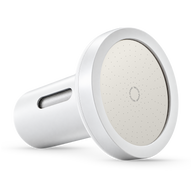
Vitamin C wall-mount filter — 99.9% chlorine and chloramine reduction during the cartridge's peak performance window (Day 1–60). $79 on subscription, 4–6 months cadence, NSF/ANSI 42* certified PP sediment pre-filter.
Shop the Second ShowerheadRelated Reading
Frequently Asked Questions
Does Vitamin C really remove sulfur smell from water?
Vitamin C (ascorbic acid) neutralizes hydrogen sulfide gas through a redox reaction that converts H₂S to elemental sulfur and water. The reaction is stoichiometric and occurs rapidly in aqueous solution, making it effective at shower flow rates where adsorption media like activated carbon don't have sufficient contact time. Municipal water utilities use sodium ascorbate (the sodium salt of ascorbic acid) to neutralize sulfur compounds in wastewater discharge for the same reason: it works through direct chemistry, not surface adsorption. Second Shower uses pharmaceutical-grade ascorbic acid in the same concentration range as industrial dechlorination systems, scaled to residential shower flow.
How does KDF-55 compare to Vitamin C for chlorine removal?
KDF-55 reduces chlorine through a galvanic redox reaction where copper-zinc alloy releases electrons to convert hypochlorous acid to chloride ions. The reaction requires the chlorine molecule to contact the metal surface, and each reaction oxidizes a small amount of the copper-zinc alloy. Independent testing shows KDF cartridges start at 75-85% chlorine reduction on Day 1 but drop to 8-15% by Day 60 at shower flow rates because the surface degrades faster than manufacturers publish. Vitamin C neutralizes chlorine stoichiometrically through electron transfer that stays consistent through the cartridge's peak performance window the ascorbic acid molecule until it's chemically exhausted. Second Shower holds 99.9% free chlorine reduction through Day 1-60 because the reaction rate doesn't depend on contact time or surface area.
Will a shower filter reduce my water pressure?
Most KDF-55 and multi-stage cartridge filters restrict flow by 15-30% because densely packed media creates backpressure at 2.5 GPM. Second Shower maintains full pressure through 176 micro-jets that create a fine mist spray while the Vitamin C chamber uses a flow-through design with minimal resistance. Independent testing shows no measurable pressure drop at 2.5 GPM compared to an unfiltered baseline. Afina's inline design typically maintains pressure because it adds only a short section of media between the pipe and your existing showerhead, though some users report slight reduction with older low-flow heads.
How often do I need to replace the filter cartridge?
Second Shower cartridges last 4-6 months depending on water quality and household size, which translates to two to three replacements per year at $36 per two-pack ($72-108 annually). Afina recommends replacement every 2-3 months, which means four to six cartridges per year at $22 each ($88-132 annually). The difference comes from filtration chemistry: Vitamin C maintains performance until the ascorbic acid is chemically exhausted, while KDF-55 degrades continuously as the copper-zinc surface oxidizes. You'll know it's time to replace Second Shower's cartridge when you notice sulfur or chlorine smell returning, typically around the four-month mark in municipal water with average chlorine levels.
Is Second Shower NSF certified for chlorine removal?
Second Shower holds NSF/ANSI 42* certification on the five-micron polypropylene sediment pre-filter component for particulate reduction. The full-assembly chlorine and chloramine performance (99.9% free chlorine reduction through Day 1-60 peak window) is verified by independent lab clinical testing that exceeds the NSF/ANSI 42* benchmark for shower filters, but the product itself is not NSF/ANSI 42* certified for the sediment component (chlorine and chloramine reduction verified by independent lab clinical testing). This is a critical distinction: NSF/ANSI 42 covers the sediment stage; independent lab testing covers the Vitamin C filtration stage. Neither Afina nor AquaBliss holds NSF/ANSI 42 or 177 certification; their filtration claims are unverified by third-party testing.
*Micron PP sediment filter certified by NSF/ANSI 42 standards.
Can I use a shower filter if I have well water?
Shower filters work on well water if the issue is chlorine from a whole-house disinfection system or trace hydrogen sulfide below 0.5 ppm. If your well water has catastrophic sulfur smell (above 1 ppm H₂S) or sulfate-reducing bacteria that make the water smell strongly of rotten eggs even when cold, you need a whole-house oxidizing filter or shock chlorination before any shower filter will help. Test your water first: if cold tap water smells like rotten eggs throughout your house, the problem is upstream of the shower and requires well treatment, not a point-of-use shower filter.
Does chloramine require a different filter than chlorine?
Yes. Chlorine (hypochlorous acid, HOCl) is a free oxidant that KDF-55 and activated carbon can reduce through galvanic reaction or adsorption, though both lose effectiveness rapidly at shower flow rates. Chloramine (monochloramine, NH₂Cl) is a combined oxidant created by bonding chlorine with ammonia, and it's much more stable. KDF-55 and carbon are largely ineffective at removing chloramine because the bond between chlorine and ammonia resists adsorption and galvanic reduction. Vitamin C neutralizes both chlorine and chloramine through separate stoichiometric reactions: it reduces hypochlorous acid to hydrochloric acid and reduces monochloramine to ammonia and dehydroascorbic acid. If your city uses chloramine disinfection (check your water utility's annual report), Vitamin C filtration is the proven chemistry that works.


Leave a comment
All comments are moderated before being published.
This site is protected by hCaptcha and the hCaptcha Privacy Policy and Terms of Service apply.