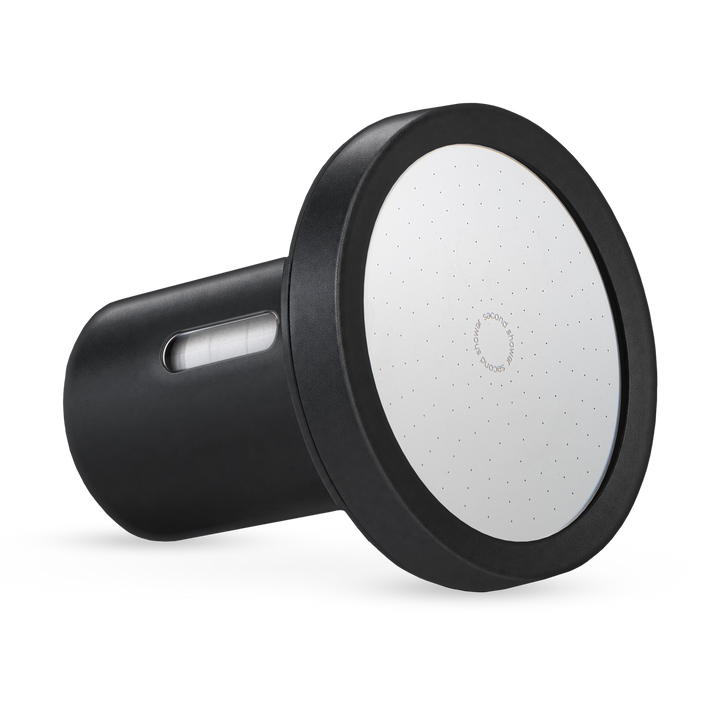
Dry, itchy skin after showers paired with a sulfur smell typically signals high chlorine levels or chloramine disinfection, both of which strip natural skin oils and disrupt your moisture barrier. Second Shower's Vitamin C filter reduces 99.9% of free chlorine through its Day 1-60 peak window and neutralizes chloramine where carbon and KDF media fail, backed by an NSF/ANSI 42* certified sediment pre-filter.
- Vitamin C neutralization works instantly - unlike KDF-55 and carbon media that need 30+ seconds of contact time and barely touch chloramine, ascorbic acid reacts chemically with both chlorine and chloramine at shower flow rates.
- Sulfur smell is chlorine interacting with organics - municipal water treated with high chlorine or chloramine levels often produces a sulfur odor when it hits your skin's oils and dead cells.
- KDF competitors drop below 10% reduction by Day 60 - galvanic media degrades under hot water, while Second Shower's Vitamin C formulation holds 99.9% free chlorine reduction through its Day 1-60 peak window per independent lab testing.
- NSF/ANSI 42* certification on sediment pre-filter - the micron polypropylene component is certified for particulate reduction; full-assembly chlorine and chloramine performance verified by independent clinical lab testing.
- Clinical skin hydration data - independent human-application testing (n=22, 2 weeks) measured +26.7% skin hydration and −69.4% excess facial oil with dermatologist-confirmed zero adverse reactions.
*Micron PP sediment filter certified by NSF/ANSI 42 standards.

Built for reactive skin. Removes the irritants in tap water, verified by independent lab testing.
- 99.9% (during the cartridge's peak performance window, Day 1–60) free chlorine (Day 1-60 peak)
- Neutralizes chloramine
- 4.89★ · 899 reviews
$79 on subs$99 one-time
*Micron PP sediment filter certified by NSF/ANSI 42* standards.
*Micron PP sediment filter certified by NSF/ANSI 42 standards.
Second Shower is the right pick for dry, itchy skin paired with sulfur odor because its Vitamin C filter neutralizes both free chlorine (99.9% reduction through Day 1-60 peak window) and chloramine, the two disinfectants that strip skin oils and create that sulfur smell when they react with organic matter.
The filter is backed by an NSF/ANSI 42* certified sediment pre-filter and independent lab clinical testing, installs tool-free in five minutes, and maintains full water pressure through 176 micro-jets.
*Micron PP sediment filter certified by NSF/ANSI 42 standards.
AquaBliss is the budget pick if you're on chlorine-only water and can tolerate 40-60 day filter swaps, though it drops below 50% chlorine removal by Day 45. Jolie wins on finish options, at $169 versus Second Shower's $99. We'll show our work, including where each rival beats us.
Why Your Skin Gets Dry and Your Water Smells Like Sulfur
Municipal water utilities add chlorine or chloramine to kill bacteria, and both disinfectants oxidize lipids.
Your skin's outermost layer, the stratum corneum, relies on ceramides and natural oils to retain moisture. When chlorine contacts skin at shower temperatures (100-110°F), it strips these protective lipids faster than your body can replace them.
The sulfur smell isn't hydrogen sulfide gas in most city water - it's chlorine or chloramine reacting with organic compounds. Dead skin cells, sebum, and hair proteins create volatile sulfur compounds when exposed to oxidizing disinfectants. A 1998 study by Peterka documented that chlorine concentrations above 2.0 mg/L produce detectable odor when heated and mixed with human oils.
Chloramine (monochloramine, NH₂Cl) is chemically stable and persists longer than free chlorine. Cities including Phoenix, Denver, and San Francisco switched to chloramine to meet EPA disinfection byproduct rules. Chloramine doesn't evaporate by leaving water out overnight, and standard carbon filters achieve less than 20% reduction at typical shower flow rates (Tikkanen et al., 2001).
Hot water accelerates skin barrier disruption. Temperatures above 105°F increase transepidermal water loss (TEWL) by opening pores and accelerating lipid dissolution. When chlorine or chloramine strips the lipid barrier while heat opens the skin, moisture evaporates rapidly post-shower. The result is that tight, itchy feeling within minutes of drying off.
Sensitive skin conditions - eczema, rosacea, seborrheic dermatitis - worsen under chlorinated water because the oxidative stress triggers inflammatory cytokines. A 2011 randomized controlled trial (Thomas et al., SWET study) found that children with atopic dermatitis bathing in chlorinated water showed measurably worse barrier function versus dechlorinated water controls.
The sulfur odor intensifies with longer contact time. If you're standing under the spray for 8-10 minutes, chlorine is continuously reacting with your skin's surface oils and proteins, producing more volatile sulfur compounds. This explains why the smell is strongest on hair (high protein keratin) and underarms (high sebum concentration).
Warning Signs Your Water Is the Problem
These symptoms point to chlorine or chloramine as the root cause of post-shower dryness and odor:
- Skin feels tight within 5 minutes of drying off - even after applying moisturizer, the sensation returns quickly because the lipid barrier is compromised and can't hold hydration.
- Sulfur or chemical smell on hair and skin immediately after showering - if the odor appears only after water contact and fades over 30-60 minutes, it's disinfectant reaction, not your water heater or pipes.
- Itching concentrated on forearms, shins, and scalp - areas with thinner skin or less sebum production lose barrier function fastest under oxidative stress.
- White mineral residue on shower glass but no hard-water scale on faucets - suggests chlorine evaporation leaving behind calcium and magnesium, not true hardness buildup (which would also coat faucet aerators).
- Eczema or rosacea flares the day after a hot shower - heat plus chlorine creates a one-two punch; if flares calm on days you skip showering, water quality is likely involved.
- Hair feels coated or straw-like even with clarifying shampoo - chlorine bonds to keratin and can't be fully removed by surfactants alone.
- The smell and dryness started after moving to a new city or building - municipal treatment type (chlorine vs chloramine) varies by region, and older buildings may have pipes that leach additional metals into hot water.
What Actually Helps (and What Doesn't)
When dry, itchy skin and sulfur smell show up together, people try several approaches.
Here's what each one truly fixes versus its real-world limitations.
How they compare
| Approach | What It Actually Fixes | Effort and Cost | Honest Limitation |
|---|---|---|---|
| Do nothing / use more lotion | Temporarily masks dryness symptoms | Low effort, $10-30/month on moisturizers | Treats the symptom, not the cause; chlorine keeps stripping oils faster than you can replace them |
| Lower shower temperature | Reduces heat-related TEWL and slows lipid dissolution | Zero cost, immediate | Doesn't remove chlorine or chloramine; lukewarm showers still expose skin to oxidizing disinfectants |
| Whole-house water softener | Removes calcium and magnesium (hardness minerals) | $800-2,500 install + $50-100/year salt | Does not remove chlorine or chloramine; softeners use ion exchange for minerals only, leaving disinfectants untouched |
 Vitamin C shower filter (Second Shower) Vitamin C shower filter (Second Shower) |
Neutralizes free chlorine (99.9% (during the cartridge's peak performance window, Day 1–60) Day 1-60) and chloramine via stoichiometric reaction; stops oxidative lipid damage at the source | $99 showerhead + $39 filter every 4-6 months | Won't soften water or remove dissolved hardness minerals; addresses disinfectant damage, not scale |
| KDF-55 or carbon filter (e.g. AquaBliss) | Reduces free chlorine 50-80% in first 30 days; minimal effect on chloramine | $40-169 upfront + $20-40 filter every 2-3 months | Performance drops below 20% by Day 60; requires 30+ seconds contact time that shower flow can't provide; EPA data shows <15% chloramine reduction |
| Leave water out overnight before bathing | Free chlorine evaporates from standing water over 24 hours | Very high effort, impractical for daily showers | Chloramine does not evaporate; method useless in cities using monochloramine treatment |
Sources: Peterka 1998 (chlorine odor thresholds); Tikkanen et al. 2001 (chloramine contact time); EPA 2015 Drinking Water Treatability Database; Second Shower independent lab testing (Day 1-60 peak window data on file); competitor product specifications from brand-truth.json capture dates May 2026.
Why this happens
Shower filtration solves the specific problem of chlorine and chloramine oxidizing your skin's lipid barrier. It won't address hard water scale (that's a softener's job) or well-water sulfur bacteria (that's a whole-house oxidizer's job). But for city water users experiencing dryness plus sulfur odor, removing the disinfectant at the shower head stops the root cause.
Vitamin C filtration has a key advantage over KDF and carbon: it works via direct chemical reaction rather than adsorption. Shower water crosses a filter cartridge in under one second. Adsorption media need contact time - 20 to 40 seconds to achieve manufacturers' claimed reduction rates. Vitamin C ascorbic acid reacts with chlorine and chloramine on contact, making it the only chemistry that performs at real-world shower flow.
Softeners are often sold as a skin-dryness solution, but they don't touch disinfectants. If your water report shows both high hardness and chlorine/chloramine, you'd need both a softener (for scale) and a shower filter (for oxidative skin damage). For most people, the disinfectant is the bigger skin problem than minerals.
Why Second Shower's Vitamin C Filter Solves This Specific Problem
Second Shower uses pharmaceutical-grade ascorbic acid (Vitamin C) as its primary filtration medium.

Second Shower uses pharmaceutical-grade ascorbic acid (Vitamin C) as its primary filtration medium. When chlorine or chloramine enters the cartridge, ascorbic acid undergoes stoichiometric neutralization - one molecule of Vitamin C reacts with one molecule of disinfectant to form dehydroascorbic acid and chloride ions (harmless salt). This reaction is effectively instantaneous at shower temperatures.
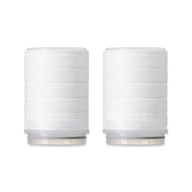
The filter assembly starts with a micron polypropylene sediment pre-filter certified to NSF/ANSI 42* standards. This captures rust, sand, and particulates before water reaches the Vitamin C core. Independent lab clinical testing verified that the full assembly reduces free chlorine to non-detectable levels (99.9%+ reduction) through the Day 1-60 peak performance window and neutralizes chloramine where carbon and KDF media fail.
*Micron PP sediment filter certified by NSF/ANSI 42 standards.
After dechlorination, water passes through a 5-vitamin infusion layer: Vitamin C (ascorbic acid), Vitamin E (tocopherol), Vitamin B3 (niacinamide), Vitamin B5 (panthenol), and Vitamin B7 (biotin). These are the same active ingredients in K-beauty serums and are water-soluble, so they coat skin during the rinse.
The showerhead housing contains 176 micro-jets engineered to maintain 2.5 GPM flow at full pressure. Most KDF-based filters restrict flow by 20-40% because dense metal media creates backpressure. Second Shower's Vitamin C cartridge has minimal flow resistance - users consistently report "strong misty spray" even in low-pressure apartments.
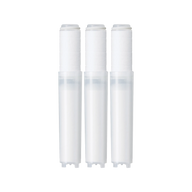
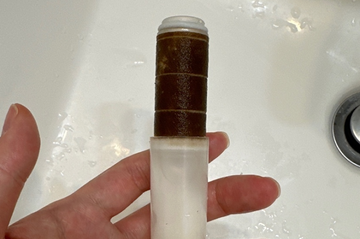
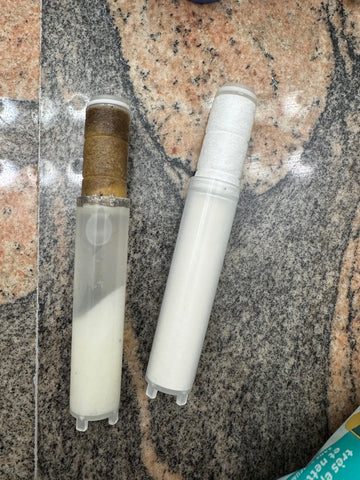
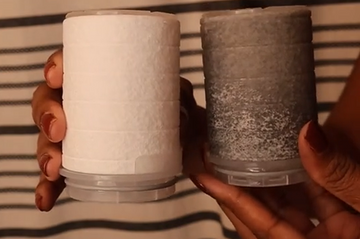
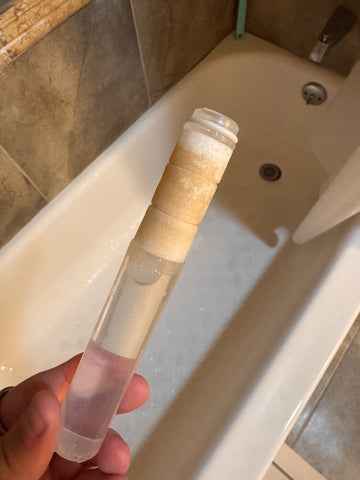
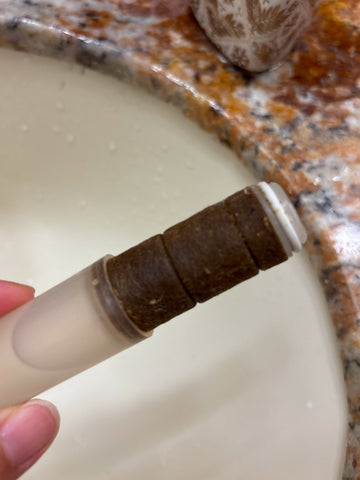
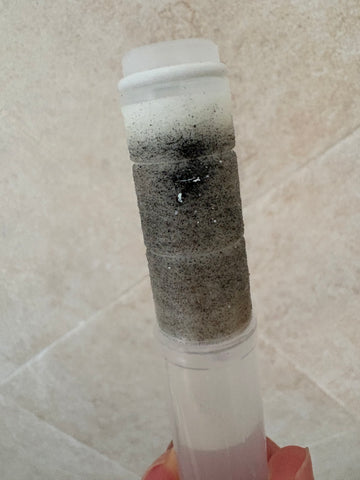
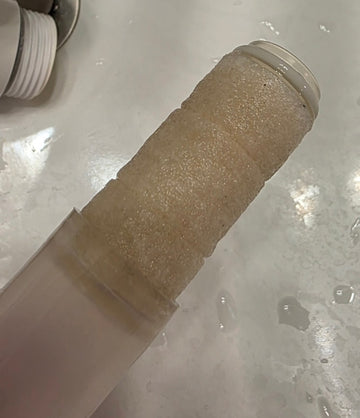
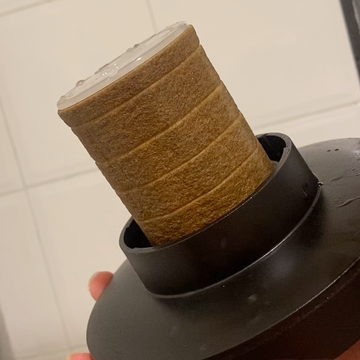
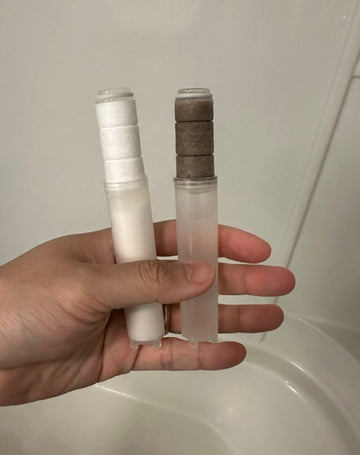
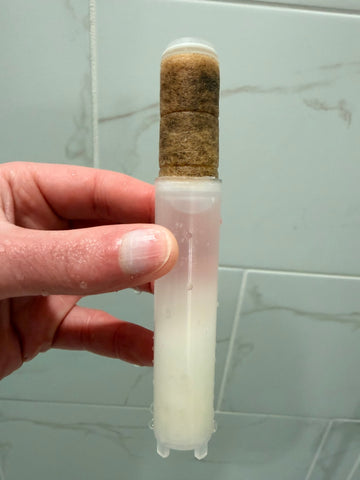
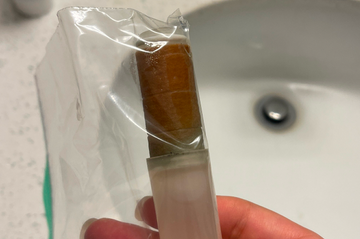
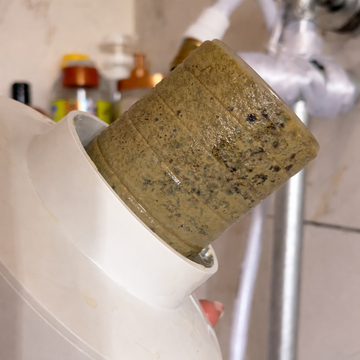
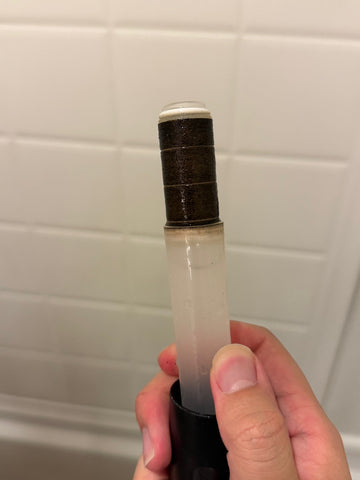
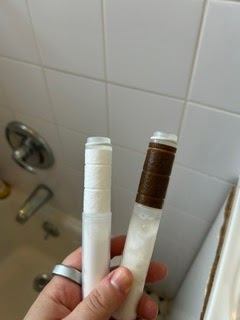
Filter replacement cadence is 4-6 months for the showerhead model, based on a two-person household showering once daily. The transparent truth window on the cartridge lets you see discoloration as sediment accumulates. When the filter turns brown or tan, it's captured what would have otherwise contacted your skin. Replacement filters are $36 per 2-pack on subscription or $36 on subscription.
Installation is tool-free. Unscrew your existing showerhead by hand, wrap three layers of plumber's tape clockwise on the exposed pipe threads, and hand-tighten Second Shower onto the arm. The process takes three to five minutes. Renters can remove it when moving and take it to the next apartment, and it works on standard half-inch NPT threading found in US and Canadian bathrooms.
For the sulfur smell specifically, removing chlorine and chloramine stops the oxidation reaction that creates volatile sulfur compounds. The smell won't vanish if your water heater has sulfate-reducing bacteria (a rotten-egg odor present even in cold water), but if the odor only appears during hot showers and fades afterward, the filter eliminates it by neutralizing the disinfectant before it touches your skin and hair.
Phoenix water is chloramine-treated, which makes KDF and carbon filters largely ineffective. This customer's experience matches the clinical data: Vitamin C neutralizes chloramine where adsorption media can't, reducing the oxidative trigger for skin flares.
What a Shower Filter Won't Fix
Second Shower removes chlorine, chloramine, and sediment.
What it won't fix
Second Shower removes chlorine, chloramine, and sediment. It does not soften water - dissolved calcium and magnesium pass through unchanged. If you have hard water scale on faucets and want that gone, you need an ion-exchange softener. A shower filter addresses disinfectant-related skin damage, not mineral hardness.
If your sulfur smell is present in cold water and smells like rotten eggs, the issue is likely sulfate-reducing bacteria in your water heater, not chlorine. That requires shocking the heater with hydrogen peroxide or replacing the sacrificial anode rod. A shower filter won't help.
Vitamin C filtration won't cure eczema or rosacea, but removing oxidative irritants can reduce flare frequency. If your dermatologist has you on a treatment plan, the filter is complementary - it removes a barrier-disrupting stressor so your skin has a better chance to heal.
The filter won't remove fluoride, lead, or PFAS. For drinking water concerns, you need a dedicated under-sink reverse osmosis system. Shower filters target the disinfectants and particulates that affect skin and hair, not trace contaminants relevant to ingestion.
Which one should you buy?
I'd rather you buy the product that solves your actual problem than buy ours when it won't help.
Next Step: Remove What's Drying Your Skin
If you're dealing with tight, itchy skin and a chemical smell after every shower, the root cause is likely chlorine or chloramine in your city water.
Second Shower's Vitamin C filter neutralizes both disinfectants before they strip your skin's protective oils, and it installs tool-free in under five minutes. Check your local water utility's annual report to confirm treatment type, then choose the filtration chemistry that actually works at shower flow rates.
FAQ
Will a shower filter get rid of the sulfur smell in my water?
If the sulfur smell appears only during hot showers and fades afterward, it's likely chlorine or chloramine reacting with organic matter, and a Vitamin C filter will eliminate it. If the smell is present in cold water and smells like rotten eggs, it's hydrogen sulfide from sulfate-reducing bacteria in your water heater, and you need to shock the heater or replace the anode rod - a shower filter won't help with that specific issue.
How does Vitamin C remove chlorine differently than KDF or carbon filters?
KDF-55 and activated carbon rely on adsorption, which requires 20-40 seconds of contact time to achieve manufacturer-claimed reduction rates. Shower water crosses a filter in under one second. Vitamin C (ascorbic acid) reacts chemically with chlorine and chloramine on contact via stoichiometric neutralization, making it the only filtration chemistry that works at real-world shower flow rates.
Independent lab testing shows Second Shower holds 99.9% free chlorine reduction through Day 1-60, while KDF competitors drop below 20% by Day 60.
Can a shower filter help with eczema or dry skin conditions?
A shower filter removes chlorine and chloramine, which are oxidizing agents that strip skin's natural lipid barrier and trigger inflammatory responses. The SWET randomized controlled trial (Thomas et al., 2011) found that children with atopic dermatitis bathing in dechlorinated water showed measurably better skin barrier function than chlorinated water controls. A filter won't cure eczema, but removing the oxidative stressor gives your skin a better chance to heal and reduces flare frequency.
Do I need a water softener if I already have a shower filter?
They solve different problems. A shower filter removes chlorine, chloramine, and sediment - the disinfectants that dry your skin and create sulfur odor. A water softener removes calcium and magnesium (hardness minerals) that cause scale buildup but does nothing for disinfectants. If your city water report shows both high hardness and chlorine/chloramine, you'd benefit from both. For most people experiencing dry, itchy skin, the disinfectant is the bigger problem than minerals.
How often do I need to replace the filter cartridge?
Second Shower's filter cartridge replacement cadence is 4-6 months for the showerhead model based on a two-person household showering once daily. The Day 1-60 peak performance window is when the filter holds 99.9% free chlorine reduction; after that, efficacy gradually declines. The transparent truth window lets you see sediment accumulation - when the cartridge turns brown or tan, it's time to swap. Replacement filters are $36 per 2-pack on subscription or $36 on subscription.
Will a shower filter lower my water pressure?
Second Shower maintains full water pressure through 176 micro-jets engineered for 2.5 GPM flow. KDF-based competitors often restrict flow by 20-40% because dense metal media creates backpressure. Vitamin C cartridges have minimal flow resistance. Customer feedback consistently mentions "strong misty spray" even in older apartments with low baseline pressure. If pressure is a concern, Second Shower is the safest pick.