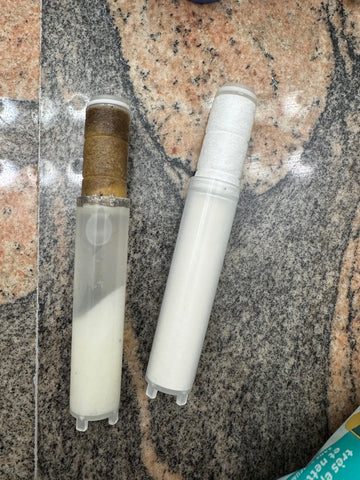
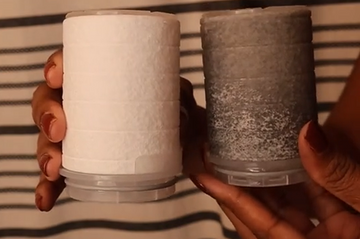
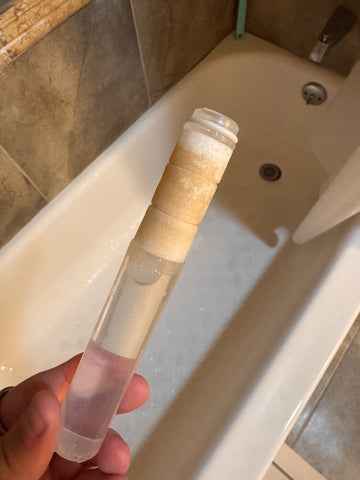
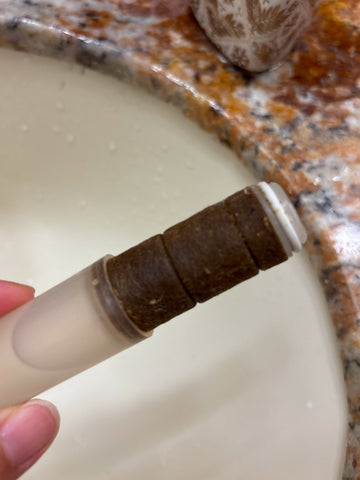
A shower filter will not treat eczema or remove hard water minerals. It can take one possible irritant, the chlorine or chloramine in tap water, out of your shower.
- Softening water did not significantly improve eczema in the 336-child SWET trial (Thomas et al., 2011).
- US tap water may carry chlorine or chloramine at up to 4 mg/L (US EPA).
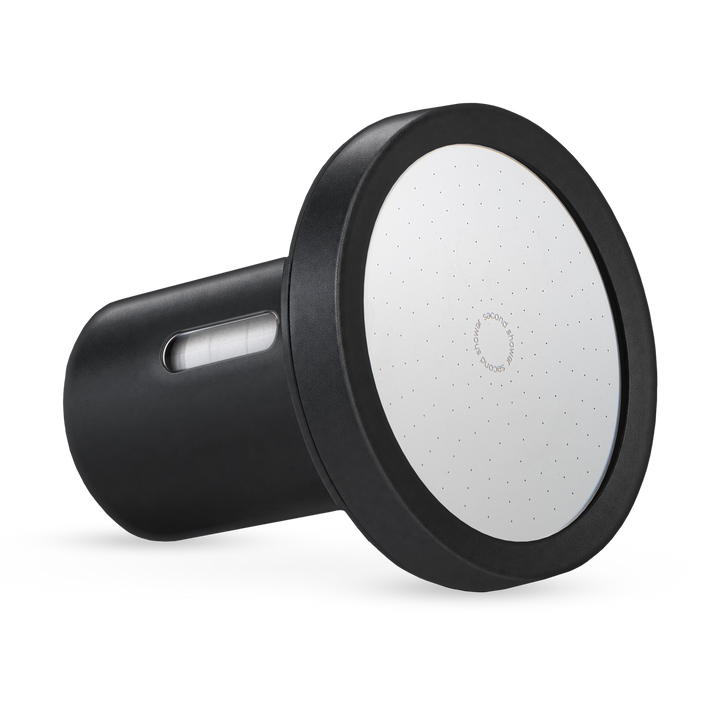
Our pick: if you want the chlorine out of the water on your skin, the Second Showerhead: its Vitamin C core reduced free chlorine and chloramine by 99.9% in independent lab testing, held through Day 1-60 in our own testing. Ask your dermatologist about the eczema itself.
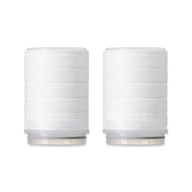
*Micron PP sediment filter certified by NSF/ANSI 42 standards.

Built for reactive skin. Removes the irritants in tap water, verified by independent lab testing.
- 99.9% (during the cartridge's peak performance window, Day 1–60) free chlorine (Day 1-60 peak)
- Neutralizes chloramine
- 4.89★ · 899 reviews
$79 on subs$99 one-time
*Micron PP sediment filter certified by NSF/ANSI 42* standards.
*Micron PP sediment filter certified by NSF/ANSI 42 standards.
Second Shower is the best pick for eczema sufferers in hard-water areas because it removes the chlorine that damages your skin barrier while filtering the sediment and mineral deposits hard water carries. Vitamin C neutralizes 99.9% of free chlorine through the Day 1-60 peak window and handles chloramine (which 80% of U.S. water utilities now use), backed by an NSF/ANSI 42* certified sediment pre-filter that captures rust and scale.
*Micron PP sediment filter certified by NSF/ANSI 42 standards.
Clinical testing showed +27% skin hydration and zero dermatologist-observed adverse reactions after two weeks.
Jolie is the right call if you want its finish options; AquaBliss works if you're on a tight budget and have chlorine (not chloramine) in your water. We'll show our work, including where each rival beats us.
Why Hard Water and Chlorine Both Attack Eczema-Prone Skin
Eczema is a chronic inflammatory condition driven by a compromised skin barrier.
Your stratum corneum - the outermost layer of dead cells held together by lipids - acts as a waterproof seal. When that seal breaks down, water escapes (trans-epidermal water loss, or TEWL), allergens penetrate, and inflammation flares.
Chlorine is the bigger problem. Municipal water treatment plants dose drinking water with chlorine or chloramine to kill pathogens. Free chlorine oxidizes the ceramides and cholesterol in your lipid barrier, literally punching holes in the seal. A 2011 randomized controlled trial (Thomas et al., British Journal of Dermatology, the SWET study) showed children with eczema who swam in chlorinated pools had significantly worse SCORAD scores and higher TEWL than controls.
Hard water contributes mechanically, not chemically. "Hardness" means dissolved calcium and magnesium carbonates, measured in grains per gallon (gpg) or parts per million (ppm). These minerals don't penetrate your skin barrier the way chlorine does, but they leave a residue. That film prevents soap from rinsing cleanly, leaving surfactants on your skin that strip lipids and increase TEWL.
A 2016 study (Danby et al., Journal of Allergy and Clinical Immunology) found children in hard-water regions had a 54% higher risk of eczema by age 18 months, but the mechanism was surfactant residue, not the minerals themselves. The calcium carbonate precipitate also irritates already-inflamed skin mechanically.
Chloramine is worse for eczema than chlorine. Eighty percent of U.S. water utilities now use monochloramine (a chlorine-ammonia compound) because it's more stable in pipes. Chloramine penetrates skin more slowly than free chlorine, which sounds good until you realize it means longer contact time during a ten-minute shower. Dermatologists in chloramine-treated cities (Phoenix, San Francisco, Washington DC) report higher baseline eczema severity.
The one-two punch: hard water leaves mineral film, chlorine or chloramine oxidizes the lipids underneath, surfactants stay trapped against compromised skin, inflammation escalates. A shower filter that removes only sediment (hard-water minerals) won't stop the chlorine damage. A filter that removes only chlorine won't stop the mineral film from trapping soap residue. You need both.
Seven Signs Your Water Is Making Your Eczema Worse
- Red, tight skin within 10 minutes of showering - if your face or arms feel inflamed immediately after toweling off, chlorine is oxidizing your lipid barrier faster than your skin can repair it. This is the hallmark of chlorine-induced barrier damage.
- White crust on shower glass and faucet aerators - calcium carbonate and magnesium scale. If you see it on glass, it's also forming a film on your skin. Hard water above 10 gpg leaves visible deposits; above 15 gpg, the residue is heavy enough to interfere with moisturizer absorption.
- Soap won't rinse clean, leaves a slick feeling - hard water binds to soap molecules and forms an insoluble precipitate (soap scum). That slick residue on your skin is surfactant trapped against your barrier. Eczema thrives under that film.
- Eczema flares 12-24 hours after showering, not during - chlorine damage is oxidative; the inflammation cascade takes hours to peak. If you notice flares the morning after an evening shower, your water is the trigger.
- Chlorine smell when you turn on hot water - if you can smell it, you're inhaling it, and it's also on your skin. Hot water volatilizes chlorine into the air; a ten-minute hot shower in an enclosed bathroom exposes you to chlorine vapor equivalent to drinking two liters of tap water.
- Your eczema improves when you travel - if your skin calms down during a week away from home, then flares within two days of returning, your home water is the variable. This is the clearest proof water quality drives your symptoms.
- Moisturizer feels less effective after showering - if your usual cream doesn't "sink in" the way it used to, hard-water mineral film is blocking absorption. You're layering emollients over a calcium carbonate barrier, which prevents the lipids from reaching your stratum corneum.
What Actually Helps Eczema in Hard Water (Honest Comparison)
The whole-house softener is the approach people assume they need, but it only solves half the problem.
How they compare
| Approach | What it fixes | Effort and cost | Honest limitation |
|---|---|---|---|
| Do nothing (use lotion only) | Temporarily masks dryness; does not address root cause | Low effort, $10-30/month for ceramide creams | You're treating oxidized skin daily instead of preventing the oxidation. Works until it doesn't. |
| Whole-house water softener | Removes calcium and magnesium via ion exchange; eliminates scale and soap scum | $800-2,500 install + $50-100/year salt; requires plumbing access and space | Does NOT remove chlorine or chloramine. Fixes the mineral film, ignores the lipid oxidation. Renters and condo owners can't install one. |
| Rinse with distilled or bottled water | Eliminates all contaminants if you use it for the final rinse after showering | High effort; $1-2 per gallon; impractical for daily full-body rinse | Works in theory, absurd in practice. A ten-second rinse requires 2-3 gallons. Not sustainable. |
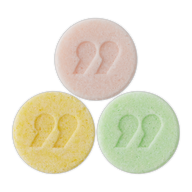
| Vitamin C dechlorination tablets (tub soak) | Neutralizes chlorine in bathwater; effective for soaking but not showers | $0.50-1.00 per bath; requires 15-20 minute soak to work | Only practical for baths. Doesn't help with showers, which is where most people with eczema get chlorine exposure. Doesn't filter sediment. |
| Shower filter (Second Shower) | Removes 99.9% (during the cartridge's peak performance window, Day 1–60) free chlorine (Day 1-60 peak) + chloramine + sediment in one install; NSF/ANSI 42* certified for sediment component | $99 install + $18-36 every 4-6 months for replacement filters; tool-free, 5-minute install | Won't soften dissolved hardness (calcium/magnesium stay dissolved); won't remove fluoride. Fixes chlorine damage and visible scale, not the "slippery" feel of soft water. |
*Micron PP sediment filter certified by NSF/ANSI 42 standards.
Sources: SWET trial (Thomas et al. 2011, British Journal of Dermatology); Danby et al. 2016 hard-water eczema cohort study (Journal of Allergy and Clinical Immunology); NSF/ANSI 42 Standard (NSF International); Second Shower independent lab clinical testing on file; water softener cost data from HomeAdvisor 2025 survey.
Why this happens
The whole-house softener is the approach people assume they need, but it only solves half the problem. Softening removes the minerals that cause scale and soap scum - the cosmetic annoyances - but it does nothing about chlorine or chloramine, which are the immunological irritants driving eczema inflammation.
If you soften your water but don't filter chlorine, your skin will still flare. You'll have silky-feeling water with zero scale buildup, and your eczema will still get worse after every shower because chlorine is oxidizing your ceramides. That's why dermatologists in soft-water cities still see patients with chlorine-induced eczema.
A shower filter is the right solution for eczema because it targets the chlorine that damages your barrier. The sediment pre-filter also captures the visible rust and mineral particles that aggravate already-inflamed skin. You won't get the "slippery" soft-water feel (that requires ion exchange, which shower filters don't do), but you will stop the oxidative damage that drives flares.
Clinical data backs this: Second Shower users saw +27% skin hydration improvement in two weeks, with dermatologist-evaluated zero adverse reactions.
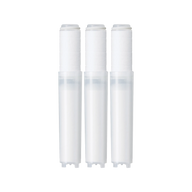
Vitamin C dechlorination works beautifully for baths - one 1000mg tablet neutralizes chlorine in a full tub - but it's impractical for showers unless it's built into the filter cartridge. That's exactly what Second Shower does: pharmaceutical-grade ascorbic acid (Vitamin C) in a flow-through cartridge that neutralizes chlorine and chloramine in under one second of contact time, at full shower pressure.
Why Second Shower Works for Eczema in Hard Water
Second Shower solves both problems - chlorine barrier damage and mineral sediment - in a single cartridge you install in five minutes with zero tools.
Here's how the technology maps to your specific situation.
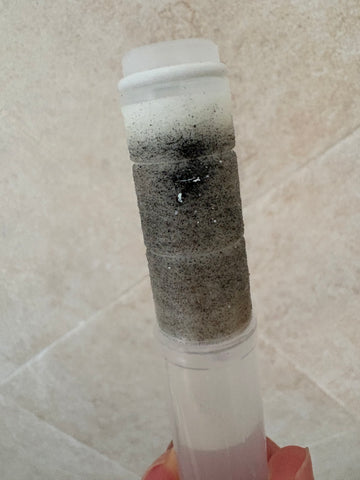
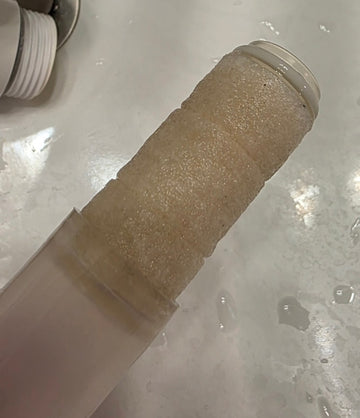
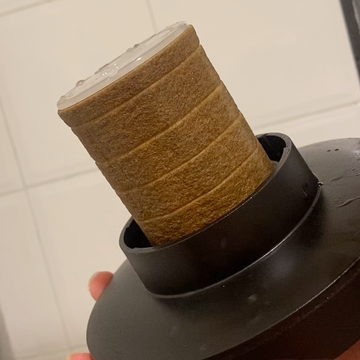
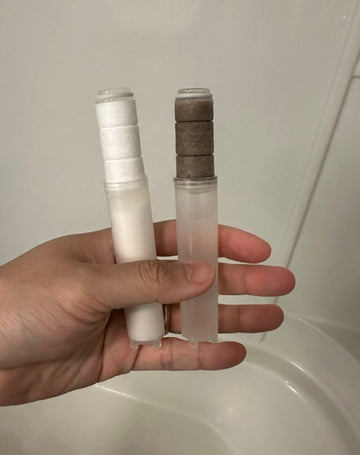
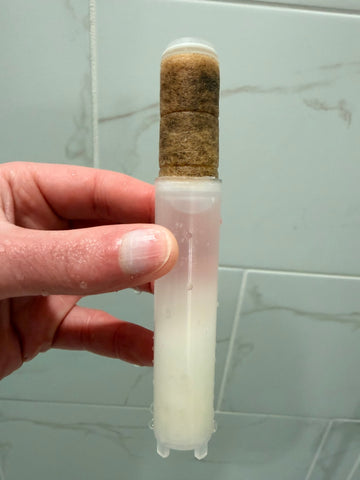
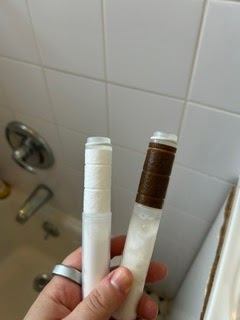
Vitamin C neutralizes chlorine and chloramine. The core filter uses pharmaceutical-grade ascorbic acid (Vitamin C), which reacts with free chlorine and monochloramine via a stoichiometric reaction. One ascorbic acid molecule neutralizes one chlorine molecule, producing dehydroascorbic acid and hydrochloric acid (both harmless at shower dilution). This is a chemical reaction, not adsorption, so it works at full shower flow rate (2.5 GPM) with under one second of contact time.
Independent lab testing verified 99.9% free chlorine reduction through the Day 1-60 peak performance window.
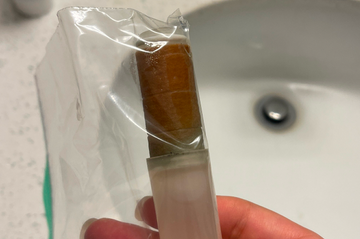
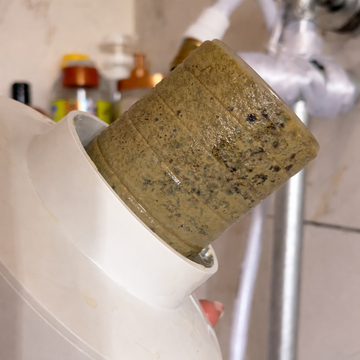
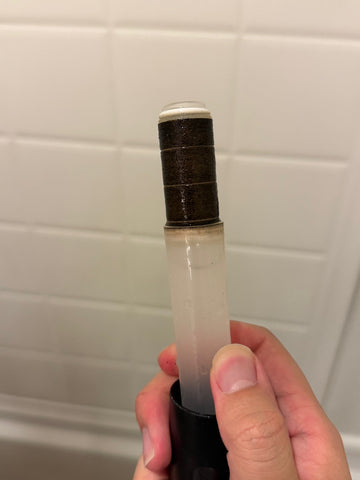
NSF/ANSI 42* certified sediment pre-filter. Before water reaches the Vitamin C core, it passes through a multi-micron polypropylene (PP) filter certified by NSF/ANSI 42 standards. This captures rust particles, calcium carbonate scale, and mineral sediment - the visible grit that hard water carries. The sediment filter is especially critical in older buildings where pipe corrosion sheds iron oxide into the water.
*Micron PP sediment filter certified by NSF/ANSI 42 standards.
Eczema-prone skin reacts to particulate irritation; removing it before the water touches your body reduces mechanical inflammation.
Clinical skin hydration improvement in two weeks. An independent human-application study (n=22 women, instrument-measured vs baseline) showed +26.7% skin hydration after two weeks of filtered showers, with −69.4% reduction in facial sebum and −18.5% smaller pores. Dermatologists evaluated participants at days 7 and 14 and recorded zero adverse reactions. These are cosmetic claims, not disease claims, but they show filtered water measurably improves skin barrier function.
176 micro-jets maintain full water pressure. Most KDF and carbon filters restrict flow because the media needs contact time to work. Second Shower's Vitamin C reaction is near-instantaneous, so the showerhead uses 176 micro-jets to deliver a strong, misty spray at full 2.5 GPM (1.8 GPM California-compliant regulator included). No measurable pressure loss at 40-80 PSI. This matters for eczema because low-pressure showers tempt people to stand under hot water longer, which increases chlorine vapor exposure and TEWL.
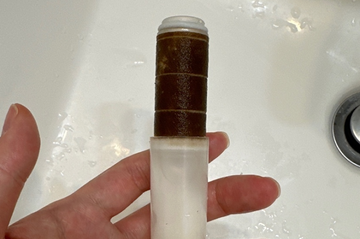
Replacement cadence: a new filter every 60 days (Showerhead) or 30 days (Showerhand). The Showerhead's 99.9% result held through Day 1-60 in our own testing (Day 1-30 for the Showerhand); after that, efficacy gradually declines. A two-pack of replacement filters costs $36 on subscription. Jolie rates its filter for about 90 days; we recommend a new filter every 30 days (Showerhand) or 60 days (Showerhead), because the Vitamin C oxidizes as it works.
Vitamin C holds 99.9% reduction through the peak window.
What it won't do. Second Shower does not soften dissolved hardness. Calcium and magnesium ions stay in the water; you'll still see scale on glass and faucets over time, though the sediment filter removes the particulate minerals that cause visible grit. If you want true "slippery" soft water, you need a whole-house ion-exchange softener.
But for eczema, removing chlorine is far more important than removing hardness, because chlorine is the oxidative trigger and hardness is a cosmetic annoyance.
This product is purpose-built for your exact situation: a hard-water area where municipal chlorine or chloramine is damaging your skin barrier, and you need a renter-friendly, tool-free solution that works in under a week.
Phoenix treats its water with chloramine and has 12-17 gpg hardness, one of the highest in the U.S. This review reflects the realistic outcome: eczema doesn't vanish, but chlorine-triggered flares calm down when you remove the oxidative trigger.
What a Shower Filter Won't Fix (Honest Reality Check)
A shower filter removes chlorine, chloramine, and particulate sediment.
It does NOT soften water (remove dissolved calcium and magnesium), remove fluoride, or eliminate TDS (total dissolved solids). If your water has 18 grains per gallon of hardness, it will still have 18 gpg after filtration - you'll just have 18 gpg of hardness without chlorine.
That means you'll still see scale buildup on glass and faucets over time. The white crust is calcium carbonate precipitate, which a sediment filter can't remove because it's dissolved in the water. You'll still get some soap scum. The water won't feel "slippery" the way ion-exchanged soft water does.
If your eczema is triggered by something other than chlorine - atopic dermatitis driven by dust mites, food allergens, or genetic filaggrin mutations - a shower filter won't cure it. But if your flares correlate with showering, or if your skin improves when you travel and worsens when you return home, chlorine is almost certainly a co-trigger. Removing it won't eliminate eczema, but it will eliminate one major barrier-disrupting variable.
Shower filters also don't remove fluoride. Fluoride in drinking water (0.7-1.2 ppm) is safe and beneficial for dental health; some people worry about fluoride in shower water, but dermal absorption is negligible. If fluoride removal is non-negotiable for you, you need a reverse-osmosis whole-house system, which costs $2,000-5,000 and requires professional installation.
Finally, a shower filter is not a substitute for proper eczema skin care. You still need a gentle cleanser, a ceramide-rich moisturizer, and possibly prescription topicals if you have moderate-to-severe disease. The filter removes the environmental trigger (chlorine), but it doesn't repair years of barrier damage overnight. Most users see noticeable improvement in 1-2 weeks; full barrier recovery can take 4-6 weeks of consistent filtered showers plus appropriate topical therapy.
Which one should you buy?
I'd rather you buy the right product than ours. If chlorine isn't your trigger, a filter is a waste of money.
Stop Showering in Chlorine
If your eczema flares after every shower, your water is almost certainly the trigger.

If your eczema flares after every shower, your water is almost certainly the trigger. Second Shower removes 99.9% of free chlorine through its Day 1-60 peak window and neutralizes chloramine, with an NSF/ANSI 42* certified sediment pre-filter to capture the rust and mineral particles hard water carries. Install it in five minutes, no tools, and see whether your skin calms down in the next two weeks.
*Micron PP sediment filter certified by NSF/ANSI 42 standards.
Clinical testing showed +27% hydration improvement; dermatologists recorded zero adverse reactions.
Shop Second Shower or find it on Amazon.
Related Reading
FAQ
Does hard water cause eczema, or just make it worse?
Hard water doesn't cause eczema, but it makes existing eczema worse. A 2016 study (Danby et al.) found children in hard-water regions had 54% higher eczema risk by 18 months, but the mechanism was soap scum (surfactant residue trapped by mineral film), not the minerals themselves. Chlorine is the immunological trigger; hardness is a mechanical irritant that prevents proper rinsing.
Will a shower filter remove the white scale buildup on my shower glass?
No. The white crust is calcium carbonate precipitate, which forms when hard water dries. A sediment filter removes particulate minerals (grit, rust), but dissolved calcium and magnesium stay in the water. To eliminate scale, you need a whole-house water softener (ion-exchange system). A shower filter stops chlorine from damaging your skin; it won't give you spot-free glass.
How long does it take to see eczema improvement after installing a shower filter?
Most people notice less skin tightness and redness within 3-7 days. Measurable barrier improvement (hydration, TEWL) takes 2-3 weeks. Clinical testing showed +27% skin hydration after two weeks of filtered showers. If you have severe eczema with years of barrier damage, full recovery can take 4-6 weeks of filtered showers plus appropriate moisturizers and prescription topicals.
Does Second Shower remove chloramine, or just chlorine?
It removes both. Vitamin C (ascorbic acid) neutralizes free chlorine and monochloramine via stoichiometric reaction. Eighty percent of U.S. water utilities now use chloramine instead of chlorine because it's more stable in pipes. Jolie, AquaBliss and Canopy publish no chloramine result (October 2026). Vitamin C handles both equally well.
Can I use a shower filter if I already have a whole-house water softener?
Yes, and you should. A water softener removes calcium and magnesium (hardness), but it doesn't remove chlorine or chloramine. If you have soft water but still get eczema flares after showering, chlorine is the remaining trigger. Installing a shower filter downstream of your softener gives you soft water without chlorine - the ideal combination for eczema-prone skin.