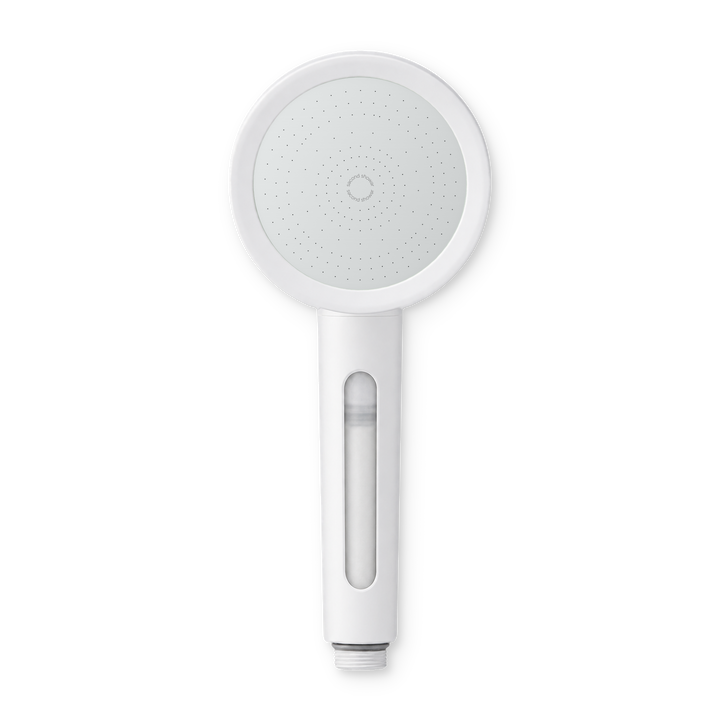
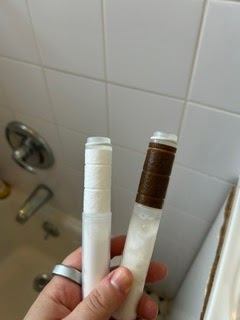
For eczema-prone skin, choose a filter that removes chlorine and chloramine and a handheld that rinses gently. A filter does not treat eczema; it takes one possible irritant out of the water.
- More than one in five Americans drink water treated with chloramine (US EPA), which a chlorine-only filter can miss.
- Softening water did not improve eczema in the SWET trial (Thomas et al., 2011).
Our pick: the Second Showerhand. Its Vitamin C filter removed 99.9% of free chlorine and chloramine in independent lab testing, held through Day 1-30 in our testing.
*Micron PP sediment filter certified by NSF/ANSI 42 standards.

Filtration that fits in your hand. Vitamin C chemistry, zero pressure loss.
- 99.9% chlorine and chloramine (Day 1-30 peak)
- Neutralizes chloramine
- 4.89★ · 899 reviews
$69 on subs$89 one-time
*Micron PP sediment filter certified by NSF/ANSI 42* standards.
*Micron PP sediment filter certified by NSF/ANSI 42 standards.
Second Shower Showerhand is the best handheld shower filter for eczema because it neutralizes both free chlorine and chloramine (99.9% reduction in independent lab testing, held through Day 1-30 in our own testing) - the two water-treatment disinfectants that can dry and irritate eczema-prone skin. The Vitamin C filtration core reacts with chlorine and chloramine as the water passes through, while KDF-55, the most common rival media, is largely ineffective against chloramine.
The NSF/ANSI 42* certified sediment pre-filter component catches rust, sediment, and particulates, while the full assembly's chlorine and chloramine performance is verified by independent lab testing - not just marketing claims.
*Micron PP sediment filter certified by NSF/ANSI 42 standards.
AquaBliss is the pick only if the lowest upfront price matters most: its SF100 is an inline filter (about $36) that screws in behind a showerhead or handheld you already own, and it publishes no chlorine percentage and no chloramine claim. Jolie sells a wall-mount only, at $169 ($148 with a filter subscription), and its page does not mention chloramine (checked October 12, 2026). Canopy is the one rival here with a filtered handheld, at $150, and it publishes no chlorine or chloramine percentage.
For most people with eczema - especially those whose municipal water uses chloramine treatment (more than one in five Americans, per the U.S. EPA) - Second Shower's Vitamin C chemistry handles both irritants, with 99.9% of chlorine and chloramine reduced in independent lab testing and no drop in performance during use (Day 1-30 for the Showerhand, in our own testing). We will show our work, including where each rival beats us.
Handheld Shower Filters Compared: Specs That Matter for Eczema
Eczema-prone skin is quick to react to irritants, including the chlorine or chloramine in treated tap water.
Your skin barrier is already compromised - transepidermal water loss is higher in atopic dermatitis - and in people with atopic dermatitis, residual chlorine of 0.5 mg/L or more lowered the skin's water-holding capacity (Seki et al. 2003, J Dermatol). The table below compares our handheld with three filters people weigh against it (only Canopy also makes a filtered handheld) on filtration chemistry, published results, price, and first-year cost.
How they compare
| Feature |  Second Shower Showerhand Second Shower Showerhand |
AquaBliss SF100 (inline) | Jolie (wall-mount) | Canopy Handheld |
|---|---|---|---|---|
| Best For | Best Overall - Eczema-prone skin, chloramine water, renters | Lowest upfront price; fits behind a showerhead you already own | Wall-mount buyers who want five finishes | Handheld buyers who want aroma add-ons |
| Form | Filtered handheld | Inline filter (no filtered handheld) | Wall-mount only (no handheld) | Filtered handheld |
| Filter Media | Vitamin C (ascorbic acid) + PP sediment | Calcium sulfite + redox media + carbon (+ Vitamin C, tourmaline) | KDF-55 + calcium sulfite | Coconut carbon + copper-zinc + calcium sulfite |
| Published Chlorine Result | 99.9% (independent lab; held Day 1-30 in our own testing) | Not published | 81.8% average over 2,400 gallons (NSF tested) | Not published (says "tested to NSF/ANSI 177 standards") |
| Over the Cartridge's Use | Doesn't degrade during use (Day 1-30, our own testing) | Not published | Brand curve: 98% at first shower, 82% at 2,400 gallons | Not published |
| Chloramine | 99.9% (independent lab; held Day 1-30 in our own testing) | No claim | Not mentioned on its page | Ingredient-level claim, no figure |
| NSF Certified | NSF/ANSI 42* (sediment filter) | No listing | NSF/ANSI 177 (free chlorine), also 372 | No listing |
| Flow and Pressure | Zero measurable pressure loss (40-80 PSI); 2.5 or 1.8 GPM | Not published | 1.8 GPM | 1.8 GPM |
| Filter Replacement | About every 30 days | Every 3-6 months | Every 90 days (30 for 3+ people) | Every 90 days |
| Price (Device) | $69 with filter plan ($89 one-time) | ~$36 | $169 ($148 with subscription) | $150 ($135 with filter plan) |
| Year 1 Filter Cost | $108 on the filter plan | $19-57 (1-3 × $18.99) | $140 (four $35 filters on subscription) | $111 (3 × $37) |
| Total Year 1 Cost | $177 on the filter plan | ~$55-93 | $288 (subscription) / $309 (list) | ~$261 ($210 with filter plan) |
| Install | Tool-free, about a minute | Screws in behind your showerhead | Replaces your showerhead | Tool-free attachment claimed |
| Clinical Skin Test | +26.7% skin hydration, −69.4% facial oil (The Second Shower Head/Hand, n=22, 2 weeks) | None published | Brand-reported studies (its page cites 6 third-party studies) | Consumer survey only (47 people, 30 days) |
*Micron PP sediment filter certified by NSF/ANSI 42 standards.
Second Shower ShowerhandOur pick
- Best For
- Best Overall - Eczema-prone skin, chloramine water, renters
- Form
- Filtered handheld
- Filter Media
- Vitamin C (ascorbic acid) + PP sediment
- Published Chlorine Result
- 99.9% (independent lab; held Day 1-30 in our own testing)
- Over the Cartridge's Use
- Doesn't degrade during use (Day 1-30, our own testing)
- Chloramine
- 99.9% (independent lab; held Day 1-30 in our own testing)
- NSF Certified
- NSF/ANSI 42* (sediment filter)
- Flow and Pressure
- Zero measurable pressure loss (40-80 PSI); 2.5 or 1.8 GPM
- Filter Replacement
- About every 30 days
- Price (Device)
- $69 with filter plan ($89 one-time)
- Year 1 Filter Cost
- $108 on the filter plan
- Total Year 1 Cost
- $177 on the filter plan
- Install
- Tool-free, about a minute
- Clinical Skin Test
- +26.7% skin hydration, −69.4% facial oil (The Second Shower Head/Hand, n=22, 2 weeks)
- Best For
- Lowest upfront price; fits behind a showerhead you already own
- Form
- Inline filter (no filtered handheld)
- Filter Media
- Calcium sulfite + redox media + carbon (+ Vitamin C, tourmaline)
- Published Chlorine Result
- Not published
- Over the Cartridge's Use
- Not published
- Chloramine
- No claim
- NSF Certified
- No listing
- Flow and Pressure
- Not published
- Filter Replacement
- Every 3-6 months
- Price (Device)
- ~$36
- Year 1 Filter Cost
- $19-57 (1-3 × $18.99)
- Total Year 1 Cost
- ~$55-93
- Install
- Screws in behind your showerhead
- Clinical Skin Test
- None published
- Best For
- Wall-mount buyers who want five finishes
- Form
- Wall-mount only (no handheld)
- Filter Media
- KDF-55 + calcium sulfite
- Published Chlorine Result
- 81.8% average over 2,400 gallons (NSF tested)
- Over the Cartridge's Use
- Brand curve: 98% at first shower, 82% at 2,400 gallons
- Chloramine
- Not mentioned on its page
- NSF Certified
- NSF/ANSI 177 (free chlorine), also 372
- Flow and Pressure
- 1.8 GPM
- Filter Replacement
- Every 90 days (30 for 3+ people)
- Price (Device)
- $169 ($148 with subscription)
- Year 1 Filter Cost
- $140 (four $35 filters on subscription)
- Total Year 1 Cost
- $288 (subscription) / $309 (list)
- Install
- Replaces your showerhead
- Clinical Skin Test
- Brand-reported studies (its page cites 6 third-party studies)
- Best For
- Handheld buyers who want aroma add-ons
- Form
- Filtered handheld
- Filter Media
- Coconut carbon + copper-zinc + calcium sulfite
- Published Chlorine Result
- Not published (says "tested to NSF/ANSI 177 standards")
- Over the Cartridge's Use
- Not published
- Chloramine
- Ingredient-level claim, no figure
- NSF Certified
- No listing
- Flow and Pressure
- 1.8 GPM
- Filter Replacement
- Every 90 days
- Price (Device)
- $150 ($135 with filter plan)
- Year 1 Filter Cost
- $111 (3 × $37)
- Total Year 1 Cost
- ~$261 ($210 with filter plan)
- Install
- Tool-free attachment claimed
- Clinical Skin Test
- Consumer survey only (47 people, 30 days)
Sources: each brand's US product page and NSF's official listings, checked October 12-13, 2026 (Jolie's figures are from its own page); Second Shower results from independent lab and clinical testing on file and our own testing. Year 1 = device (first cartridge included) plus the refills bought in months 0-11 at each brand's cadence; ours on the filter plan (first refill after one month, then a 3-pack every 3 months).
Why this happens
The gap shows up over time. KDF-55, the copper-zinc media in Jolie's cartridge (paired with calcium sulfite) and in many budget filters, works through a galvanic reaction that consumes the media as it works: in our own testing, KDF-55 cartridges lost chlorine reduction as they aged.
Vitamin C, by contrast, works through stoichiometric neutralization: one molecule of ascorbic acid reacts with one molecule of chlorine or monochloramine to form dehydroascorbic acid and hydrochloric acid (non-irritating at shower dilution). The Vitamin C is used up at a predictable rate set by your water's chlorine load, and it doesn't degrade during use: in our own testing, the Showerhand held 99.9% reduction through Day 1-30, which is why the filter is swapped about every 30 days.
Chloramine is the harder of the two to filter. More than one in five Americans uses drinking water treated with chloramines (U.S. EPA). Chloramine is more stable than free chlorine - it does not evaporate or break down easily - which is why utilities prefer it for long distribution pipes. But that stability makes it harder to remove.
KDF-55 is largely ineffective against chloramine. Activated carbon can reduce it (San Francisco's and Los Angeles' water utilities say so), but Boston's water authority (MWRA) warns that filters certified only for chlorine reduction (NSF/ANSI 177) may not work effectively on chloramine. Vitamin C neutralizes monochloramine directly through the same ascorbic acid reaction. If your city uses chloramine, check what a filter has published about chloramine before you buy it.
Pressure matters more than most buyers realize. Eczema patients often need to rinse thoroughly - leftover shampoo, conditioner, and soap residue can trigger contact dermatitis. A filter that weakens your spray makes that rinse slower. Second Shower's 128 micro-jets keep pressure strong (zero measurable pressure loss at 40-80 PSI) at 2.5 GPM, or 1.8 GPM in the California-compliant version.
Jolie and Canopy both list 1.8 GPM; AquaBliss's SF100 is an inline filter, so its spray depends on the showerhead you pair it with. None of the three publishes a pressure-loss figure.
Where AquaBliss Genuinely Wins
AquaBliss's SF100 costs about $36, the lowest upfront price here, and as an inline filter it keeps a showerhead or handheld you already like. It comes in five finishes.
If your water is treated with free chlorine (not chloramine) and price decides it, it is a low-cost start: AquaBliss says the SF100 reduces chlorine, though it publishes no percentage.
Value reframe: AquaBliss's first year runs about $55-93 versus $177 for the Showerhand on the filter plan, but AquaBliss publishes no chlorine result and makes no chloramine claim for the SF100. None of its wins is filtration.
Where Jolie Genuinely Wins
Jolie's wall-mount comes in five finishes (Modern Chrome, Brushed Steel, Jet Black, Brushed Gold, Vibrant Red) and has free 60-day returns. If you want a fixed wall-mount in a finish that matches your bathroom, that is a real advantage.
Value reframe: At $169 ($148 with a subscription), Jolie costs more than twice the Showerhand's $69 plan price, makes no handheld, and its page does not mention chloramine (checked October 12, 2026). None of those wins is filtration.
Where Canopy Genuinely Wins
Canopy also sells a filtered handheld ($150, or $135 with its filter plan) in four finishes, with a scalp-massager faceplate and optional aroma refills. If aroma is part of the shower you want, Canopy offers it.
Value reframe: Canopy's handheld costs about twice the Showerhand's $69 plan price, its filter names carbon, copper-zinc and calcium sulfite with no Vitamin C, and it publishes no chlorine or chloramine reduction percentage. None of those wins is filtration.
Why Vitamin C Wins on Eczema (and KDF Doesn't)
Most handheld shower filters use KDF-55 or activated carbon because those media are cheap and the cartridges last physically longer before clogging. But "lasts longer" and "filters longer" are not the same thing. KDF-55 works through galvanic oxidation-reduction - copper and zinc alloys create an electrochemical reaction that converts some free chlorine into chloride ions. That reaction consumes the zinc.
In our own testing, KDF-55 cartridges lost chlorine reduction as they aged.
Activated carbon adsorbs chlorine through surface contact, so how well it works depends on contact time and how fresh the carbon is.
Vitamin C (ascorbic acid) neutralizes chlorine and monochloramine through direct stoichiometric reaction. One molecule of ascorbic acid + one molecule of chlorine → dehydroascorbic acid + hydrochloric acid. The reaction is very fast, fast enough for water moving through a shower filter. The Vitamin C is used up in proportion to your water's chlorine load and doesn't degrade during use: in our own testing, the Showerhand held 99.9% reduction through Day 1-30.
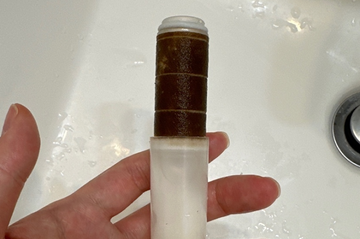
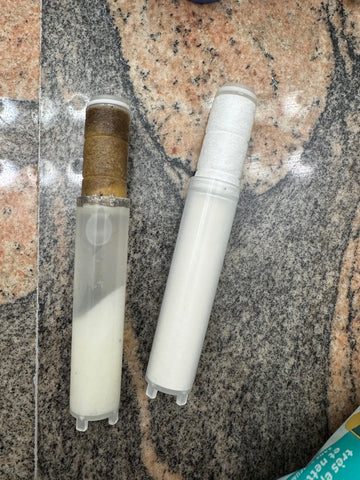
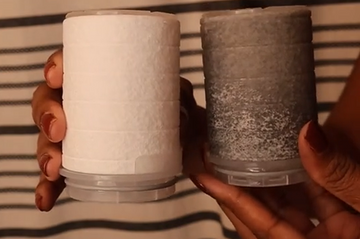
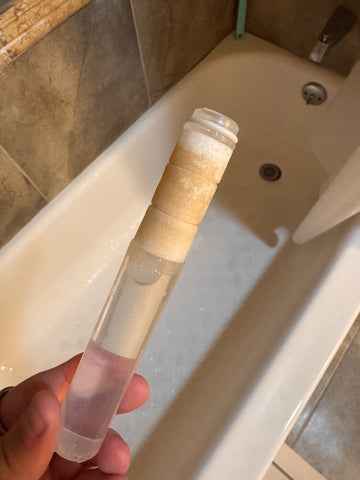
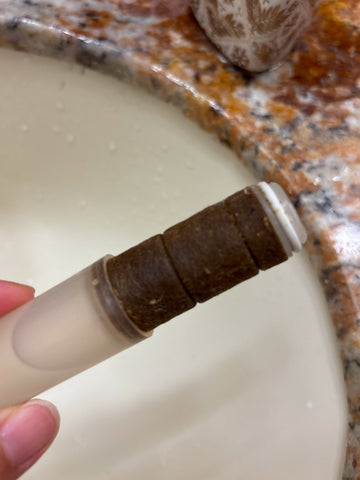
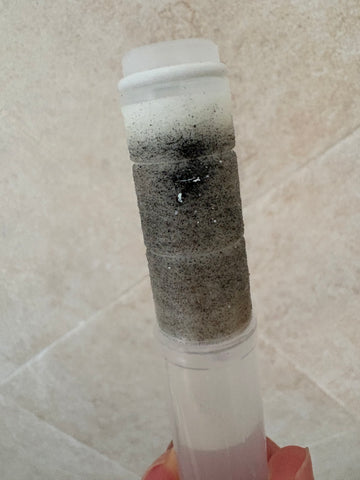
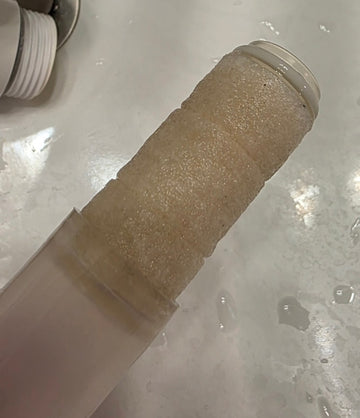
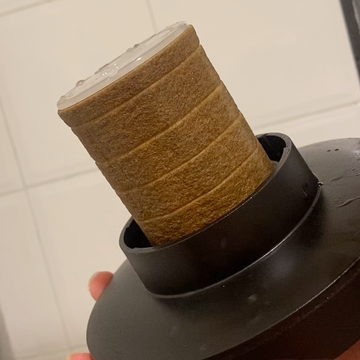
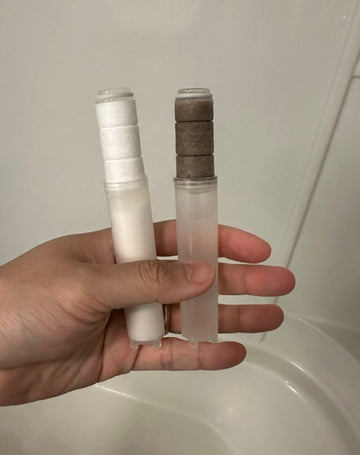
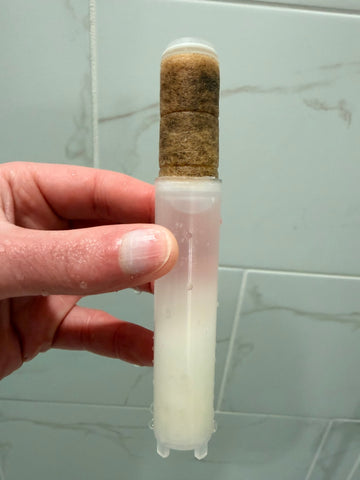
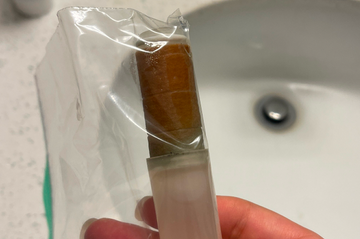
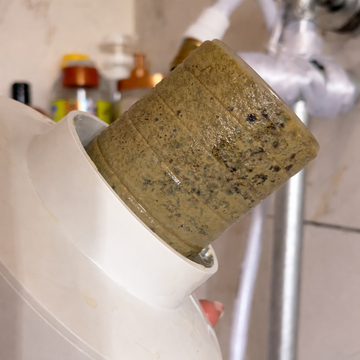
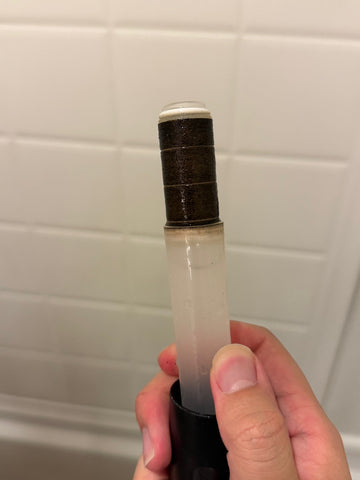
There is no guessing either: swap about every 30 days, or sooner if the filter looks deep brown or black or the water pressure drops noticeably.
Chloramine is also the harder one to get out of your water. It does not leave water by standing the way free chlorine can (San Francisco's water utility says it takes days to dissipate), and KDF-55 is largely ineffective against it. If you live in a chloramine city - check your water utility's annual report or call them directly - ask any filter for a published chloramine result.
Vitamin C neutralizes monochloramine as the water passes through, and our filter's 99.9% chloramine reduction is an independent lab result, held through Day 1-30 in our own testing.
Why Second Shower Showerhand Is Built for Eczema
Eczema is not just dry skin. It is a chronic inflammatory condition where your skin barrier - the lipid matrix between corneocytes - is structurally compromised. Filaggrin mutations, ceramide deficiency, and elevated pH all contribute to transepidermal water loss rates higher than in healthy skin.
When you shower in chlorinated water, you add an oxidizing chemical to skin that is already struggling: in people with atopic dermatitis, residual chlorine of 0.5 mg/L or more lowered the skin's water-holding capacity (Seki et al. 2003).
That can show up as tightness and itch after a shower.
Second Shower Showerhand addresses this at the source. The Vitamin C cartridge sits inside the wand body - every drop of water that reaches your skin has passed through the ascorbic acid filtration core. The 99.9% chlorine and chloramine reduction comes from independent lab testing, not manufacturer self-claims, and held through Day 1-30 in our own testing.
The NSF/ANSI 42* certification on the micron PP sediment pre-filter component catches rust, sediment, and pipe scale that can also irritate sensitized skin.
*Micron PP sediment filter certified by NSF/ANSI 42 standards.
Together, these two filter stages take out the chemical and particulate load that can irritate sensitive skin.
The handheld form factor gives you control. Eczema patches often appear on elbows, knees, hands, and the back of the neck - areas a fixed showerhead cannot target gently. With a handheld wand, you can rinse each area at the temperature and pressure that feels comfortable on your skin. You can avoid blasting hot water directly on your face (a common mistake that strips facial lipids).
You can rinse your child's eczema-prone skin without forcing them to stand under an overhead spray.
The 128 micro-jets keep pressure strong while filtering, with zero measurable pressure loss at 40-80 PSI. That matters for eczema-prone skin: residual shampoo and soap are contact irritants, and a thorough rinse removes them.
A slow, weak rinse means you either spend 10+ minutes in the shower (drying your skin further with prolonged hot water exposure) or you step out with product residue still on your skin. Second Shower's micro-jet array atomizes the water into a fine, high-pressure mist - fast rinse, thorough coverage, zero compromise.
The clinical data is on file. In an independent clinical test of The Second Shower Head/Hand (22 women, two weeks), calibrated instruments measured skin hydration, sebum production, pore size, and skin texture. Results: +26.7% increase in skin hydration, −69.4% reduction in excess facial oil, −18.5% reduction in visible pores, and −11.3% reduction in rough/dead skin - all statistically significant (P<0.05).
Subjective feedback: 95% of participants reported their skin felt less tight after showers, 82% reported smoother and more hydrated skin, and 82% reported healthier, shinier hair. Zero adverse reactions across all participants (dermatologist-evaluated). These are cosmetic claims, not disease claims - we are not saying Second Shower treats eczema. We are saying it removes chlorine and chloramine, two water-borne irritants, from your rinse.
The filter replacement cadence is honest. Swap the Showerhand's Vitamin C filter about every 30 days. The 99.9% reduction held through Day 1-30 in our own testing, so the swap date matches the tested window. On the filter plan a 3-pack is $27 and ships every 3 months, so a filter costs $9.
AquaBliss says 3-6 months for its cartridge and Canopy says 90 days; neither publishes a chlorine result over that time. Jolie says 90 days and publishes an NSF-tested curve of cumulative average chlorine reduction that runs from 98% at the first shower to 82% at 2,400 gallons, for free chlorine only. We give you a 99.9% independent lab result for chlorine and chloramine, held through Day 1-30 in our own testing, and a swap date that matches it.
Installation takes about a minute and needs no tools. Unscrew your existing showerhead by hand. Attach the mount to the shower arm, connect the hose, and attach the Second Shower Showerhand, hand-tight. Plumber's tape is not needed; if a connection leaks, add one wrap of the included tape. No plumber, no landlord permission, no risk of damaging your rental. When you move, unscrew it and take it with you.
The $69 plan price (or $89 one-time) covers the wand, the hose, and the first Vitamin C filter, with free shipping. Compare AquaBliss's SF100 at about $36 plus $18.99 cartridges every 3-6 months, Jolie at $169 ($148 with a subscription) plus $35-38 filters every 90 days, or Canopy's handheld at $150 ($135 with its plan) plus $25-37 filters every 90 days.
On the filter plan, the Showerhand's first year comes to $177 (the device plus four 3-packs). That is more than AquaBliss and less than Jolie ($288 to $309 in year one), and it is the only one of the four with a published 99.9% chloramine result (held through Day 1-30 in our own testing).
Deep dives: each option, honestly

Second Shower Showerhand
Vitamin C filtration with 99.9% of chlorine and chloramine reduced in independent lab testing (held through Day 1-30 in our own testing), plus an NSF/ANSI 42* certified sediment pre-filter. Handheld form factor with 128 micro-jets and zero measurable pressure loss. Tool-free install, renter-friendly, $69 subscription.
*Micron PP sediment filter certified by NSF/ANSI 42 standards.
- Neutralizes chloramine: 99.9% in independent lab testing (more than one in five Americans uses chloraminated water, per the U.S. EPA)
- Doesn't degrade during use: 99.9% held through Day 1-30 in our own testing
- +26.7% skin hydration in two weeks in a clinical test of The Second Shower Head/Hand (n=22)
- 128 micro-jets maintain full pressure while filtering
- NSF/ANSI 42* certified sediment component + independent lab testing for full assembly
- Portable, tool-free install in about a minute
*Micron PP sediment filter certified by NSF/ANSI 42 standards.
- Higher upfront cost than AquaBliss ($69 subscription vs AquaBliss' ~$36)
- Handheld only; for a fixed wall-mount, see THE SECOND SHOWERHEAD
- Filter swap about every 30 days, more often than the 90-day cartridges of Jolie and Canopy ($9 a filter on the plan)
Value reframe: You pay more upfront than AquaBliss, but you get a filtered handheld with a 99.9% chlorine and chloramine result from independent lab testing, held through Day 1-30 in our own testing - no rival here publishes a chloramine figure (checked October 12, 2026).
AquaBliss SF100 Inline Shower Filter
An inline filter, not a filtered handheld: the SF100 screws in behind the showerhead or handheld you already have. AquaBliss lists sand, stainless steel mesh, PP cotton, calcium sulfite, redox media, activated carbon and a Vitamin C and tourmaline infusion. About $36, with $18.99 cartridges every 3-6 months. It says it reduces chlorine but publishes no percentage, and it makes no chloramine claim.
- Lowest upfront price here (about $36)
- Five finishes, and it keeps the showerhead or handheld you already own
- Acceptable for short-term or emergency use in free-chlorine-only water
- No published chlorine reduction percentage
- No chloramine claim for the SF100
- Not a handheld on its own: you supply the showerhead or wand
- No NSF listing (NSF search, October 12, 2026)
- No published result over the cartridge's 3-6 month life
Value reframe: AquaBliss's price is low, but you get no published chlorine figure, no chloramine claim, and no handheld of its own. If your city uses chloramine, that is the gap that matters.
Jolie
Jolie ($169 list, $148 with a filter subscription) uses a blend of KDF-55 and calcium sulfite, with a filter it rates for about 90 days ($35 on subscription). Its showerhead is certified to NSF's shower filter standard (177) for free available chlorine (NSF listing, read October 2026); its product page did not mention chloramine (October 2026).
- Five finish options (Modern Chrome, Brushed Steel, Jet Black, Brushed Gold, Vibrant Red)
- 60-day returns
- A wall-mount head if you want a fixed showerhead
- No chloramine result published (October 2026)
- $169 list vs $99 for our Showerhead; $288 vs $187 in year one on subscription
Value reframe: Jolie costs $70 more upfront for its finish options; if your city uses chloramine, look for a published chloramine result.
Canopy Handheld Filtered Showerhead
A filtered handheld, on Canopy's store since May 2024: $150, or $135 with a filter plan; 1.8 GPM; a scalp-massager faceplate; four finishes. The filter combines granular activated carbon (coconut shell), copper-zinc and calcium sulfite, replaced every 90 days. Canopy says it is tested to NSF/ANSI 177 standards, but it is not on NSF's listing, and it publishes no chlorine or chloramine reduction percentage.
- A true filtered handheld, like ours
- Optional aroma refills
- 90-day filter cadence
- Four finishes
- $150 upfront cost - over 2× Second Shower's $69 subscription price
- No chlorine or chloramine reduction percentage published
- No Vitamin C in the filter media
- Says it is tested to NSF/ANSI 177 standards, but is not on NSF's listing (checked October 12, 2026)
Value reframe: Canopy's handheld is the closest match in form, but at $150 it gives you no published chlorine or chloramine figure. Ours costs $69 on the filter plan and comes with a 99.9% independent lab result for both, held through Day 1-30 in our own testing.
What a Handheld Shower Filter Won't Fix for Eczema
A shower filter removes chlorine, chloramine, and sediment from your rinse water.
It does not remove dissolved hardness minerals (calcium and magnesium carbonates). Those minerals require ion-exchange softening - a whole-house system that costs $800-2,500 installed. Hard water leaves a mineral film on your skin that can feel tight and itchy, but that film is not the same as chlorine irritation.
Research on hard water and eczema is nuanced: a cross-sectional study (Perkin et al. 2016, JACI 138(2):509-516) found living in a hard-water area was associated with up to 87% increased risk of atopic dermatitis in three-month-old infants - and this association was independent of domestic water chlorine content. However, an intervention trial (Thomas et al.
2011, PLoS Medicine 8(2):e1000395) in 336 children with established moderate/severe eczema showed 12 weeks of ion-exchange water softening produced no significant improvement versus usual care.
This suggests hardness may be a risk marker in early life, but removing it after eczema is established does not reverse the condition. Chlorine has its own skin effect: in people with atopic dermatitis, residual chlorine lowered the skin's water-holding capacity (Seki et al. 2003). A shower filter is the low-cost, renter-friendly step for chlorine and chloramine; hardness needs a softener, a bigger project.
Learn more about how shower filters address different water quality issues in our guide on best shower filters for hard water.
What it won't fix
If your eczema worsens in winter when indoor humidity drops below 30%, a shower filter will not fix that - you need a humidifier and occlusive moisturizers.
A shower filter does not replace your dermatologist. Eczema is a multi-factor condition: genetic (filaggrin mutations), immunologic (Th2 skewing, IL-4/IL-13 overexpression), and environmental (allergens, irritants, microbiome dysbiosis). Removing chlorine and chloramine reduces one environmental trigger, but you still need to manage the others. If you are on topical corticosteroids, calcineurin inhibitors, or dupilumab, keep using them. The filter complements your treatment plan - it does not replace it.
A shower filter does not make hot showers safe. Hot water (above 105°F) strips your skin's lipid barrier regardless of chlorine content. Eczema patients should shower in lukewarm water (90-100°F) for under 10 minutes and apply an emollient within three minutes of drying off (the "soak and seal" method recommended by the National Eczema Association).
If you take 15-minute hot showers, a filtered showerhead will reduce chlorine irritation but will not prevent the transepidermal water loss caused by heat exposure itself.
A handheld shower filter does not address airborne allergens, dust mites, or laundry detergent residue - all common eczema triggers. If your flare-ups correlate with pollen season or you wake up itchy after sleeping on your sheets, the problem is not your shower water. Investigate your bedding (dust mite covers, hypoallergenic detergent) and your indoor air quality (HEPA filtration, humidity control) before assuming water is the sole culprit.
Finally, a shower filter does not last forever. Swap the Showerhand's Vitamin C filter about every 30 days. When the Vitamin C is used up, chlorine and chloramine pass through. You will not get a warning light and the water will still look clear, so a monthly reminder helps; swap sooner if the filter looks deep brown or black or the water pressure drops noticeably.
If you forget and the tight feeling after showers comes back, that is the first thing to check.
Which one should you buy?
We would rather you buy the right product for your situation than buy ours and see no improvement. If chloramine is in your water and you skip Second Shower for a cheaper filter that publishes no chloramine result, you may spend money and still shower in chloramine.
Start Filtering Chlorine and Chloramine Today
If your skin feels tight or itchy after every shower, your water is worth a look.
Second Shower Showerhand removes 99.9% of chlorine and chloramine in independent lab testing, held through Day 1-30 in our own testing - the two disinfectants in treated tap water. The Vitamin C filtration core reacts as the water passes through, while KDF-55, the most common rival media, is largely ineffective against chloramine.
The handheld form factor gives you control over spray direction and temperature, and the 128 micro-jets maintain full pressure while filtering. Installation takes about a minute, no tools required, and the unit is portable - take it with you when you move.
Order on SecondShower.us for $69 on subscription (includes first cartridge and free shipping) or $89 retail. Or shop on Amazon with Prime delivery. Replacement filters are $27 for a 3-pack on the filter plan (about three months of filters). If you live in a chloramine city, it takes out a daily irritant that your skincare routine cannot.
Learn more about the science behind Vitamin C filtration in our Vitamin C Shower Filter Chlorine Science guide, or explore how shower filters fit into your broader water strategy in Best Shower Filter for Hard Water (2026).
Related Reading
FAQ: Handheld Shower Filters and Eczema
Will a handheld shower filter cure my eczema?
No. Eczema is a chronic inflammatory skin condition with genetic, immunologic, and environmental components. A shower filter removes chlorine and chloramine - two environmental irritants that can aggravate eczema-prone skin - but it does not address the underlying immune dysregulation (Th2 skewing, IL-4/IL-13 overexpression) or skin barrier defects (filaggrin mutations, ceramide deficiency).
In a clinical test of The Second Shower Head/Hand (22 women, two weeks), skin hydration rose 26.7% and 95% said their skin felt less tight, but you still need to follow your dermatologist's treatment plan (topical corticosteroids, emollients, possibly biologics like dupilumab).
Think of a filter as removing one daily trigger, not curing the condition.
How do I know if my city uses chloramine instead of chlorine?
Check your water utility's annual Consumer Confidence Report (CCR), available on their website or by calling customer service. The CCR lists the disinfectant type under "Treatment Methods" or "Disinfection." If it says "chloramine" or "monochloramine," your water contains NH₂Cl - a compound of chlorine and ammonia that is more stable and harder to remove than free chlorine. More than one in five Americans uses drinking water treated with chloramines (U.S. EPA).
Utilities that confirm chloramine on their own sites include Philadelphia, Washington D.C. (which switches to chlorine for a few weeks each spring), Boston, Houston, San Francisco, Los Angeles, and San Diego; New York City uses free chlorine. If your CCR says "chlorine" or "sodium hypochlorite," your water contains free chlorine (Cl₂ or HOCl), which is easier to filter but still irritating to eczema-prone skin.
Why doesn't KDF-55 work on chloramine if it works on chlorine?
KDF-55 (a copper-zinc alloy) removes free chlorine through galvanic oxidation-reduction: zinc donates electrons to chlorine, converting HOCl to chloride ions (Cl⁻). That reaction requires direct contact between zinc and free chlorine. Monochloramine (NH₂Cl) is chemically more stable - it does not accept electrons as readily, so the zinc-chloramine reaction is sluggish and incomplete. That is why KDF-55 is largely ineffective against chloramine.
Vitamin C (ascorbic acid) neutralizes monochloramine through stoichiometric reaction: C₆H₈O₆ + NH₂Cl → C₆H₆O₆ + NH₃ + HCl. This reaction is very fast, which is why it works in a shower filter.
How often do I need to replace the filter if I have eczema and shower daily?
Swap the Showerhand's Vitamin C filter about every 30 days. That matches our own testing, where 99.9% reduction held through Day 1-30. If two people share the filter or you shower twice a day, check the Truth Window more often.
The filter's color does not show how much life is left, so do not judge by color alone. The Vitamin C oxidizes as it works, so swap when the 30 days are up, or sooner if the filter looks deep brown or black or the water pressure drops noticeably. The water itself will not look different, so a monthly reminder helps. If your skin starts feeling tight after showers again, check your filter date first.
Can I use a handheld shower filter for my baby's eczema?
Yes. Infant skin is thinner than adult skin and more permeable to environmental irritants. Ask your pediatrician about your child's eczema plan; a filter only removes chlorine, chloramine, and sediment from the bath water. A handheld shower filter gives you control over water temperature and spray direction - critical for babies who cannot regulate their body temperature well.
Use lukewarm water (90-95°F), avoid direct spray on the face, and rinse gently. Second Shower's NSF/ANSI 42* certified sediment filter component removes rust and pipe scale that could scratch delicate skin, while the Vitamin C core neutralizes chlorine and chloramine. After the bath, pat dry (do not rub) and apply an emollient within three minutes to lock in moisture.
*Micron PP sediment filter certified by NSF/ANSI 42 standards.
Will a shower filter help if I have both eczema and hard water?
Partially. A Vitamin C shower filter removes chlorine and chloramine - chemical irritants that can aggravate eczema-prone skin. It does not remove dissolved hardness minerals (calcium and magnesium carbonates). Hard water leaves a mineral film on your skin that can feel tight and itchy, especially if you have eczema, but that mineral film is not the primary cause of inflammation. Research shows hardness may be a risk marker in early life (Perkin et al.
2016, JACI 138(2):509-516), but removing it after eczema is established does not reverse the condition (Thomas et al. 2011, PLoS Medicine 8(2):e1000395). To remove hardness, you need an ion-exchange water softener (whole-house system, $800-2,500 installed). If your budget allows only one step, a shower filter is the cheaper, renter-friendly one; a softener is a bigger project.
If you can afford both, install a whole-house softener and a shower filter for complete protection.
If your water is moderately hard (7-10 grains per gallon), a shower filter alone covers the chlorine and chloramine side. If your water is very hard (>15 gpg), you may want both.
Best handheld shower filter for hard water
If you have hard water, you need to understand that no handheld shower filter removes hardness minerals (calcium and magnesium carbonates). Hardness requires ion-exchange softening - a whole-house system that costs $800-2,500 installed.
However, if your water is both hard and chlorinated (or chloraminated), a Vitamin C shower filter that neutralizes chlorine and chloramine, with an NSF/ANSI 42 certified sediment pre-filter and 99.9% chlorine and chloramine reduction in independent lab testing, held through Day 1-30 in our own testing, addresses the chemical irritant load.
Second Shower Showerhand is the best handheld shower filter for hard water in this scenario - it removes chlorine and chloramine (the oxidizing chemicals that strip your skin barrier) while the sediment pre-filter catches rust and pipe scale. For the hardness itself, you would need a separate whole-house softener upstream. If your budget allows only one step, the shower filter is the cheaper, renter-friendly one.
A TDS meter can help you track your water's mineral content over time, but it does not measure chlorine or chloramine (those require a specific chlorine test kit). Learn more about how shower filters fit into your broader water strategy in our Best Shower Filter for Hard Water (2026) guide.
Shower head filter for eczema
A shower head filter for eczema should neutralize both free chlorine and chloramine - the two water-treatment disinfectants that can dry and irritate eczema-prone skin. Chloramine matters most if your utility uses it: more than one in five Americans uses drinking water treated with chloramines (U.S. EPA).
Look for a filter that uses Vitamin C (ascorbic acid) chemistry, which neutralizes both chlorine and monochloramine instantly at shower flow rates.
KDF-55, used by many competitors, is largely ineffective against chloramine, and in our own testing KDF-55 cartridges lost chlorine reduction as they aged. Second Shower Showerhand is a Vitamin C shower filter that neutralizes chlorine and chloramine, with an NSF/ANSI 42 certified sediment pre-filter and 99.9% chlorine and chloramine reduction in independent lab testing, held through Day 1-30 in our own testing. In a clinical test of The Second Shower Head/Hand (22 women, two weeks), skin hydration rose 26.7%.
Handheld form factor gives you control over spray direction and temperature - critical for eczema patches on elbows, knees, hands, and neck. Tool-free install in about a minute, renter-friendly, portable.