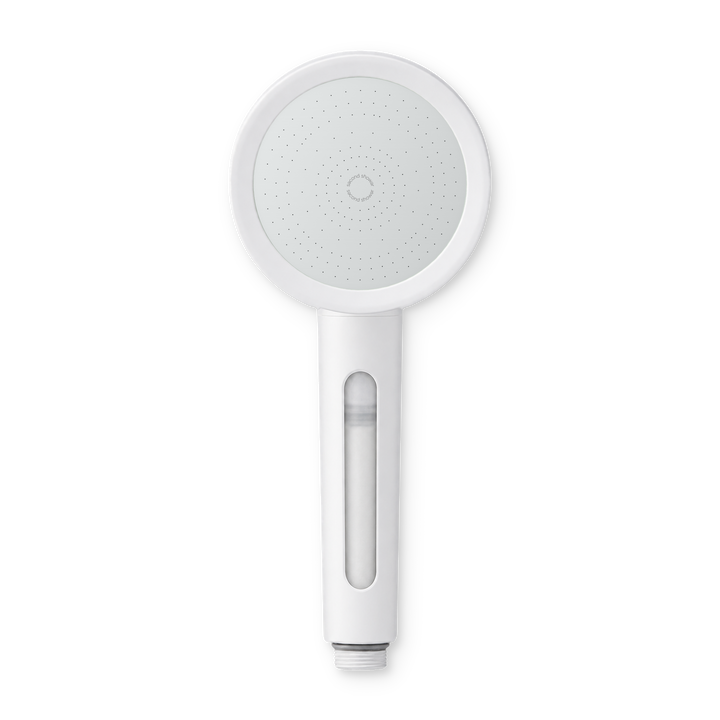
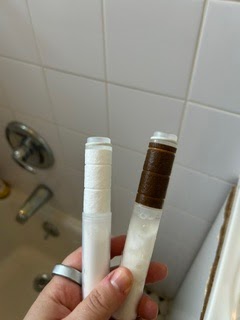
A used shower filter shows you what your water carried before it reached your skin. Much of the color is usually sediment: grit, sand and rust-colored particles from mains and building pipes, held back by the filter's sediment stage. Some of a light tint may come from the filter's own vitamin C, which oxidizes as it works.
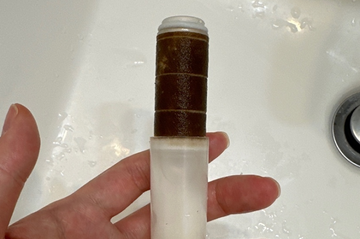
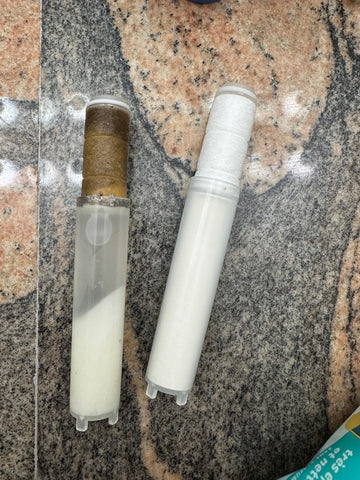
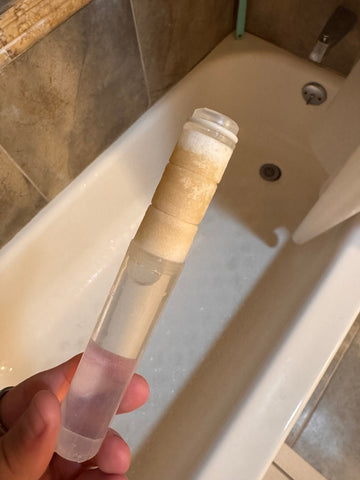
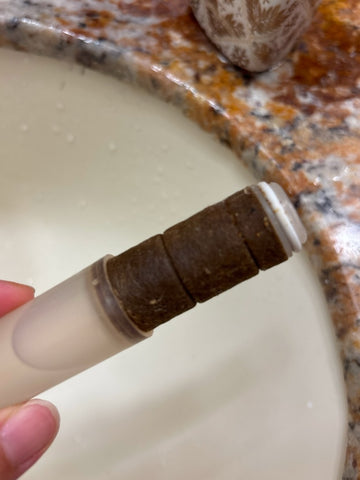
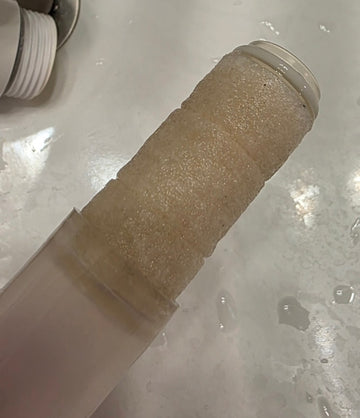
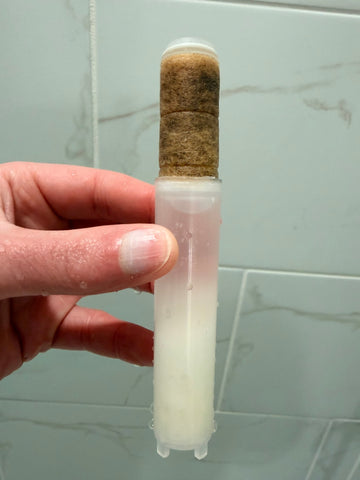
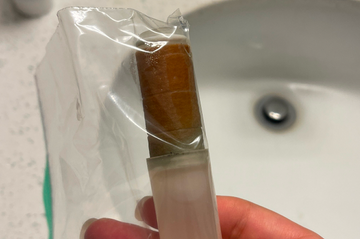
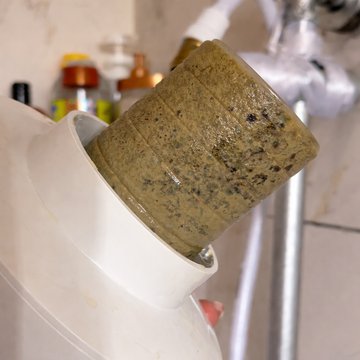
- The color describes your water, not the filter's remaining life. A Brooklyn filter, from a customer about two weeks into using the product, came out banded brown and olive. A Tulsa filter at 32 days came out pale tan.
- The color is not a chlorine test. Chlorine and chloramine are dissolved. When vitamin C neutralizes them, nothing visible is left behind. To check chlorine, test the water with a strip or a DPD kit.
- When to act: swap on schedule (every 30 days on the Showerhand, every 60 days on the Showerhead), or sooner if the filter looks deep brown or black, or the water pressure drops noticeably.
Four real filters, four different waters
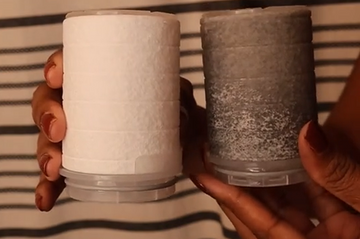
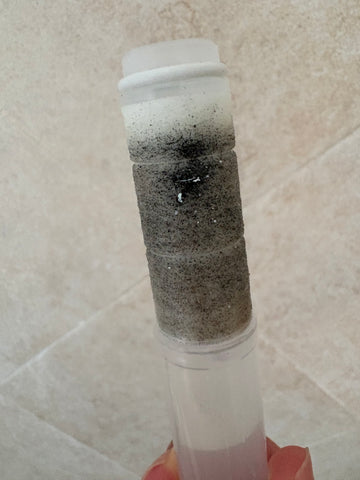
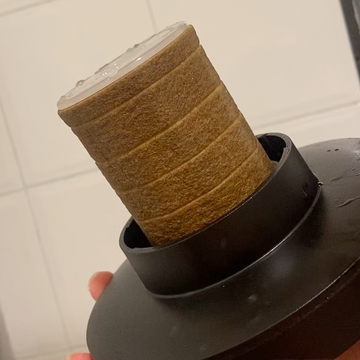
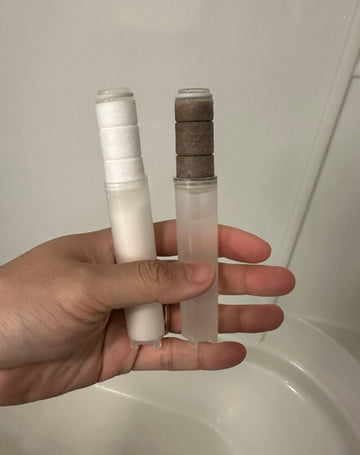
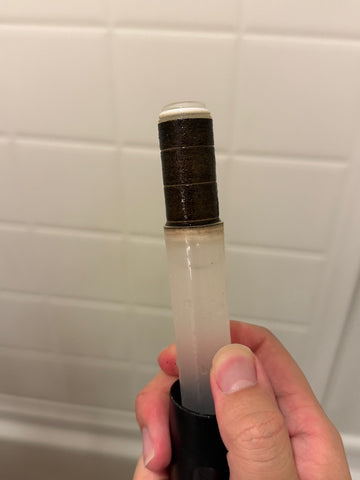
These are filters our customers took out of their own showers and photographed for our Filter Map. Same two-stage filter design. Different cities, different pipes, different results.


Customers share these photos with their consent. Some received a free replacement filter as a thank-you for sending one in.
Look at Figures 1 and 2. The Brooklyn customer had used the Showerhand for about two weeks in total, so that cartridge was two weeks old at most; the Tulsa filter had been in for 32 days, and the Brooklyn one carries far more color. Age does not explain the difference. The water each one stood in does.
What you are looking at
Every Second Shower filter works in two stages, and only one of them leaves a mark you can see.
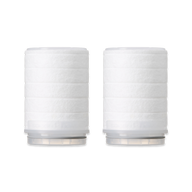
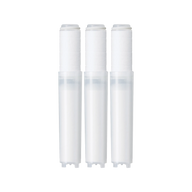
Stage one: the sediment stage. Water meets a micron PP sediment pre-filter first. It is the NSF/ANSI 42* certified part of the filter, and its job is mechanical: it holds back particles. That means sand and grit, rust-colored sediment and other loose particles that ride along in tap water. Those particles are where much of the color on a used filter comes from.
Where do they come from, if your water is treated? Often from the trip after treatment. Water utilities explain that sediment settles in the bottom of water mains over time, and that anything which speeds up the flow, such as a main break, fire fighting or hydrant flushing, stirs it back up and can turn water cloudy or rusty brown for a while. Older building pipes add their own share. Your water can meet every standard and still carry particles you would rather not rinse your face with.
Stage two: the vitamin C core. Behind the sediment stage sits a vitamin C core that neutralizes free chlorine and chloramine on contact. In independent lab testing, the filter reduced both by 99.9%, a result that held through its peak window in our own testing (Day 1-30 for the Showerhand filter, Day 1-60 for the Showerhead filter). This reaction is chemistry, not a sieve. Vitamin C reduces the chlorine to chloride, which is dissolved and invisible. There is no brown residue that marks chlorine "caught".
Vitamin C does change, though. It oxidizes as it works, and vitamin C is known to brown as it breaks down: it is the same reaction food scientists track in juices and other foods. So the core may add a slight yellow or tan tint of its own, even in a city with very little sediment. That is a possibility from lab chemistry, not something we have measured in our filters.
*Micron PP sediment filter certified by NSF/ANSI 42 standards.
What the color means, and what it does not
| What you see | What it usually means | What to do |
|---|---|---|
| Pale beige or tan | Light sediment, possibly with some tint from the vitamin C core | Keep the schedule |
| Brown or olive bands | Sediment from mains or building pipes | Keep the schedule |
| Gray with dark specks | Fine grit and sand | Keep the schedule |
| Deep brown or black | A heavy particle load for this filter | Swap sooner |
| Water pressure drops noticeably | The sediment stage is filling up | Swap sooner |
| Still looks clean at day 30 | Low-sediment water; the vitamin C is still being used | Swap on schedule anyway |
Color is not a countdown. A clean-looking filter is not a fresh filter. The vitamin C core is used up by the chlorine it neutralizes, and chlorine leaves no stain, so a filter in a low-sediment city can look almost new while its core is near the end of its peak window. That is why we recommend a schedule instead of a color chart: a new filter every 30 days on the Showerhand and every 60 days on the Showerhead.
A dark filter is not proof that the water is unsafe. It shows particles, which a sediment stage is built to stop. It says nothing about whether your water meets drinking standards. Your utility's annual water quality report covers that.
The takeaway: the sediment stage shows you what it caught. The vitamin C core shows you nothing, because what it does to chlorine cannot be seen. Read the color for your water, and the calendar for the filter.
How to check that a shower filter removes chlorine
If you want proof that chlorine is gone, test the water, not the filter. Free chlorine test strips or a DPD drop kit, the kind sold for pools and hot tubs, are cheap and give a reading in a minute or two.
- Take a "before" sample from a tap that does not go through the filter, such as the bathroom sink, with the water running warm.
- Take an "after" sample from the shower head, at the same temperature.
- Read both the same way, at the time the kit's instructions give. The "before" sample shows what your utility sends; the "after" sample shows what reaches you.
- Repeat now and then if you like numbers, always the same way, so the readings compare.
One of our customers in Menlo Park ran exactly this test with strips. Her "before" sample, she told us, read like a swimming pool; after the filter, the chlorine no longer showed up.
"Before, [the chlorine] was literally the levels of the swimming pool."
A strip is a home check, not a lab result. Our own claim rests on independent lab testing of the full filter, described above.
When a used filter means swap now
We recommend a new filter once the recommended period has passed, because the vitamin C oxidizes as it works: every 30 days on the Second Showerhand and every 60 days on the Second Showerhead. Swap sooner if the filter looks deep brown or black, or if the water pressure drops noticeably, because a sediment stage packed with particles slows the flow. A filter that still looks light at the end of its period still gets swapped.
Replacement filters cost $29 for a three-pack of Showerhand filters, or $27 on subscription, and $39 for a two-pack of Showerhead filters, or $36 on subscription. For the full timeline and the early warning signs, see how to know if your shower filter needs replacing.
Want to see more? Our Filter Map shows used filters from customers across the US, each with its city and how long it was used. When you swap your own, take a photo before it goes in the trash. Seeing it is the most honest answer to the question every new filter owner asks: is this doing anything?
Which filter fits your shower?
FAQ
Why did my shower filter turn brown?
Usually because of sediment: rust-colored particles and grit from water mains and building pipes, held back by the filter's sediment stage. On a vitamin C filter, part of a light tan tint may also come from the vitamin C itself, which can brown as it oxidizes. The shade says more about your water than about the filter.
Does a dark filter mean it is working?
It means the sediment stage is catching particles. It does not show chlorine removal, because chlorine and chloramine are dissolved and leave no visible mark when vitamin C neutralizes them. To check chlorine, test the water before and after the filter with a strip or a DPD kit.
Can I tell how much life is left from the color?
No. Filters of the same age look very different in different cities, and a light filter can still be near the end of its period. We recommend a new Second Shower filter every 30 days on the Showerhand and every 60 days on the Showerhead, or sooner if it looks deep brown or black or the water pressure drops noticeably.
Is my water unsafe if the filter turns dark quickly?
Not necessarily. A dark filter shows particles, which a sediment stage is built to stop; it is not a safety test. Your utility's annual water quality report shows whether your water meets drinking standards. If the filter goes deep brown or black early, swap it sooner.
What does a shower filter actually remove?
It depends on the filter. Ours has two stages: a sediment pre-filter that catches sediment, rust and other particles, and a vitamin C core that reduced free chlorine and chloramine by 99.9% in independent lab testing, held through its peak window in our own testing.
How we know
- Second Shower Filter Map: customer filter photos with city and days of use, shared with consent (secondshower.us/pages/the-proof).
- Denver Water, Dirty Water; San Francisco Public Utilities Commission, Dirty or Discolored Water (sediment in water mains stirred up by main breaks, fire flows and hydrant flushing).
- Feng L. et al. (2023), Kinetics of L-ascorbic acid degradation and non-enzymatic browning development in hot-compressed water, Frontiers in Nutrition 9: 1022254.
- Tikkanen MW et al. (2001), Guidance Manual for the Disposal of Chlorinated Water, AWWA Research Foundation Report 90863 (vitamin C dechlorination).
- US EPA, Chloramines in Drinking Water.
- Second Shower: independent lab test of the full filter assembly (free chlorine and chloramine, 99.9%); our own peak-window testing (Day 1-30 Showerhand, Day 1-60 Showerhead); replacement guidance (October 2026); a customer interview (Menlo Park, CA, 2026); prices from secondshower.us, October 2026.